


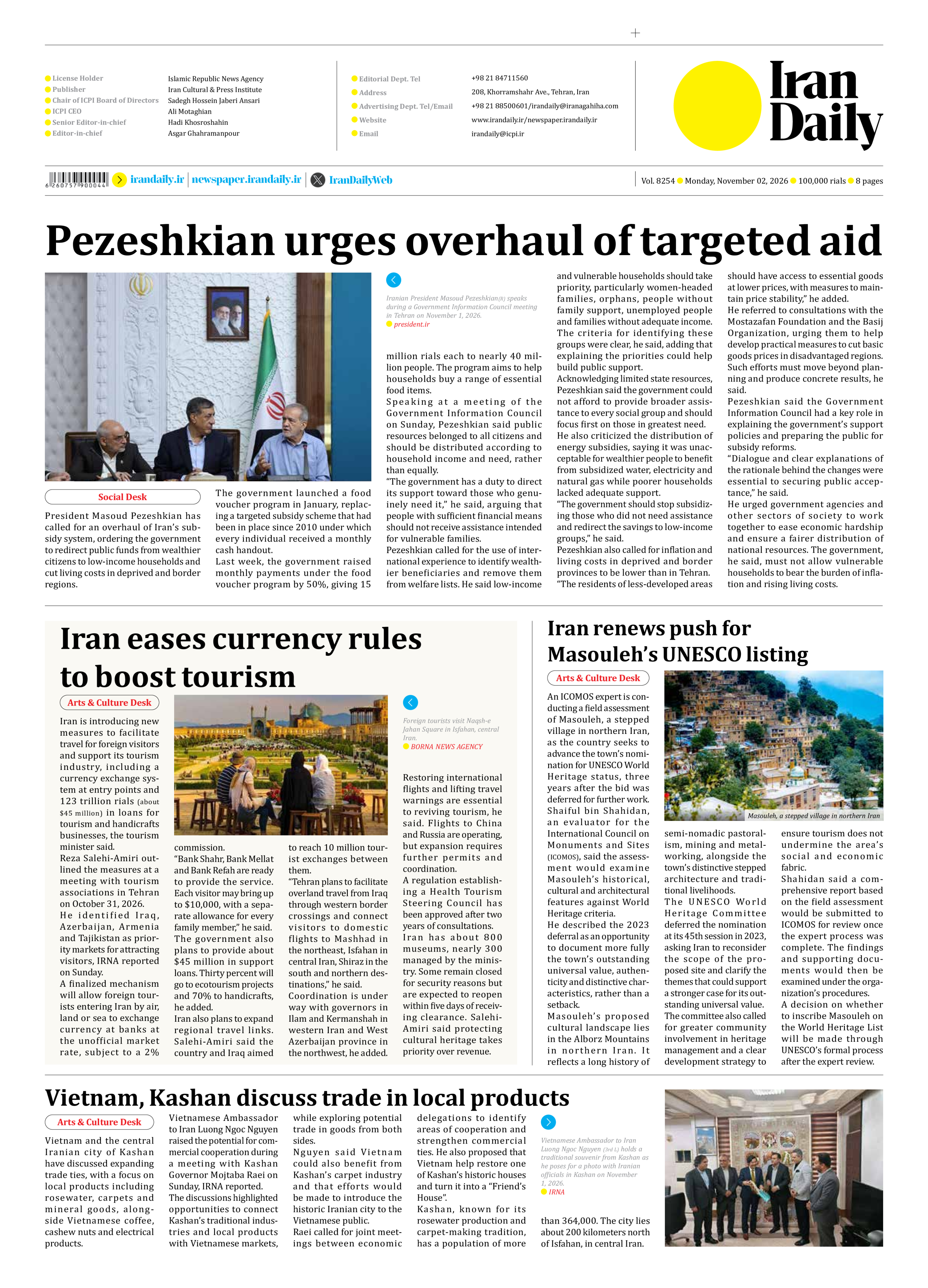


Pezeshkian urges overhaul of targeted aid
President Masoud Pezeshkian has called for an overhaul of Iran’s subsidy system, ordering the government to redirect public funds from wealthier citizens to low-income households and cut living costs in deprived and border regions.
The government launched a food voucher program in January, replacing a targeted subsidy scheme that had been in place since 2010 under which every individual received a monthly cash handout.
Last week, the government raised monthly payments under the food voucher program by 50%, giving 15 million rials each to nearly 40 million people. The program aims to help households buy a range of essential food items.
Speaking at a meeting of the Government Information Council on Sunday, Pezeshkian said public resources belonged to all citizens and should be distributed according to household income and need, rather than equally.
“The government has a duty to direct its support toward those who genuinely need it,” he said, arguing that people with sufficient financial means should not receive assistance intended for vulnerable families.
Pezeshkian called for the use of international experience to identify wealthier beneficiaries and remove them from welfare lists. He said low-income and vulnerable households should take priority, particularly women-headed families, orphans, people without family support, unemployed people and families without adequate income.
The criteria for identifying these groups were clear, he said, adding that explaining the priorities could help build public support.
Acknowledging limited state resources, Pezeshkian said the government could not afford to provide broader assistance to every social group and should focus first on those in greatest need.
He also criticized the distribution of energy subsidies, saying it was unacceptable for wealthier people to benefit from subsidized water, electricity and natural gas while poorer households lacked adequate support.
“The government should stop subsidizing those who did not need assistance and redirect the savings to low-income groups,” he said.
Pezeshkian also called for inflation and living costs in deprived and border provinces to be lower than in Tehran.
“The residents of less-developed areas should have access to essential goods at lower prices, with measures to maintain price stability,” he added.
He referred to consultations with the Mostazafan Foundation and the Basij Organization, urging them to help develop practical measures to cut basic goods prices in disadvantaged regions. Such efforts must move beyond planning and produce concrete results, he said.
Pezeshkian said the Government Information Council had a key role in explaining the government’s support policies and preparing the public for subsidy reforms.
“Dialogue and clear explanations of the rationale behind the changes were essential to securing public acceptance,” he said.
He urged government agencies and other sectors of society to work together to ease economic hardship and ensure a fairer distribution of national resources. The government, he said, must not allow vulnerable households to bear the burden of inflation and rising living costs.