




Mazari palm plays vital role in Mehrestan’s economy, environment
The Mazari palm, known locally as “Daz” in Baluchestan and also referred to as the dwarf palm, is an important part of the natural and cultural heritage of Mehrestan in southeastern Iran. Adapted to the region’s hot, dry climate, the plant has been used for generations by local and nomadic communities, providing raw materials for traditional handicrafts, supporting household livelihoods and contributing to the conservation of the natural environment.
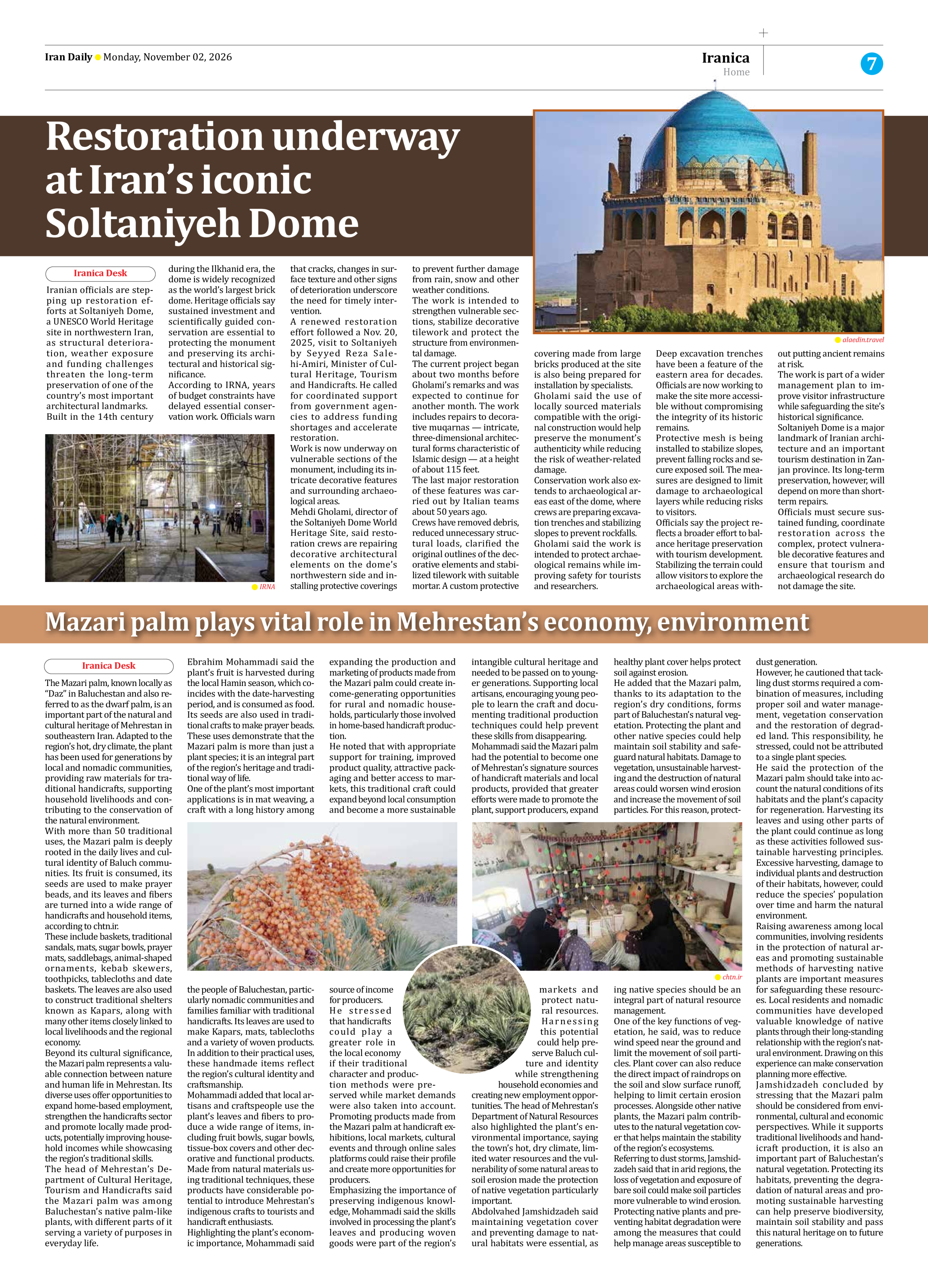
With more than 50 traditional uses, the Mazari palm is deeply rooted in the daily lives and cultural identity of Baluch communities. Its fruit is consumed, its seeds are used to make prayer beads, and its leaves and fibers are turned into a wide range of handicrafts and household items, according to chtn.ir.
These include baskets, traditional sandals, mats, sugar bowls, prayer mats, saddlebags, animal-shaped ornaments, kebab skewers, toothpicks, tablecloths and date baskets. The leaves are also used to construct traditional shelters known as Kapars, along with many other items closely linked to local livelihoods and the regional economy.
Beyond its cultural significance, the Mazari palm represents a valuable connection between nature and human life in Mehrestan. Its diverse uses offer opportunities to expand home-based employment, strengthen the handicrafts sector and promote locally made products, potentially improving household incomes while showcasing the region’s traditional skills.
The head of Mehrestan’s Department of Cultural Heritage, Tourism and Handicrafts said the Mazari palm was among Baluchestan’s native palm-like plants, with different parts of it serving a variety of purposes in everyday life.
Ebrahim Mohammadi said the plant’s fruit is harvested during the local Hamin season, which coincides with the date-harvesting period, and is consumed as food. Its seeds are also used in traditional crafts to make prayer beads. These uses demonstrate that the Mazari palm is more than just a plant species; it is an integral part of the region’s heritage and traditional way of life.
One of the plant’s most important applications is in mat weaving, a craft with a long history among the people of Baluchestan, particularly nomadic communities and families familiar with traditional handicrafts. Its leaves are used to make Kapars, mats, tablecloths and a variety of woven products. In addition to their practical uses, these handmade items reflect the region’s cultural identity and craftsmanship.
Mohammadi added that local artisans and craftspeople use the plant’s leaves and fibers to produce a wide range of items, including fruit bowls, sugar bowls, tissue-box covers and other decorative and functional products. Made from natural materials using traditional techniques, these products have considerable potential to introduce Mehrestan’s indigenous crafts to tourists and handicraft enthusiasts.
Highlighting the plant’s economic importance, Mohammadi said expanding the production and marketing of products made from the Mazari palm could create income-generating opportunities for rural and nomadic households, particularly those involved in home-based handicraft production.
He noted that with appropriate support for training, improved product quality, attractive packaging and better access to markets, this traditional craft could expand beyond local consumption and become a more sustainable source of income for producers.
He stressed that handicrafts could play a greater role in the local economy if their traditional character and production methods were preserved while market demands were also taken into account. Promoting products made from the Mazari palm at handicraft exhibitions, local markets, cultural events and through online sales platforms could raise their profile and create more opportunities for producers.
Emphasizing the importance of preserving indigenous knowledge, Mohammadi said the skills involved in processing the plant’s leaves and producing woven goods were part of the region’s intangible cultural heritage and needed to be passed on to younger generations. Supporting local artisans, encouraging young people to learn the craft and documenting traditional production techniques could help prevent these skills from disappearing.
Mohammadi said the Mazari palm had the potential to become one of Mehrestan’s signature sources of handicraft materials and local products, provided that greater efforts were made to promote the plant, support producers, expand markets and protect natural resources. Harnessing this potential could help preserve Baluch culture and identity while strengthening household economies and creating new employment opportunities. The head of Mehrestan’s Department of Natural Resources also highlighted the plant’s environmental importance, saying the town’s hot, dry climate, limited water resources and the vulnerability of some natural areas to soil erosion made the protection of native vegetation particularly important.
Abdolvahed Jamshidzadeh said maintaining vegetation cover and preventing damage to natural habitats were essential, as healthy plant cover helps protect soil against erosion.
He added that the Mazari palm, thanks to its adaptation to the region’s dry conditions, forms part of Baluchestan’s natural vegetation. Protecting the plant and other native species could help maintain soil stability and safeguard natural habitats. Damage to vegetation, unsustainable harvesting and the destruction of natural areas could worsen wind erosion and increase the movement of soil particles. For this reason, protecting native species should be an integral part of natural resource management.
One of the key functions of vegetation, he said, was to reduce wind speed near the ground and limit the movement of soil particles. Plant cover can also reduce the direct impact of raindrops on the soil and slow surface runoff, helping to limit certain erosion processes. Alongside other native plants, the Mazari palm contributes to the natural vegetation cover that helps maintain the stability of the region’s ecosystems.
Referring to dust storms, Jamshidzadeh said that in arid regions, the loss of vegetation and exposure of bare soil could make soil particles more vulnerable to wind erosion. Protecting native plants and preventing habitat degradation were among the measures that could help manage areas susceptible to dust generation.
However, he cautioned that tackling dust storms required a combination of measures, including proper soil and water management, vegetation conservation and the restoration of degraded land. This responsibility, he stressed, could not be attributed to a single plant species.
He said the protection of the Mazari palm should take into account the natural conditions of its habitats and the plant’s capacity for regeneration. Harvesting its leaves and using other parts of the plant could continue as long as these activities followed sustainable harvesting principles. Excessive harvesting, damage to individual plants and destruction of their habitats, however, could reduce the species’ population over time and harm the natural environment.
Raising awareness among local communities, involving residents in the protection of natural areas and promoting sustainable methods of harvesting native plants are important measures for safeguarding these resources. Local residents and nomadic communities have developed valuable knowledge of native plants through their long-standing relationship with the region’s natural environment. Drawing on this experience can make conservation planning more effective.
Jamshidzadeh concluded by stressing that the Mazari palm should be considered from environmental, cultural and economic perspectives. While it supports traditional livelihoods and handicraft production, it is also an important part of Baluchestan’s natural vegetation. Protecting its habitats, preventing the degradation of natural areas and promoting sustainable harvesting can help preserve biodiversity, maintain soil stability and pass this natural heritage on to future generations.