


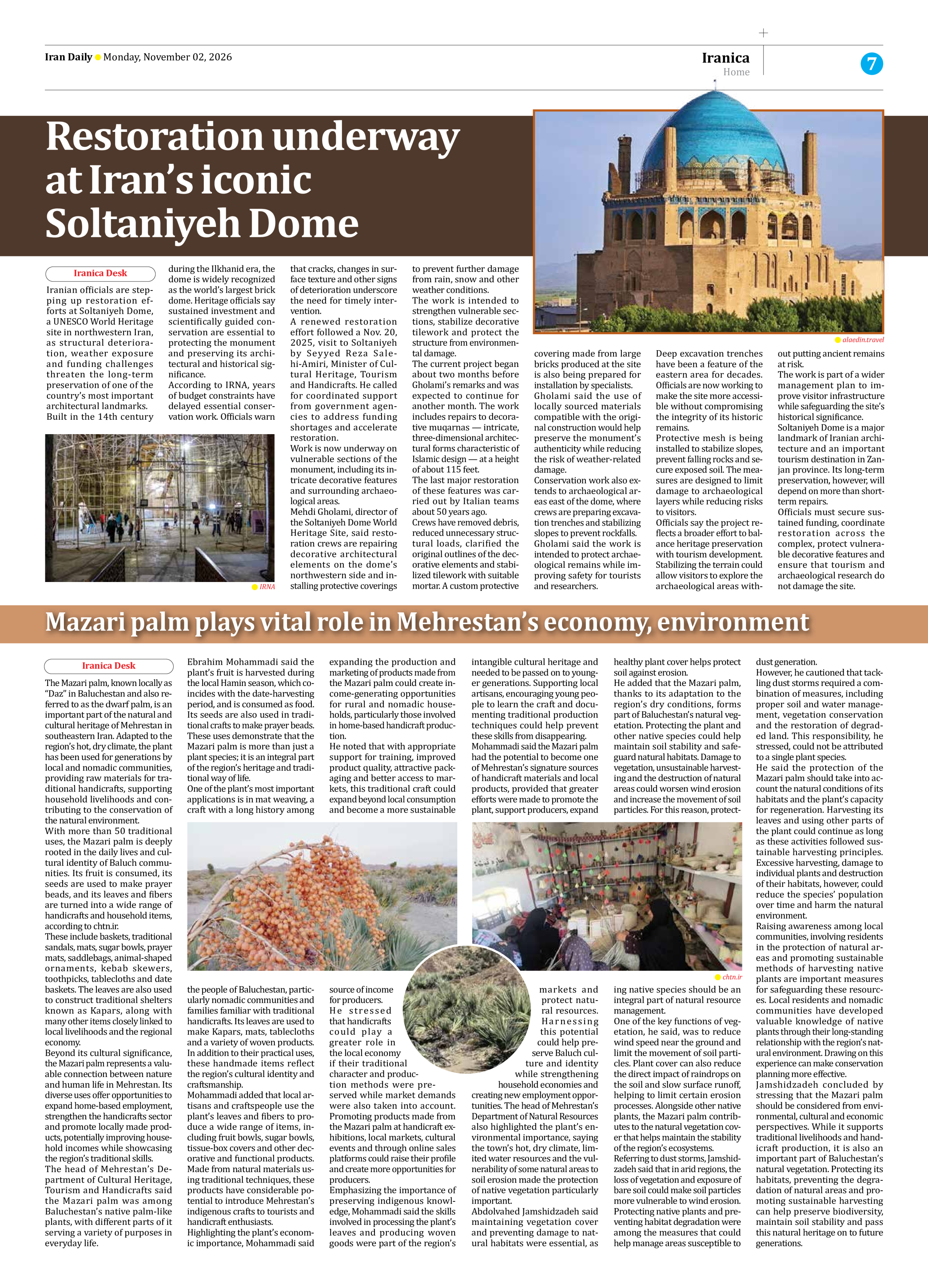


Restoration underway at Iran’s iconic Soltaniyeh Dome
Iranian officials are stepping up restoration efforts at Soltaniyeh Dome, a UNESCO World Heritage site in northwestern Iran, as structural deterioration, weather exposure and funding challenges threaten the long-term preservation of one of the country’s most important architectural landmarks.
Built in the 14th century during the Ilkhanid era, the dome is widely recognized as the world’s largest brick dome. Heritage officials say sustained investment and scientifically guided conservation are essential to protecting the monument and preserving its architectural and historical significance.
According to IRNA, years of budget constraints have delayed essential conservation work. Officials warn that cracks, changes in surface texture and other signs of deterioration underscore the need for timely intervention.
A renewed restoration effort followed a Nov. 20, 2025, visit to Soltaniyeh by Seyyed Reza Salehi-Amiri, Minister of Cultural Heritage, Tourism and Handicrafts. He called for coordinated support from government agencies to address funding shortages and accelerate restoration.
Work is now underway on vulnerable sections of the monument, including its intricate decorative features and surrounding archaeological areas.
Mehdi Gholami, director of the Soltaniyeh Dome World Heritage Site, said restoration crews are repairing decorative architectural elements on the dome’s northwestern side and installing protective coverings to prevent further damage from rain, snow and other weather conditions.
The work is intended to strengthen vulnerable sections, stabilize decorative tilework and protect the structure from environmental damage.
The current project began about two months before Gholami’s remarks and was expected to continue for another month. The work includes repairs to decorative muqarnas — intricate, three-dimensional architectural forms characteristic of Islamic design — at a height of about 115 feet.
The last major restoration of these features was carried out by Italian teams about 50 years ago.
Crews have removed debris, reduced unnecessary structural loads, clarified the original outlines of the decorative elements and stabilized tilework with suitable mortar. A custom protective covering made from large bricks produced at the site is also being prepared for installation by specialists.
Gholami said the use of locally sourced materials compatible with the original construction would help preserve the monument’s authenticity while reducing the risk of weather-related damage.
Conservation work also extends to archaeological areas east of the dome, where crews are preparing excavation trenches and stabilizing slopes to prevent rockfalls.
Gholami said the work is intended to protect archaeological remains while improving safety for tourists and researchers.
Deep excavation trenches have been a feature of the eastern area for decades. Officials are now working to make the site more accessible without compromising the integrity of its historic remains.
Protective mesh is being installed to stabilize slopes, prevent falling rocks and secure exposed soil. The measures are designed to limit damage to archaeological layers while reducing risks to visitors.
Officials say the project reflects a broader effort to balance heritage preservation with tourism development. Stabilizing the terrain could allow visitors to explore the archaeological areas without putting ancient remains at risk.
The work is part of a wider management plan to improve visitor infrastructure while safeguarding the site’s historical significance.
Soltaniyeh Dome is a major landmark of Iranian architecture and an important tourism destination in Zanjan province. Its long-term preservation, however, will depend on more than short-term repairs.
Officials must secure sustained funding, coordinate restoration across the complex, protect vulnerable decorative features and ensure that tourism and archaeological research do not damage the site.