




Pezeshkian warns US military intervention threatens global energy markets
Iran offers to expand gas investment, cooperation through GECF
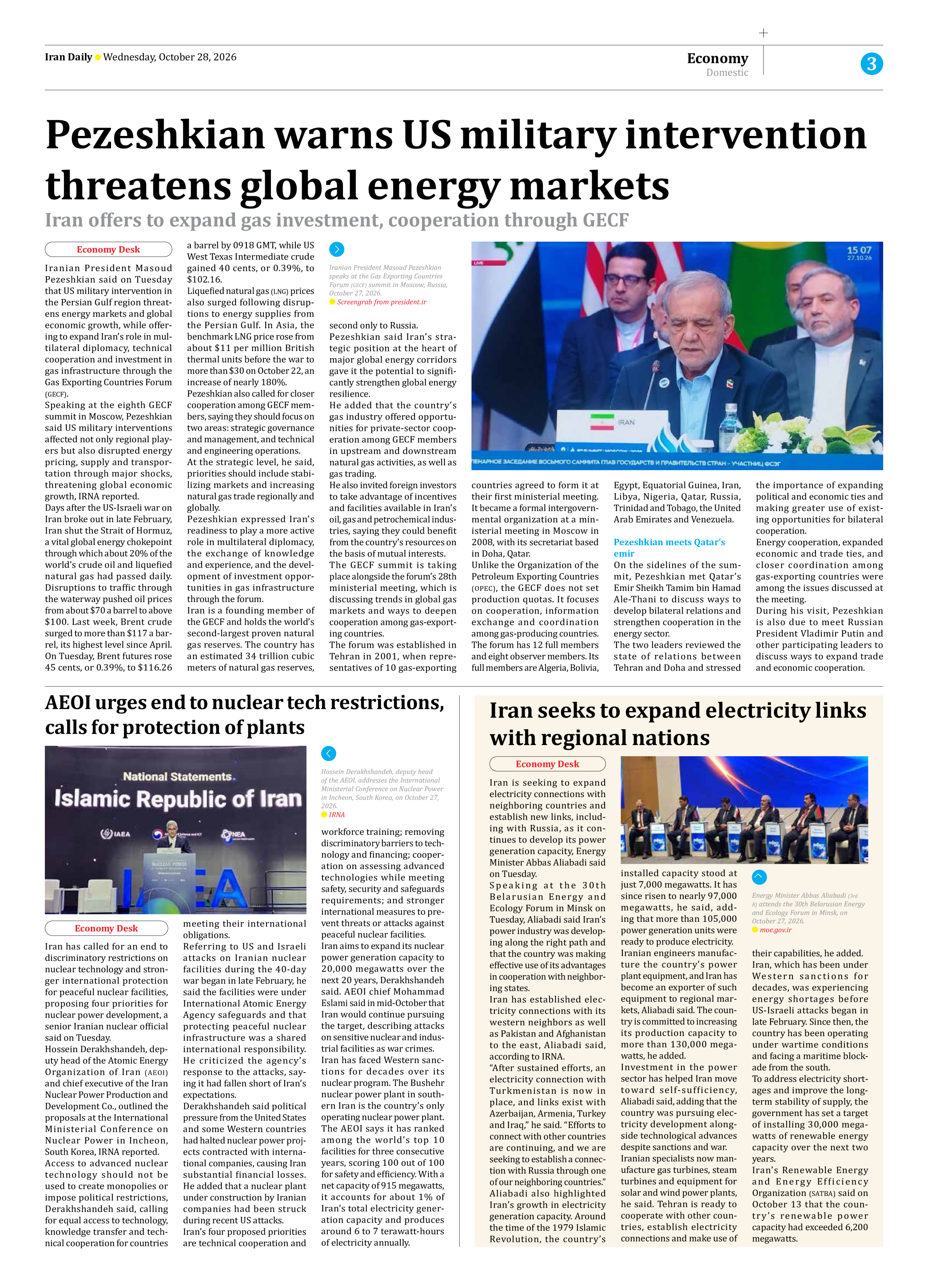
Iranian President Masoud Pezeshkian said on Tuesday that US military intervention in the Persian Gulf region threatens energy markets and global economic growth, while offering to expand Iran’s role in multilateral diplomacy, technical cooperation and investment in gas infrastructure through the Gas Exporting Countries Forum (GECF).
Speaking at the eighth GECF summit in Moscow, Pezeshkian said US military interventions affected not only regional players but also disrupted energy pricing, supply and transportation through major shocks, threatening global economic growth, IRNA reported.
Days after the US-Israeli war on Iran broke out in late February, Iran shut the Strait of Hormuz, a vital global energy chokepoint through which about 20% of the world’s crude oil and liquefied natural gas had passed daily. Disruptions to traffic through the waterway pushed oil prices from about $70 a barrel to above $100. Last week, Brent crude surged to more than $117 a barrel, its highest level since April. On Tuesday, Brent futures rose 45 cents, or 0.39%, to $116.26 a barrel by 0918 GMT, while US West Texas Intermediate crude gained 40 cents, or 0.39%, to $102.16.
Liquefied natural gas (LNG) prices also surged following disruptions to energy supplies from the Persian Gulf. In Asia, the benchmark LNG price rose from about $11 per million British thermal units before the war to more than $30 on October 22, an increase of nearly 180%.
Pezeshkian also called for closer cooperation among GECF members, saying they should focus on two areas: strategic governance and management, and technical and engineering operations.
At the strategic level, he said, priorities should include stabilizing markets and increasing natural gas trade regionally and globally.
Pezeshkian expressed Iran’s readiness to play a more active role in multilateral diplomacy, the exchange of knowledge and experience, and the development of investment opportunities in gas infrastructure through the forum.
Iran is a founding member of the GECF and holds the world’s second-largest proven natural gas reserves. The country has an estimated 34 trillion cubic meters of natural gas reserves, second only to Russia.
Pezeshkian said Iran’s strategic position at the heart of major global energy corridors gave it the potential to significantly strengthen global energy resilience.
He added that the country’s gas industry offered opportunities for private-sector cooperation among GECF members in upstream and downstream natural gas activities, as well as gas trading.
He also invited foreign investors to take advantage of incentives and facilities available in Iran’s oil, gas and petrochemical industries, saying they could benefit from the country’s resources on the basis of mutual interests.
The GECF summit is taking place alongside the forum’s 28th ministerial meeting, which is discussing trends in global gas markets and ways to deepen cooperation among gas-exporting countries.
The forum was established in Tehran in 2001, when representatives of 10 gas-exporting countries agreed to form it at their first ministerial meeting. It became a formal intergovernmental organization at a ministerial meeting in Moscow in 2008, with its secretariat based in Doha, Qatar.
Unlike the Organization of the Petroleum Exporting Countries (OPEC), the GECF does not set production quotas. It focuses on cooperation, information exchange and coordination among gas-producing countries.
The forum has 12 full members and eight observer members. Its full members are Algeria, Bolivia, Egypt, Equatorial Guinea, Iran, Libya, Nigeria, Qatar, Russia, Trinidad and Tobago, the United Arab Emirates and Venezuela.
Pezeshkian meets Qatar’s emir
On the sidelines of the summit, Pezeshkian met Qatar’s Emir Sheikh Tamim bin Hamad Ale-Thani to discuss ways to develop bilateral relations and strengthen cooperation in the energy sector.
The two leaders reviewed the state of relations between Tehran and Doha and stressed the importance of expanding political and economic ties and making greater use of existing opportunities for bilateral cooperation.
Energy cooperation, expanded economic and trade ties, and closer coordination among gas-exporting countries were among the issues discussed at the meeting.
During his visit, Pezeshkian is also due to meet Russian President Vladimir Putin and other participating leaders to discuss ways to expand trade and economic cooperation.