




Oman calls for security framework, non-aggression pact among Persian Gulf states
‘Excluding Iran would undermine any regional security arrangement’
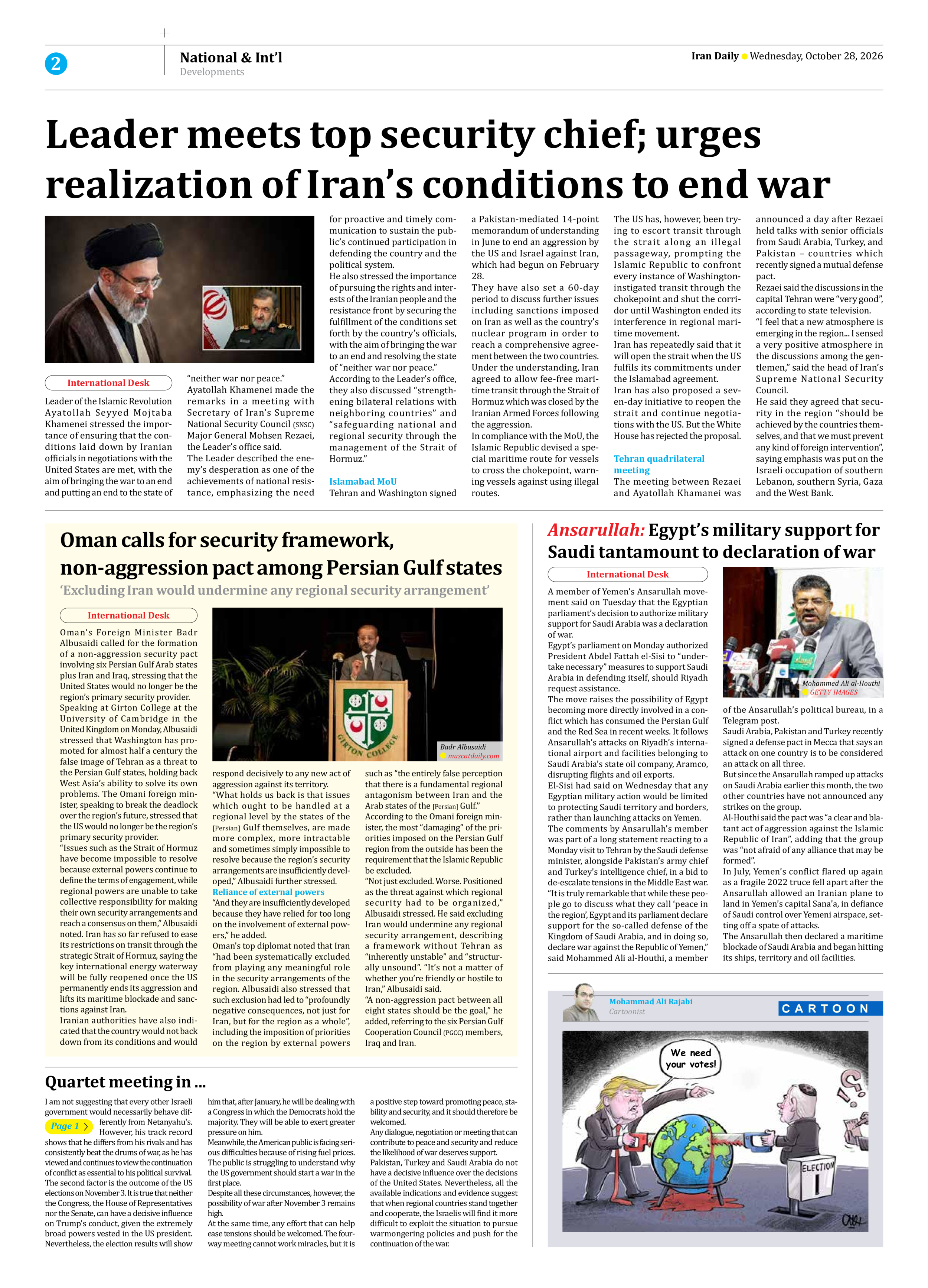
Oman’s Foreign Minister Badr Albusaidi called for the formation of a non-aggression security pact involving six Persian Gulf Arab states plus Iran and Iraq, stressing that the United States would no longer be the region’s primary security provider.
Speaking at Girton College at the University of Cambridge in the United Kingdom on Monday, Albusaidi stressed that Washington has promoted for almost half a century the false image of Tehran as a threat to the Persian Gulf states, holding back West Asia’s ability to solve its own problems. The Omani foreign minister, speaking to break the deadlock over the region’s future, stressed that the US would no longer be the region’s primary security provider.
“Issues such as the Strait of Hormuz have become impossible to resolve because external powers continue to define the terms of engagement, while regional powers are unable to take collective responsibility for making their own security arrangements and reach a consensus on them,” Albusaidi noted. Iran has so far refused to ease its restrictions on transit through the strategic Strait of Hormuz, saying the key international energy waterway will be fully reopened once the US permanently ends its aggression and lifts its maritime blockade and sanctions against Iran.
Iranian authorities have also indicated that the country would not back down from its conditions and would respond decisively to any new act of aggression against its territory.
“What holds us back is that issues which ought to be handled at a regional level by the states of the [Persian] Gulf themselves, are made more complex, more intractable and sometimes simply impossible to resolve because the region’s security arrangements are insufficiently developed,” Albusaidi further stressed.
Reliance of external powers
“And they are insufficiently developed because they have relied for too long on the involvement of external powers,” he added.
Oman’s top diplomat noted that Iran “had been systematically excluded from playing any meaningful role in the security arrangements of the region. Albusaidi also stressed that such exclusion had led to “profoundly negative consequences, not just for Iran, but for the region as a whole”, including the imposition of priorities on the region by external powers such as “the entirely false perception that there is a fundamental regional antagonism between Iran and the Arab states of the [Persian] Gulf.”
According to the Omani foreign minister, the most “damaging” of the priorities imposed on the Persian Gulf region from the outside has been the requirement that the Islamic Republic be excluded.
“Not just excluded. Worse. Positioned as the threat against which regional security had to be organized,” Albusaidi stressed. He said excluding Iran would undermine any regional security arrangement, describing a framework without Tehran as “inherently unstable” and “structurally unsound”. “It’s not a matter of whether you’re friendly or hostile to Iran,” Albusaidi said.
“A non-aggression pact between all eight states should be the goal,” he added, referring to the six Persian Gulf Cooperation Council (PGCC) members, Iraq and Iran.