


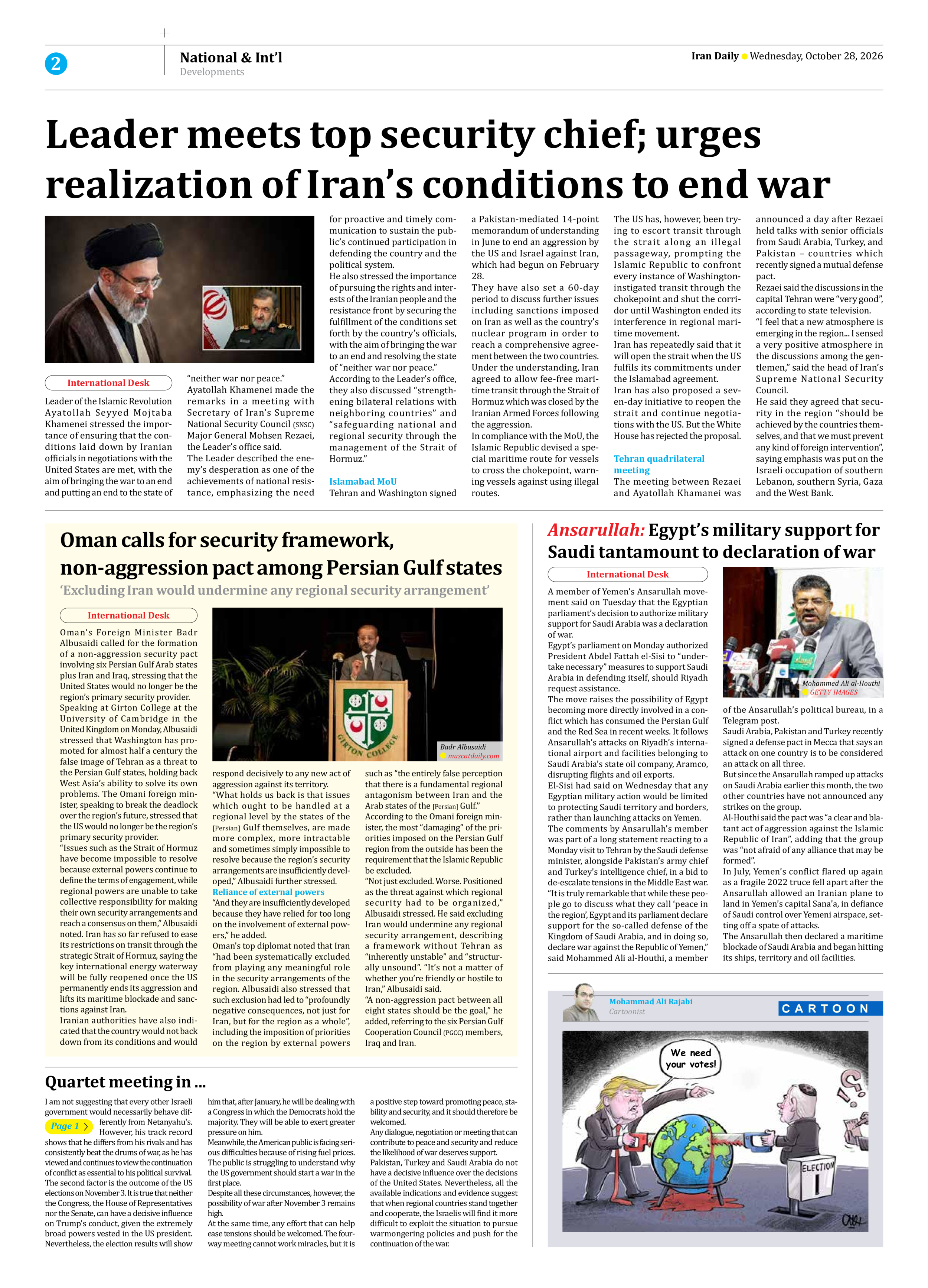


Leader meets top security chief; urges realization of Iran’s conditions to end war
Leader of the Islamic Revolution Ayatollah Seyyed Mojtaba Khamenei stressed the importance of ensuring that the conditions laid down by Iranian officials in negotiations with the United States are met, with the aim of bringing the war to an end and putting an end to the state of “neither war nor peace.”
Ayatollah Khamenei made the remarks in a meeting with Secretary of Iran’s Supreme National Security Council (SNSC) Major General Mohsen Rezaei, the Leader’s office said.
The Leader described the enemy’s desperation as one of the achievements of national resistance, emphasizing the need for proactive and timely communication to sustain the public’s continued participation in defending the country and the political system.
He also stressed the importance of pursuing the rights and interests of the Iranian people and the resistance front by securing the fulfillment of the conditions set forth by the country’s officials, with the aim of bringing the war to an end and resolving the state of “neither war nor peace.”
According to the Leader’s office, they also discussed “strengthening bilateral relations with neighboring countries” and “safeguarding national and regional security through the management of the Strait of Hormuz.”
Islamabad MoU
Tehran and Washington signed a Pakistan-mediated 14-point memorandum of understanding in June to end an aggression by the US and Israel against Iran, which had begun on February 28.
They have also set a 60-day period to discuss further issues including sanctions imposed on Iran as well as the country’s nuclear program in order to reach a comprehensive agreement between the two countries.
Under the understanding, Iran agreed to allow fee-free maritime transit through the Strait of Hormuz which was closed by the Iranian Armed Forces following the aggression.
In compliance with the MoU, the Islamic Republic devised a special maritime route for vessels to cross the chokepoint, warning vessels against using illegal routes.
The US has, however, been trying to escort transit through the strait along an illegal passageway, prompting the Islamic Republic to confront every instance of Washington-instigated transit through the chokepoint and shut the corridor until Washington ended its interference in regional maritime movement.
Iran has repeatedly said that it will open the strait when the US fulfils its commitments under the Islamabad agreement.
Iran has also proposed a seven-day initiative to reopen the strait and continue negotiations with the US. But the White House has rejected the proposal.
Tehran quadrilateral meeting
The meeting between Rezaei and Ayatollah Khamanei was announced a day after Rezaei held talks with senior officials from Saudi Arabia, Turkey, and Pakistan – countries which recently signed a mutual defense pact.
Rezaei said the discussions in the capital Tehran were “very good”, according to state television.
“I feel that a new atmosphere is emerging in the region... I sensed a very positive atmosphere in the discussions among the gentlemen,” said the head of Iran’s Supreme National Security Council.
He said they agreed that security in the region “should be achieved by the countries themselves, and that we must prevent any kind of foreign intervention”, saying emphasis was put on the Israeli occupation of southern Lebanon, southern Syria, Gaza and the West Bank.