




Copy in clipboard...
Iran’s handicrafts carry culture beyond borders
Realizing this potential requires moving beyond traditional approaches to production and sales, identifying target markets, expanding international marketing and linking exports with tourism and cultural diplomacy. To gain a larger share of foreign trade, handicrafts must evolve from locally produced goods and tourist souvenirs into competitive products with consistent quality, distinctive designs and a clear cultural identity.
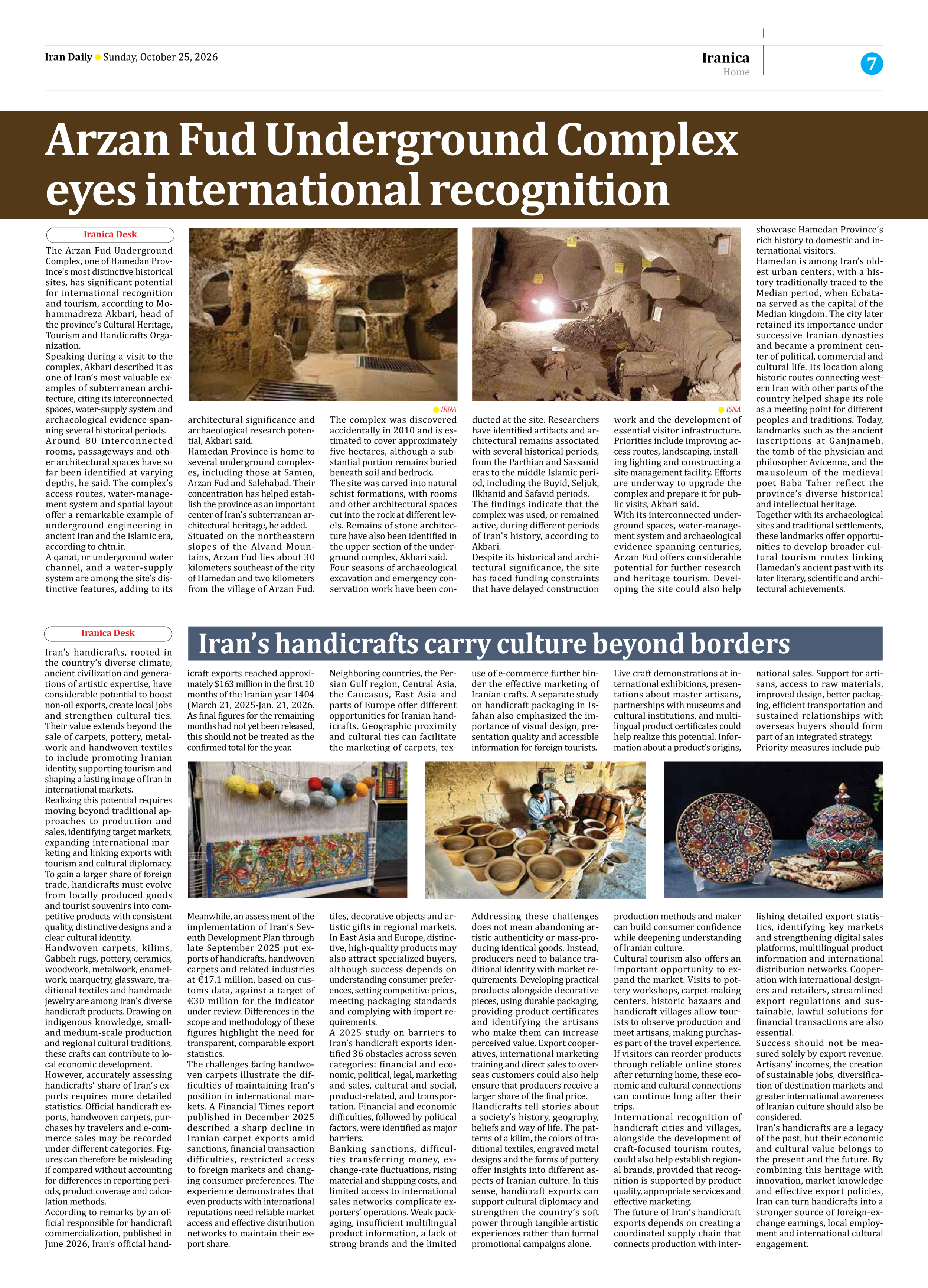
Handwoven carpets, kilims, Gabbeh rugs, pottery, ceramics, woodwork, metalwork, enamelwork, marquetry, glassware, traditional textiles and handmade jewelry are among Iran’s diverse handicraft products. Drawing on indigenous knowledge, small- and medium-scale production and regional cultural traditions, these crafts can contribute to local economic development.
However, accurately assessing handicrafts’ share of Iran’s exports requires more detailed statistics. Official handicraft exports, handwoven carpets, purchases by travelers and e-commerce sales may be recorded under different categories. Figures can therefore be misleading if compared without accounting for differences in reporting periods, product coverage and calculation methods.
According to remarks by an official responsible for handicraft commercialization, published in June 2026, Iran’s official handicraft exports reached approximately $163 million in the first 10 months of the Iranian year 1404 (March 21, 2025-Jan. 21, 2026. As final figures for the remaining months had not yet been released, this should not be treated as the confirmed total for the year.
Meanwhile, an assessment of the implementation of Iran’s Seventh Development Plan through late September 2025 put exports of handicrafts, handwoven carpets and related industries at €17.1 million, based on customs data, against a target of €30 million for the indicator under review. Differences in the scope and methodology of these figures highlight the need for transparent, comparable export statistics.
The challenges facing handwoven carpets illustrate the difficulties of maintaining Iran’s position in international markets. A Financial Times report published in December 2025 described a sharp decline in Iranian carpet exports amid sanctions, financial transaction difficulties, restricted access to foreign markets and changing consumer preferences. The experience demonstrates that even products with international reputations need reliable market access and effective distribution networks to maintain their export share.
Neighboring countries, the Persian Gulf region, Central Asia, the Caucasus, East Asia and parts of Europe offer different opportunities for Iranian handicrafts. Geographic proximity and cultural ties can facilitate the marketing of carpets, textiles, decorative objects and artistic gifts in regional markets. In East Asia and Europe, distinctive, high-quality products may also attract specialized buyers, although success depends on understanding consumer preferences, setting competitive prices, meeting packaging standards and complying with import requirements.
A 2025 study on barriers to Iran’s handicraft exports identified 36 obstacles across seven categories: financial and economic, political, legal, marketing and sales, cultural and social, product-related, and transportation. Financial and economic difficulties, followed by political factors, were identified as major barriers.
Banking sanctions, difficulties transferring money, exchange-rate fluctuations, rising material and shipping costs, and limited access to international sales networks complicate exporters’ operations. Weak packaging, insufficient multilingual product information, a lack of strong brands and the limited use of e-commerce further hinder the effective marketing of Iranian crafts. A separate study on handicraft packaging in Isfahan also emphasized the importance of visual design, presentation quality and accessible information for foreign tourists.
Addressing these challenges does not mean abandoning artistic authenticity or mass-producing identical goods. Instead, producers need to balance traditional identity with market requirements. Developing practical products alongside decorative pieces, using durable packaging, providing product certificates and identifying the artisans who make them can increase perceived value. Export cooperatives, international marketing training and direct sales to overseas customers could also help ensure that producers receive a larger share of the final price.
Handicrafts tell stories about a society’s history, geography, beliefs and way of life. The patterns of a kilim, the colors of traditional textiles, engraved metal designs and the forms of pottery offer insights into different aspects of Iranian culture. In this sense, handicraft exports can support cultural diplomacy and strengthen the country’s soft power through tangible artistic experiences rather than formal promotional campaigns alone.
Live craft demonstrations at international exhibitions, presentations about master artisans, partnerships with museums and cultural institutions, and multilingual product certificates could help realize this potential. Information about a product’s origins, production methods and maker can build consumer confidence while deepening understanding of Iranian culture.
Cultural tourism also offers an important opportunity to expand the market. Visits to pottery workshops, carpet-making centers, historic bazaars and handicraft villages allow tourists to observe production and meet artisans, making purchases part of the travel experience. If visitors can reorder products through reliable online stores after returning home, these economic and cultural connections can continue long after their trips.
International recognition of handicraft cities and villages, alongside the development of craft-focused tourism routes, could also help establish regional brands, provided that recognition is supported by product quality, appropriate services and effective marketing.
The future of Iran’s handicraft exports depends on creating a coordinated supply chain that connects production with international sales. Support for artisans, access to raw materials, improved design, better packaging, efficient transportation and sustained relationships with overseas buyers should form part of an integrated strategy.
Priority measures include publishing detailed export statistics, identifying key markets and strengthening digital sales platforms, multilingual product information and international distribution networks. Cooperation with international designers and retailers, streamlined export regulations and sustainable, lawful solutions for financial transactions are also essential.
Success should not be measured solely by export revenue. Artisans’ incomes, the creation of sustainable jobs, diversification of destination markets and greater international awareness of Iranian culture should also be considered.
Iran’s handicrafts are a legacy of the past, but their economic and cultural value belongs to the present and the future. By combining this heritage with innovation, market knowledge and effective export policies, Iran can turn handicrafts into a stronger source of foreign-exchange earnings, local employment and international cultural engagement.