




Arzan Fud Underground Complex eyes international recognition
The Arzan Fud Underground Complex, one of Hamedan Province’s most distinctive historical sites, has significant potential for international recognition and tourism, according to Mohammadreza Akbari, head of the province’s Cultural Heritage, Tourism and Handicrafts Organization.
Speaking during a visit to the complex, Akbari described it as one of Iran’s most valuable examples of subterranean architecture, citing its interconnected spaces, water-supply system and archaeological evidence spanning several historical periods.
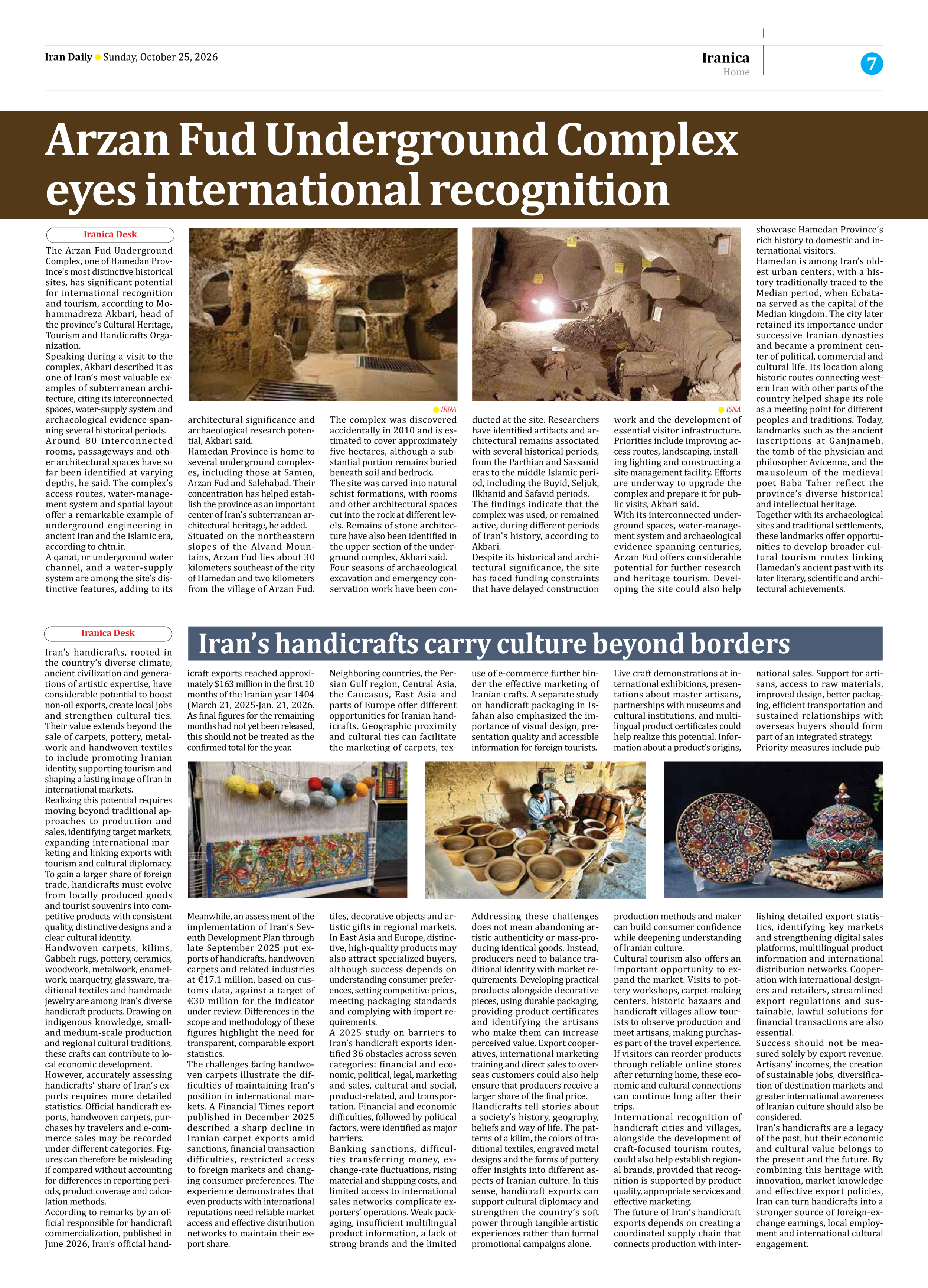
Around 80 interconnected rooms, passageways and other architectural spaces have so far been identified at varying depths, he said. The complex’s access routes, water-management system and spatial layout offer a remarkable example of underground engineering in ancient Iran and the Islamic era, according to chtn.ir.
A qanat, or underground water channel, and a water-supply system are among the site’s distinctive features, adding to its architectural significance and archaeological research potential, Akbari said.
Hamedan Province is home to several underground complexes, including those at Samen, Arzan Fud and Salehabad. Their concentration has helped establish the province as an important center of Iran’s subterranean architectural heritage, he added.
Situated on the northeastern slopes of the Alvand Mountains, Arzan Fud lies about 30 kilometers southeast of the city of Hamedan and two kilometers from the village of Arzan Fud. The complex was discovered accidentally in 2010 and is estimated to cover approximately five hectares, although a substantial portion remains buried beneath soil and bedrock.
The site was carved into natural schist formations, with rooms and other architectural spaces cut into the rock at different levels. Remains of stone architecture have also been identified in the upper section of the underground complex, Akbari said.
Four seasons of archaeological excavation and emergency conservation work have been conducted at the site. Researchers have identified artifacts and architectural remains associated with several historical periods, from the Parthian and Sassanid eras to the middle Islamic period, including the Buyid, Seljuk, Ilkhanid and Safavid periods.
The findings indicate that the complex was used, or remained active, during different periods of Iran’s history, according to Akbari.
Despite its historical and architectural significance, the site has faced funding constraints that have delayed construction work and the development of essential visitor infrastructure. Priorities include improving access routes, landscaping, installing lighting and constructing a site management facility. Efforts are underway to upgrade the complex and prepare it for public visits, Akbari said.
With its interconnected underground spaces, water-management system and archaeological evidence spanning centuries, Arzan Fud offers considerable potential for further research and heritage tourism. Developing the site could also help showcase Hamedan Province’s rich history to domestic and international visitors.
Hamedan is among Iran’s oldest urban centers, with a history traditionally traced to the Median period, when Ecbatana served as the capital of the Median kingdom. The city later retained its importance under successive Iranian dynasties and became a prominent center of political, commercial and cultural life. Its location along historic routes connecting western Iran with other parts of the country helped shape its role as a meeting point for different peoples and traditions. Today, landmarks such as the ancient inscriptions at Ganjnameh, the tomb of the physician and philosopher Avicenna, and the mausoleum of the medieval poet Baba Taher reflect the province’s diverse historical and intellectual heritage.
Together with its archaeological sites and traditional settlements, these landmarks offer opportunities to develop broader cultural tourism routes linking Hamedan’s ancient past with its later literary, scientific and architectural achievements.