




Masjed Soleyman’s industrial heritage moves closer to global recognition
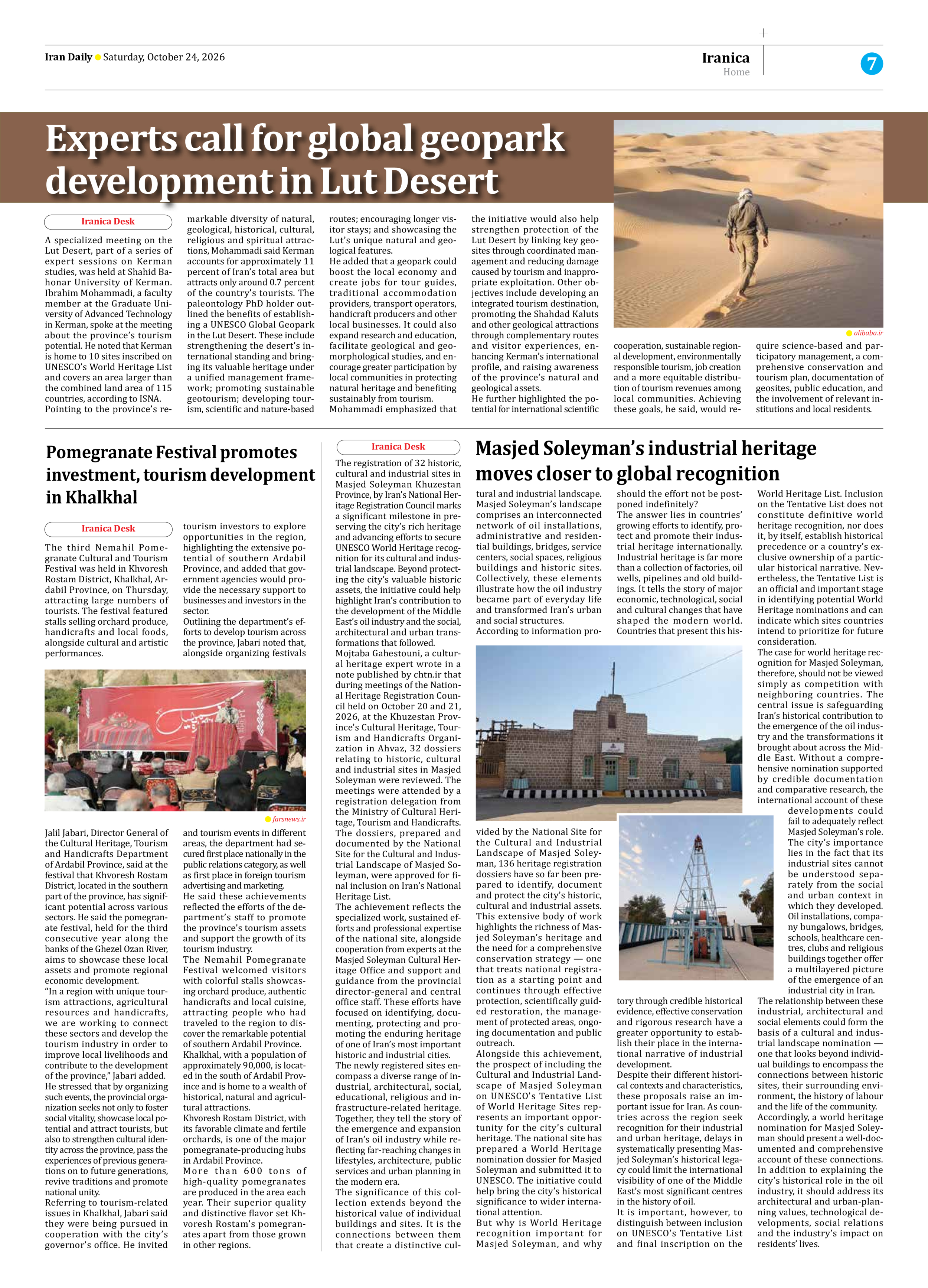
The registration of 32 historic, cultural and industrial sites in Masjed Soleyman Khuzestan Province, by Iran’s National Heritage Registration Council marks a significant milestone in preserving the city’s rich heritage and advancing efforts to secure UNESCO World Heritage recognition for its cultural and industrial landscape. Beyond protecting the city’s valuable historic assets, the initiative could help highlight Iran’s contribution to the development of the Middle East’s oil industry and the social, architectural and urban transformations that followed.
Mojtaba Gahestouni, a cultural heritage expert wrote in a note published by chtn.ir that during meetings of the National Heritage Registration Council held on October 20 and 21, 2026, at the Khuzestan Province’s Cultural Heritage, Tourism and Handicrafts Organization in Ahvaz, 32 dossiers relating to historic, cultural and industrial sites in Masjed Soleyman were reviewed. The meetings were attended by a registration delegation from the Ministry of Cultural Heritage, Tourism and Handicrafts. The dossiers, prepared and documented by the National Site for the Cultural and Industrial Landscape of Masjed Soleyman, were approved for final inclusion on Iran’s National Heritage List.
The achievement reflects the specialized work, sustained efforts and professional expertise of the national site, alongside cooperation from experts at the Masjed Soleyman Cultural Heritage Office and support and guidance from the provincial director-general and central office staff. These efforts have focused on identifying, documenting, protecting and promoting the enduring heritage of one of Iran’s most important historic and industrial cities.
The newly registered sites encompass a diverse range of industrial, architectural, social, educational, religious and infrastructure-related heritage. Together, they tell the story of the emergence and expansion of Iran’s oil industry while reflecting far-reaching changes in lifestyles, architecture, public services and urban planning in the modern era.
The significance of this collection extends beyond the historical value of individual buildings and sites. It is the connections between them that create a distinctive cultural and industrial landscape. Masjed Soleyman’s landscape comprises an interconnected network of oil installations, administrative and residential buildings, bridges, service centers, social spaces, religious buildings and historic sites. Collectively, these elements illustrate how the oil industry became part of everyday life and transformed Iran’s urban and social structures.
According to information provided by the National Site for the Cultural and Industrial Landscape of Masjed Soleyman, 136 heritage registration dossiers have so far been prepared to identify, document and protect the city’s historic, cultural and industrial assets. This extensive body of work highlights the richness of Masjed Soleyman’s heritage and the need for a comprehensive conservation strategy — one that treats national registration as a starting point and continues through effective protection, scientifically guided restoration, the management of protected areas, ongoing documentation and public outreach.
Alongside this achievement, the prospect of including the Cultural and Industrial Landscape of Masjed Soleyman on UNESCO’s Tentative List of World Heritage Sites represents an important opportunity for the city’s cultural heritage. The national site has prepared a World Heritage nomination dossier for Masjed Soleyman and submitted it to UNESCO. The initiative could help bring the city’s historical significance to wider international attention.
But why is World Heritage recognition important for Masjed Soleyman, and why should the effort not be postponed indefinitely?
The answer lies in countries’ growing efforts to identify, protect and promote their industrial heritage internationally. Industrial heritage is far more than a collection of factories, oil wells, pipelines and old buildings. It tells the story of major economic, technological, social and cultural changes that have shaped the modern world. Countries that present this history through credible historical evidence, effective conservation and rigorous research have a greater opportunity to establish their place in the international narrative of industrial development.
Despite their different historical contexts and characteristics, these proposals raise an important issue for Iran. As countries across the region seek recognition for their industrial and urban heritage, delays in systematically presenting Masjed Soleyman’s historical legacy could limit the international visibility of one of the Middle East’s most significant centres in the history of oil.
It is important, however, to distinguish between inclusion on UNESCO’s Tentative List and final inscription on the World Heritage List. Inclusion on the Tentative List does not constitute definitive world heritage recognition, nor does it, by itself, establish historical precedence or a country’s exclusive ownership of a particular historical narrative. Nevertheless, the Tentative List is an official and important stage in identifying potential World Heritage nominations and can indicate which sites countries intend to prioritize for future consideration.
The case for world heritage recognition for Masjed Soleyman, therefore, should not be viewed simply as competition with neighboring countries. The central issue is safeguarding Iran’s historical contribution to the emergence of the oil industry and the transformations it brought about across the Middle East. Without a comprehensive nomination supported by credible documentation and comparative research, the international account of these developments could fail to adequately reflect Masjed Soleyman’s role.
The city’s importance lies in the fact that its industrial sites cannot be understood separately from the social and urban context in which they developed. Oil installations, company bungalows, bridges, schools, healthcare centres, clubs and religious buildings together offer a multilayered picture of the emergence of an industrial city in Iran.
The relationship between these industrial, architectural and social elements could form the basis of a cultural and industrial landscape nomination — one that looks beyond individual buildings to encompass the connections between historic sites, their surrounding environment, the history of labour and the life of the community.
Accordingly, a world heritage nomination for Masjed Soleyman should present a well-documented and comprehensive account of these connections. In addition to explaining the city’s historical role in the oil industry, it should address its architectural and urban-planning values, technological developments, social relations and the industry’s impact on residents’ lives.