


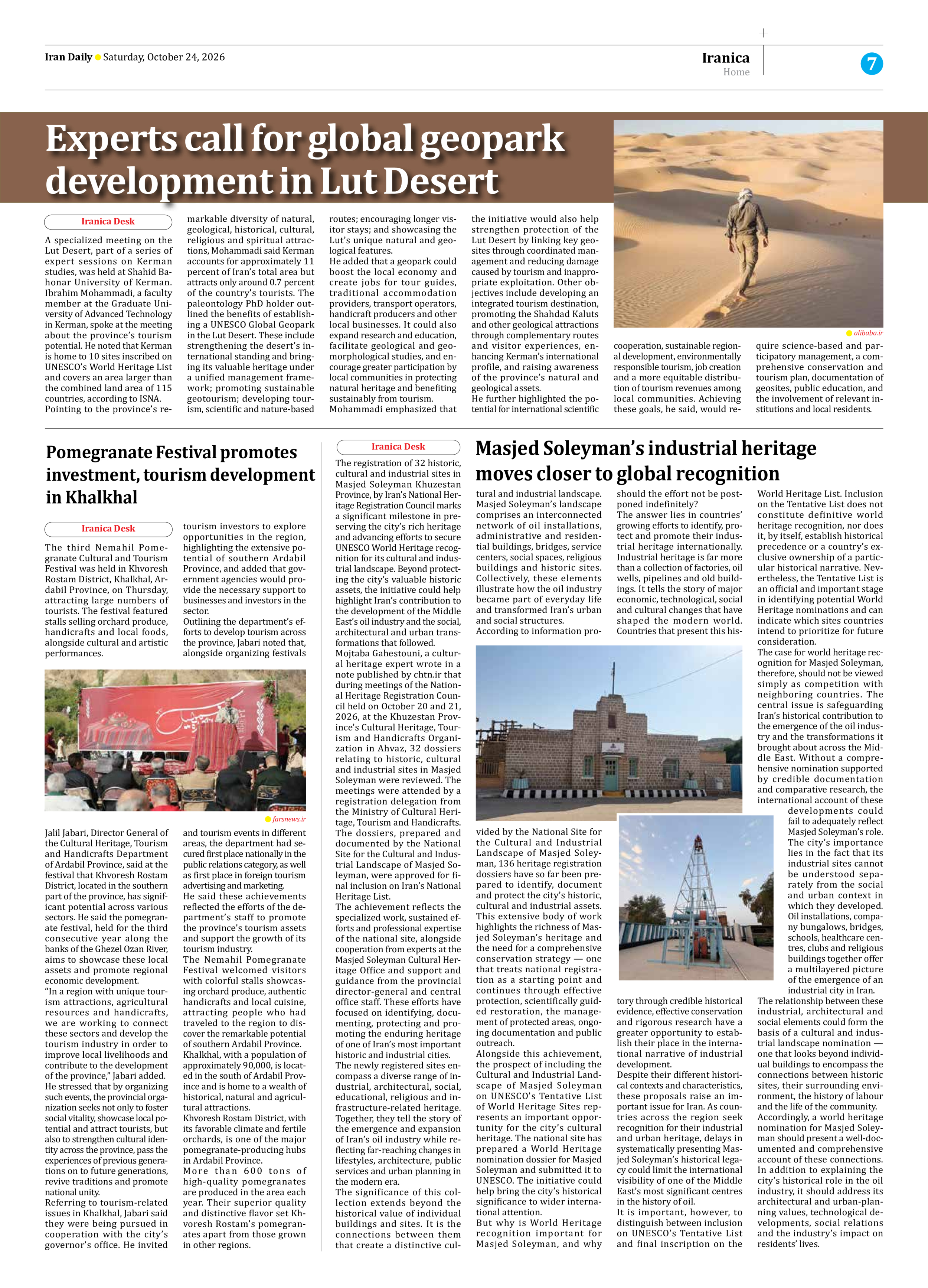


Experts call for global geopark development in Lut Desert
A specialized meeting on the Lut Desert, part of a series of expert sessions on Kerman studies, was held at Shahid Bahonar University of Kerman. Ibrahim Mohammadi, a faculty member at the Graduate University of Advanced Technology in Kerman, spoke at the meeting about the province’s tourism potential. He noted that Kerman is home to 10 sites inscribed on UNESCO’s World Heritage List and covers an area larger than the combined land area of 115 countries, according to ISNA.
Pointing to the province’s remarkable diversity of natural, geological, historical, cultural, religious and spiritual attractions, Mohammadi said Kerman accounts for approximately 11 percent of Iran’s total area but attracts only around 0.7 percent of the country’s tourists. The paleontology PhD holder outlined the benefits of establishing a UNESCO Global Geopark in the Lut Desert. These include strengthening the desert’s international standing and bringing its valuable heritage under a unified management framework; promoting sustainable geotourism; developing tourism, scientific and nature-based routes; encouraging longer visitor stays; and showcasing the Lut’s unique natural and geological features.
He added that a geopark could boost the local economy and create jobs for tour guides, traditional accommodation providers, transport operators, handicraft producers and other local businesses. It could also expand research and education, facilitate geological and geomorphological studies, and encourage greater participation by local communities in protecting natural heritage and benefiting sustainably from tourism.
Mohammadi emphasized that the initiative would also help strengthen protection of the Lut Desert by linking key geosites through coordinated management and reducing damage caused by tourism and inappropriate exploitation. Other objectives include developing an integrated tourism destination, promoting the Shahdad Kaluts and other geological attractions through complementary routes and visitor experiences, enhancing Kerman’s international profile, and raising awareness of the province’s natural and geological assets.
He further highlighted the potential for international scientific cooperation, sustainable regional development, environmentally responsible tourism, job creation and a more equitable distribution of tourism revenues among local communities. Achieving these goals, he said, would require science-based and participatory management, a comprehensive conservation and tourism plan, documentation of geosites, public education, and the involvement of relevant institutions and local residents.