


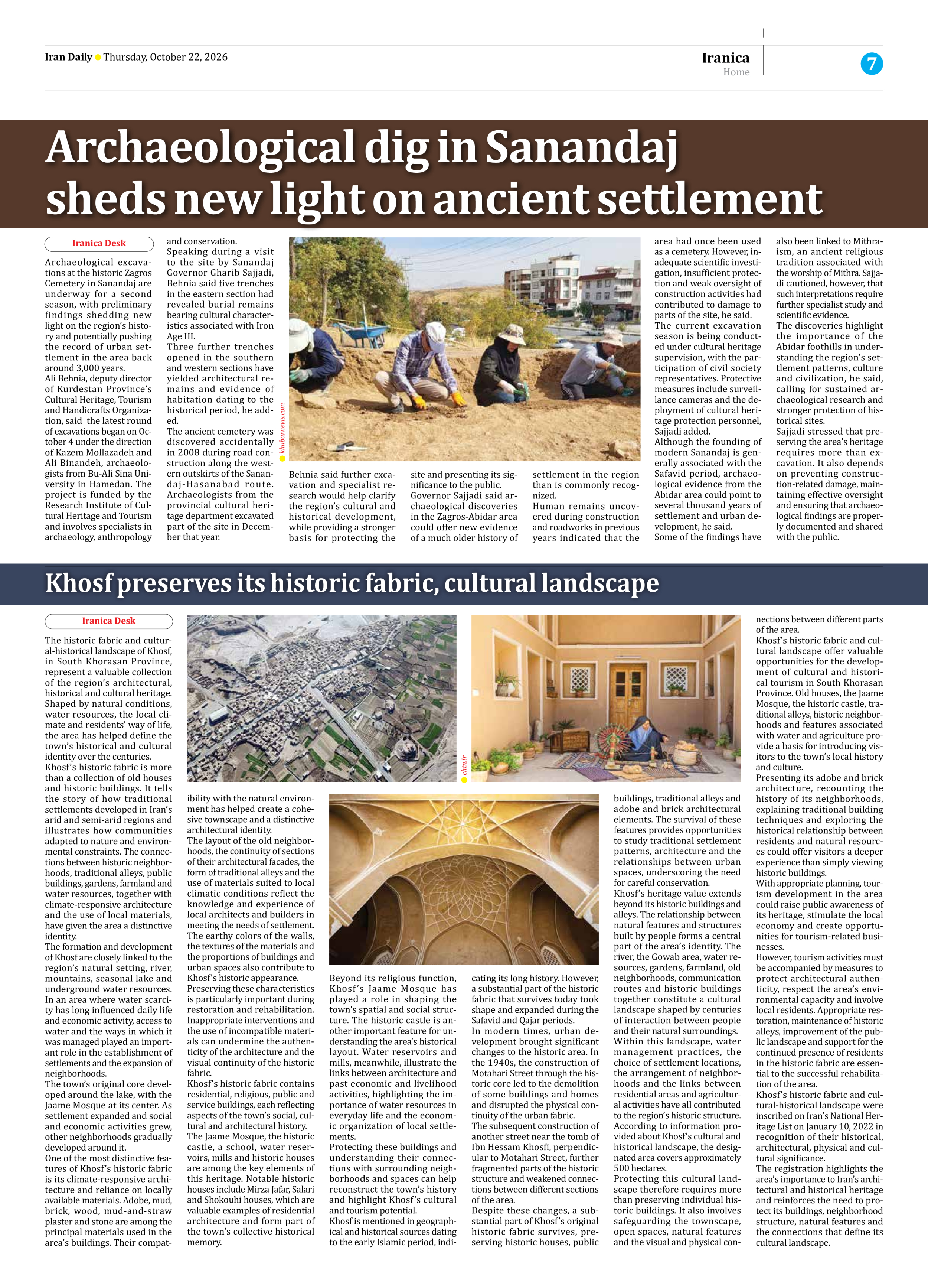


Khosf preserves its historic fabric, cultural landscape
The historic fabric and cultural-historical landscape of Khosf, in South Khorasan Province, represent a valuable collection of the region’s architectural, historical and cultural heritage. Shaped by natural conditions, water resources, the local climate and residents’ way of life, the area has helped define the town’s historical and cultural identity over the centuries.
Khosf’s historic fabric is more than a collection of old houses and historic buildings. It tells the story of how traditional settlements developed in Iran’s arid and semi-arid regions and illustrates how communities adapted to nature and environmental constraints. The connections between historic neighborhoods, traditional alleys, public buildings, gardens, farmland and water resources, together with climate-responsive architecture and the use of local materials, have given the area a distinctive identity.
The formation and development of Khosf are closely linked to the region’s natural setting, river, mountains, seasonal lake and underground water resources. In an area where water scarcity has long influenced daily life and economic activity, access to water and the ways in which it was managed played an important role in the establishment of settlements and the expansion of neighborhoods.
The town’s original core developed around the lake, with the Jaame Mosque at its center. As settlement expanded and social and economic activities grew, other neighborhoods gradually developed around it.
One of the most distinctive features of Khosf’s historic fabric is its climate-responsive architecture and reliance on locally available materials. Adobe, mud, brick, wood, mud-and-straw plaster and stone are among the principal materials used in the area’s buildings. Their compatibility with the natural environment has helped create a cohesive townscape and a distinctive architectural identity.
The layout of the old neighborhoods, the continuity of sections of their architectural facades, the form of traditional alleys and the use of materials suited to local climatic conditions reflect the knowledge and experience of local architects and builders in meeting the needs of settlement. The earthy colors of the walls, the textures of the materials and the proportions of buildings and urban spaces also contribute to Khosf’s historic appearance.
Preserving these characteristics is particularly important during restoration and rehabilitation. Inappropriate interventions and the use of incompatible materials can undermine the authenticity of the architecture and the visual continuity of the historic fabric.
Khosf’s historic fabric contains residential, religious, public and service buildings, each reflecting aspects of the town’s social, cultural and architectural history.
The Jaame Mosque, the historic castle, a school, water reservoirs, mills and historic houses are among the key elements of this heritage. Notable historic houses include Mirza Jafar, Salari and Shokouhi houses, which are valuable examples of residential architecture and form part of the town’s collective historical memory.
Beyond its religious function, Khosf’s Jaame Mosque has played a role in shaping the town’s spatial and social structure. The historic castle is another important feature for understanding the area’s historical layout. Water reservoirs and mills, meanwhile, illustrate the links between architecture and past economic and livelihood activities, highlighting the importance of water resources in everyday life and the economic organization of local settlements.
Protecting these buildings and understanding their connections with surrounding neighborhoods and spaces can help reconstruct the town’s history and highlight Khosf’s cultural and tourism potential.
Khosf is mentioned in geographical and historical sources dating to the early Islamic period, indicating its long history. However, a substantial part of the historic fabric that survives today took shape and expanded during the Safavid and Qajar periods.
In modern times, urban development brought significant changes to the historic area. In the 1940s, the construction of Motahari Street through the historic core led to the demolition of some buildings and homes and disrupted the physical continuity of the urban fabric.
The subsequent construction of another street near the tomb of Ibn Hessam Khosfi, perpendicular to Motahari Street, further fragmented parts of the historic structure and weakened connections between different sections of the area.
Despite these changes, a substantial part of Khosf’s original historic fabric survives, preserving historic houses, public buildings, traditional alleys and adobe and brick architectural elements. The survival of these features provides opportunities to study traditional settlement patterns, architecture and the relationships between urban spaces, underscoring the need for careful conservation.
Khosf’s heritage value extends beyond its historic buildings and alleys. The relationship between natural features and structures built by people forms a central part of the area’s identity. The river, the Gowab area, water resources, gardens, farmland, old neighborhoods, communication routes and historic buildings together constitute a cultural landscape shaped by centuries of interaction between people and their natural surroundings.
Within this landscape, water management practices, the choice of settlement locations, the arrangement of neighborhoods and the links between residential areas and agricultural activities have all contributed to the region’s historic structure.
According to information provided about Khosf’s cultural and historical landscape, the designated area covers approximately 500 hectares.
Protecting this cultural landscape therefore requires more than preserving individual historic buildings. It also involves safeguarding the townscape, open spaces, natural features and the visual and physical connections between different parts of the area.
Khosf’s historic fabric and cultural landscape offer valuable opportunities for the development of cultural and historical tourism in South Khorasan Province. Old houses, the Jaame Mosque, the historic castle, traditional alleys, historic neighborhoods and features associated with water and agriculture provide a basis for introducing visitors to the town’s local history and culture.
Presenting its adobe and brick architecture, recounting the history of its neighborhoods, explaining traditional building techniques and exploring the historical relationship between residents and natural resources could offer visitors a deeper experience than simply viewing historic buildings.
With appropriate planning, tourism development in the area could raise public awareness of its heritage, stimulate the local economy and create opportunities for tourism-related businesses.
However, tourism activities must be accompanied by measures to protect architectural authenticity, respect the area’s environmental capacity and involve local residents. Appropriate restoration, maintenance of historic alleys, improvement of the public landscape and support for the continued presence of residents in the historic fabric are essential to the successful rehabilitation of the area.
Khosf’s historic fabric and cultural-historical landscape were inscribed on Iran’s National Heritage List on January 10, 2022 in recognition of their historical, architectural, physical and cultural significance.
The registration highlights the area’s importance to Iran’s architectural and historical heritage and reinforces the need to protect its buildings, neighborhood structure, natural features and the connections that define its cultural landscape.