




Food self-sufficiency improved despite sanctions, war: Minister
Iran has increased self-sufficiency in most agricultural and food products and boosted output of major staples despite sanctions, two wars and an economic blockade, Agriculture Minister Gholamreza Nouri-Qezeljeh said at a global food security meeting in Rome.
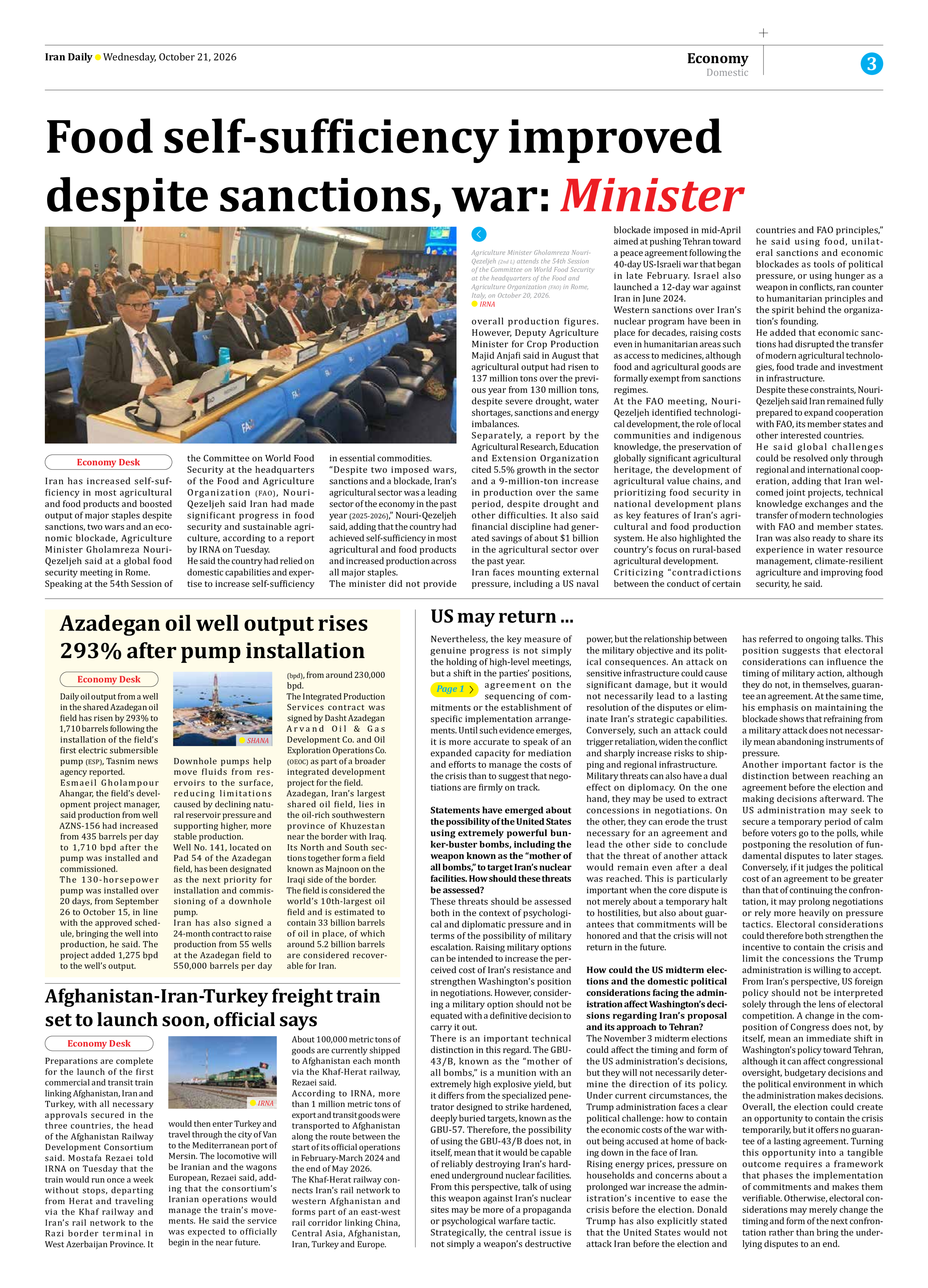
Speaking at the 54th Session of the Committee on World Food Security at the headquarters of the Food and Agriculture Organization (FAO), Nouri-Qezeljeh said Iran had made significant progress in food security and sustainable agriculture, according to a report by IRNA on Tuesday.
He said the country had relied on domestic capabilities and expertise to increase self-sufficiency in essential commodities.
“Despite two imposed wars, sanctions and a blockade, Iran’s agricultural sector was a leading sector of the economy in the past year (2025-2026),” Nouri-Qezeljeh said, adding that the country had achieved self-sufficiency in most agricultural and food products and increased production across all major staples.
The minister did not provide overall production figures. However, Deputy Agriculture Minister for Crop Production Majid Anjafi said in August that agricultural output had risen to 137 million tons over the previous year from 130 million tons, despite severe drought, water shortages, sanctions and energy imbalances.
Separately, a report by the Agricultural Research, Education and Extension Organization cited 5.5% growth in the sector and a 9-million-ton increase in production over the same period, despite drought and other difficulties. It also said financial discipline had generated savings of about $1 billion in the agricultural sector over the past year.
Iran faces mounting external pressure, including a US naval blockade imposed in mid-April aimed at pushing Tehran toward a peace agreement following the 40-day US-Israeli war that began in late February. Israel also launched a 12-day war against Iran in June 2024.
Western sanctions over Iran’s nuclear program have been in place for decades, raising costs even in humanitarian areas such as access to medicines, although food and agricultural goods are formally exempt from sanctions regimes.
At the FAO meeting, Nouri-Qezeljeh identified technological development, the role of local communities and indigenous knowledge, the preservation of globally significant agricultural heritage, the development of agricultural value chains, and prioritizing food security in national development plans as key features of Iran’s agricultural and food production system. He also highlighted the country’s focus on rural-based agricultural development.
Criticizing “contradictions between the conduct of certain countries and FAO principles,” he said using food, unilateral sanctions and economic blockades as tools of political pressure, or using hunger as a weapon in conflicts, ran counter to humanitarian principles and the spirit behind the organization’s founding.
He added that economic sanctions had disrupted the transfer of modern agricultural technologies, food trade and investment in infrastructure.
Despite these constraints, Nouri-Qezeljeh said Iran remained fully prepared to expand cooperation with FAO, its member states and other interested countries.
He said global challenges could be resolved only through regional and international cooperation, adding that Iran welcomed joint projects, technical knowledge exchanges and the transfer of modern technologies with FAO and member states. Iran was also ready to share its experience in water resource management, climate-resilient agriculture and improving food security, he said.