




Reading Room
Book traces history of license plates in Iran
Iran’s vehicle registration history dates back to 1926, when the country’s first automobiles began arriving. At the time, a set of 32 regulations governing vehicle registration was drafted. The rules were finalized in 1929, three years after the cars’ introduction, and required vehicles to display five separate plates.
The book “The First Number Plate: A History of Vehicle Registration in Iran, from Its Origins to the Introduction of National Plates” has been published by the Cultural Museums Institute of the Mostazafan Foundation, in collaboration with the Traffic Police Applied Research Center.
The publication examines the history of vehicle license plates in Iran, from the arrival of the first automobiles and the establishment of early registration systems to the introduction and adoption of national plates. Its contents draw on historical research, documentary evidence and authoritative sources, particularly archival materials held at the Iran Classic Car Museum, according to IBNA.
At first glance, a vehicle license plate may appear to be little more than a combination of numbers, letters or symbols used to identify a vehicle. Like a fingerprint, it must be unique. Viewed more closely, however, a license plate can also serve as a historical record, reflecting the technological, administrative, social and even political changes of its time.
The evolution of license plates in Iran began with the arrival of the first motor vehicles more than a century ago. Since then, their structure, function, identification systems and physical appearance have undergone numerous changes. The book seeks to retrace this history and bring together knowledge that has previously appeared only in scattered and limited references.
In the book’s foreword, Hamidreza Soleimani, managing director of the Cultural Institute of Bonyad Museums, outlines the publication’s main themes:
“The study begins with a brief account of the arrival of the police and the emergence of early traffic-control systems in Iran, noting that the development of license plates cannot be separated from the establishment of institutions responsible for urban order and traffic management. It then traces the physical evolution of plates, from the earliest simple designs to modern national plates. Their materials, colors, dimensions, lettering, distinctive markings and graphic features are examined in detail.
“Another key section classifies plates according to type and use, including private, government, public-service, military and ceremonial vehicles, as well as the technical and administrative requirements associated with each category. These classifications, the foreword notes, help explain not only the structure of registration systems but also how vehicles were organized and managed in different historical periods.
“The book also reviews selected traffic and vehicle-registration laws and regulations to clarify the legal and administrative framework governing license plates.”
Soleimani says the need for the publication arose from the limited attention previously given to the subject. Until now, the history of Iranian license plates has generally been covered only briefly, in individual chapters of various books. This research gap prompted the compilation of a comprehensive account intended to shed light on a relatively overlooked aspect of Iran’s contemporary history.
The earliest vehicle-numbering efforts in Iran predated the arrival of automobiles. During the premiership of Vosough al-Dowleh in 1919, numbered plates were attached to horse-drawn carriages and carts under the supervision of the municipal administration, known as the Baladieh.
The initiative aimed to improve urban order, regulate the movement of public conveyances and collect municipal taxes and fees. Tehran and several other major Iranian cities were expanding rapidly, and the growing number of carriages and carts had created challenges in traffic management, enforcement and handling public complaints.
The municipal authorities therefore introduced a numbering system for urban vehicles to make it easier to identify owners, track routes and determine the taxes or fees payable.
The plates were generally made of metal, with numbers either embossed or painted in clearly distinguishable colors. Municipal officers were tasked with regularly patrolling major routes and fining vehicles that lacked plates or displayed damaged or defaced ones.
The initiative marked one of the earliest steps toward a formal system for registering and identifying vehicles in Iran, a system that would later expand and become more sophisticated with the arrival of automobiles.
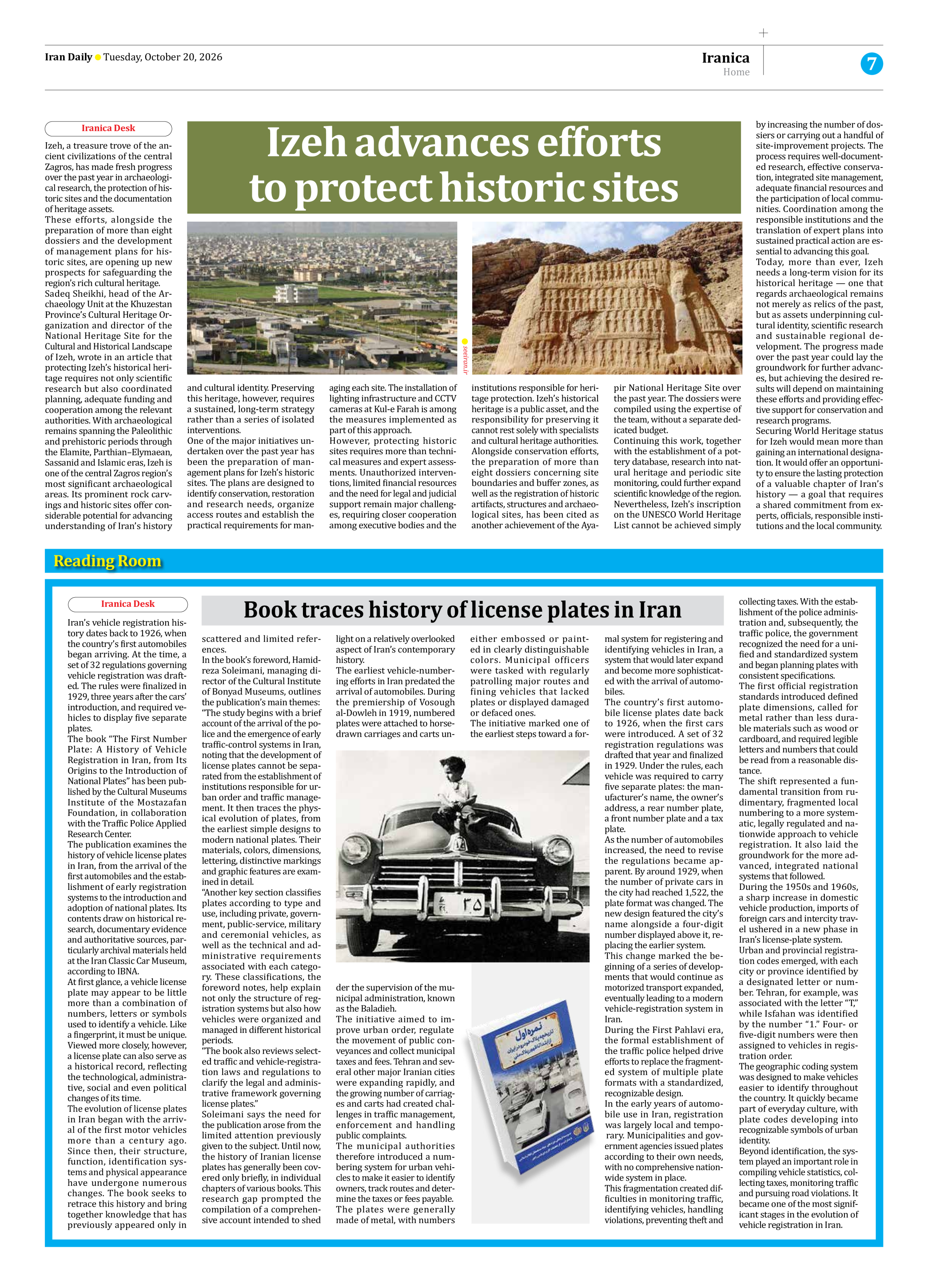
The country’s first automobile license plates date back to 1926, when the first cars were introduced. A set of 32 registration regulations was drafted that year and finalized in 1929. Under the rules, each vehicle was required to carry five separate plates: the manufacturer’s name, the owner’s address, a rear number plate, a front number plate and a tax plate.
As the number of automobiles increased, the need to revise the regulations became apparent. By around 1929, when the number of private cars in the city had reached 1,522, the plate format was changed. The new design featured the city’s name alongside a four-digit number displayed above it, replacing the earlier system.
This change marked the beginning of a series of developments that would continue as motorized transport expanded, eventually leading to a modern vehicle-registration system in Iran.
During the First Pahlavi era, the formal establishment of the traffic police helped drive efforts to replace the fragmented system of multiple plate formats with a standardized, recognizable design.
In the early years of automobile use in Iran, registration was largely local and temporary. Municipalities and government agencies issued plates according to their own needs, with no comprehensive nationwide system in place.
This fragmentation created difficulties in monitoring traffic, identifying vehicles, handling violations, preventing theft and collecting taxes. With the establishment of the police administration and, subsequently, the traffic police, the government recognized the need for a unified and standardized system and began planning plates with consistent specifications.
The first official registration standards introduced defined plate dimensions, called for metal rather than less durable materials such as wood or cardboard, and required legible letters and numbers that could be read from a reasonable distance.
The shift represented a fundamental transition from rudimentary, fragmented local numbering to a more systematic, legally regulated and nationwide approach to vehicle registration. It also laid the groundwork for the more advanced, integrated national systems that followed.
During the 1950s and 1960s, a sharp increase in domestic vehicle production, imports of foreign cars and intercity travel ushered in a new phase in Iran’s license-plate system.
Urban and provincial registration codes emerged, with each city or province identified by a designated letter or number. Tehran, for example, was associated with the letter “T,” while Isfahan was identified by the number “1.” Four- or five-digit numbers were then assigned to vehicles in registration order.
The geographic coding system was designed to make vehicles easier to identify throughout the country. It quickly became part of everyday culture, with plate codes developing into recognizable symbols of urban identity.
Beyond identification, the system played an important role in compiling vehicle statistics, collecting taxes, monitoring traffic and pursuing road violations. It became one of the most significant stages in the evolution of vehicle registration in Iran.