




Mina’i pottery preserves lost tradition of Persian art
Mina’i pottery, one of the most delicate and sophisticated ceramic techniques developed in Iran during the Seljuk period, transformed pottery into a medium for depicting literary tales, hunting scenes, musical gatherings and human figures. Today, these works in major museums around the world testify to the technical skill and artistic imagination of Iranian potters in the medieval period.
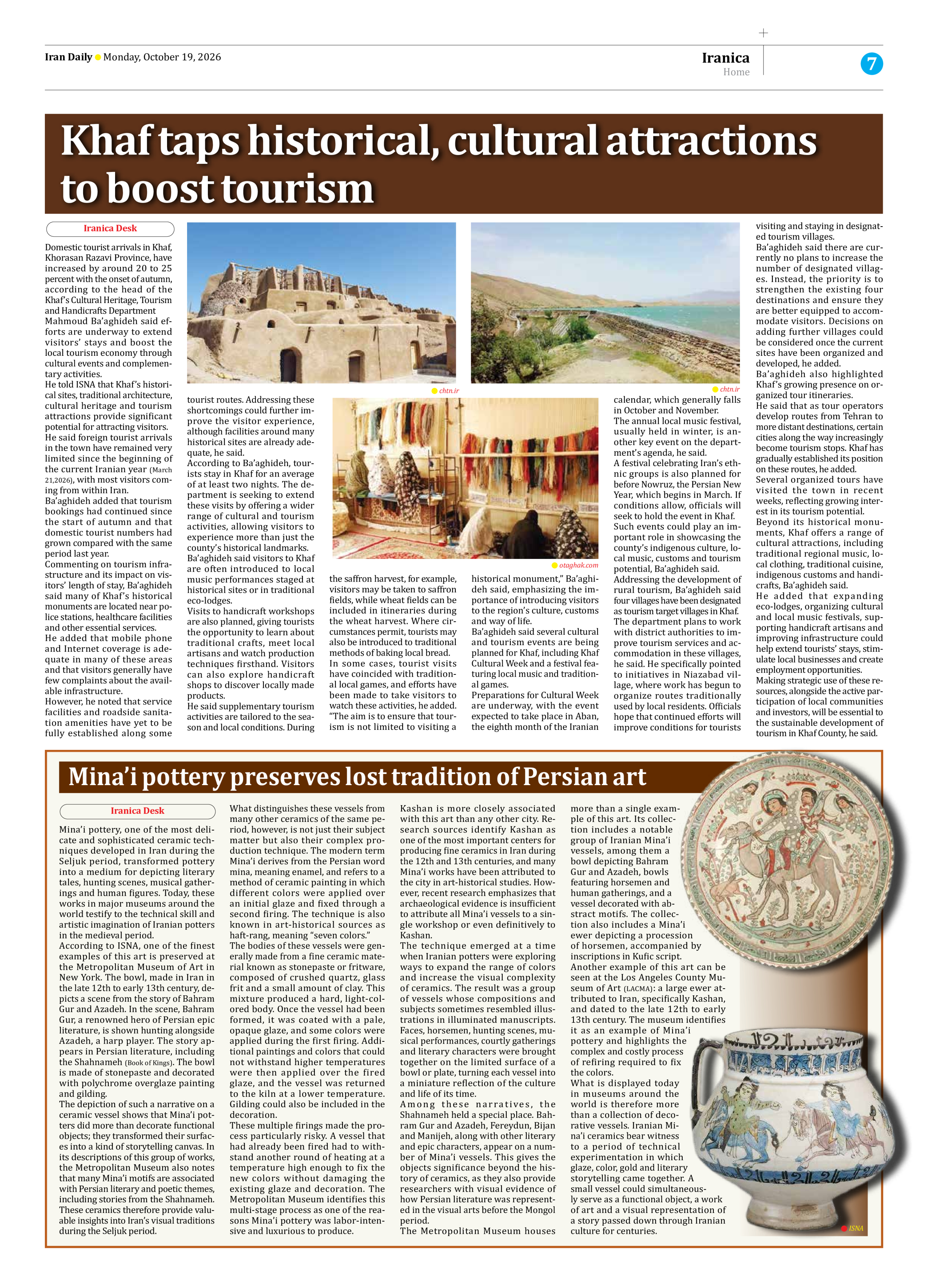
According to ISNA, one of the finest examples of this art is preserved at the Metropolitan Museum of Art in New York. The bowl, made in Iran in the late 12th to early 13th century, depicts a scene from the story of Bahram Gur and Azadeh. In the scene, Bahram Gur, a renowned hero of Persian epic literature, is shown hunting alongside Azadeh, a harp player. The story appears in Persian literature, including the Shahnameh (Book of Kings). The bowl is made of stonepaste and decorated with polychrome overglaze painting and gilding.
The depiction of such a narrative on a ceramic vessel shows that Mina’i potters did more than decorate functional objects; they transformed their surfaces into a kind of storytelling canvas. In its descriptions of this group of works, the Metropolitan Museum also notes that many Mina’i motifs are associated with Persian literary and poetic themes, including stories from the Shahnameh. These ceramics therefore provide valuable insights into Iran’s visual traditions during the Seljuk period.
What distinguishes these vessels from many other ceramics of the same period, however, is not just their subject matter but also their complex production technique. The modern term Mina’i derives from the Persian word mina, meaning enamel, and refers to a method of ceramic painting in which different colors were applied over an initial glaze and fixed through a second firing. The technique is also known in art-historical sources as haft-rang, meaning “seven colors.”
The bodies of these vessels were generally made from a fine ceramic material known as stonepaste or fritware, composed of crushed quartz, glass frit and a small amount of clay. This mixture produced a hard, light-colored body. Once the vessel had been formed, it was coated with a pale, opaque glaze, and some colors were applied during the first firing. Additional paintings and colors that could not withstand higher temperatures were then applied over the fired glaze, and the vessel was returned to the kiln at a lower temperature. Gilding could also be included in the decoration.
These multiple firings made the process particularly risky. A vessel that had already been fired had to withstand another round of heating at a temperature high enough to fix the new colors without damaging the existing glaze and decoration. The Metropolitan Museum identifies this multi-stage process as one of the reasons Mina’i pottery was labor-intensive and luxurious to produce.
Kashan is more closely associated with this art than any other city. Research sources identify Kashan as one of the most important centers for producing fine ceramics in Iran during the 12th and 13th centuries, and many Mina’i works have been attributed to the city in art-historical studies. However, recent research emphasizes that archaeological evidence is insufficient to attribute all Mina’i vessels to a single workshop or even definitively to Kashan.
The technique emerged at a time when Iranian potters were exploring ways to expand the range of colors and increase the visual complexity of ceramics. The result was a group of vessels whose compositions and subjects sometimes resembled illustrations in illuminated manuscripts. Faces, horsemen, hunting scenes, musical performances, courtly gatherings and literary characters were brought together on the limited surface of a bowl or plate, turning each vessel into a miniature reflection of the culture and life of its time.
Among these narratives, the Shahnameh held a special place. Bahram Gur and Azadeh, Fereydun, Bijan and Manijeh, along with other literary and epic characters, appear on a number of Mina’i vessels. This gives the objects significance beyond the history of ceramics, as they also provide researchers with visual evidence of how Persian literature was represented in the visual arts before the Mongol period.
The Metropolitan Museum houses more than a single example of this art. Its collection includes a notable group of Iranian Mina’i vessels, among them a bowl depicting Bahram Gur and Azadeh, bowls featuring horsemen and human gatherings, and a vessel decorated with abstract motifs. The collection also includes a Mina’i ewer depicting a procession of horsemen, accompanied by inscriptions in Kufic script.
Another example of this art can be seen at the Los Angeles County Museum of Art (LACMA): a large ewer attributed to Iran, specifically Kashan, and dated to the late 12th to early 13th century. The museum identifies it as an example of Mina’i pottery and highlights the complex and costly process of refiring required to fix the colors.
What is displayed today in museums around the world is therefore more than a collection of decorative vessels. Iranian Mina’i ceramics bear witness to a period of technical experimentation in which glaze, color, gold and literary storytelling came together. A small vessel could simultaneously serve as a functional object, a work of art and a visual representation of a story passed down through Iranian culture for centuries.