




Khaf taps historical, cultural attractions to boost tourism
Domestic tourist arrivals in Khaf, Khorasan Razavi Province, have increased by around 20 to 25 percent with the onset of autumn, according to the head of the Khaf’s Cultural Heritage, Tourism and Handicrafts Department
Mahmoud Ba’aghideh said efforts are underway to extend visitors’ stays and boost the local tourism economy through cultural events and complementary activities.
He told ISNA that Khaf’s historical sites, traditional architecture, cultural heritage and tourism attractions provide significant potential for attracting visitors.
He said foreign tourist arrivals in the town have remained very limited since the beginning of the current Iranian year (March 21,2026), with most visitors coming from within Iran.
Ba’aghideh added that tourism bookings had continued since the start of autumn and that domestic tourist numbers had grown compared with the same period last year.
Commenting on tourism infrastructure and its impact on visitors’ length of stay, Ba’aghideh said many of Khaf’s historical monuments are located near police stations, healthcare facilities and other essential services.
He added that mobile phone and Internet coverage is adequate in many of these areas and that visitors generally have few complaints about the available infrastructure.
However, he noted that service facilities and roadside sanitation amenities have yet to be fully established along some tourist routes. Addressing these shortcomings could further improve the visitor experience, although facilities around many historical sites are already adequate, he said.
According to Ba’aghideh, tourists stay in Khaf for an average of at least two nights. The department is seeking to extend these visits by offering a wider range of cultural and tourism activities, allowing visitors to experience more than just the county’s historical landmarks.
Ba’aghideh said visitors to Khaf are often introduced to local music performances staged at historical sites or in traditional eco-lodges.
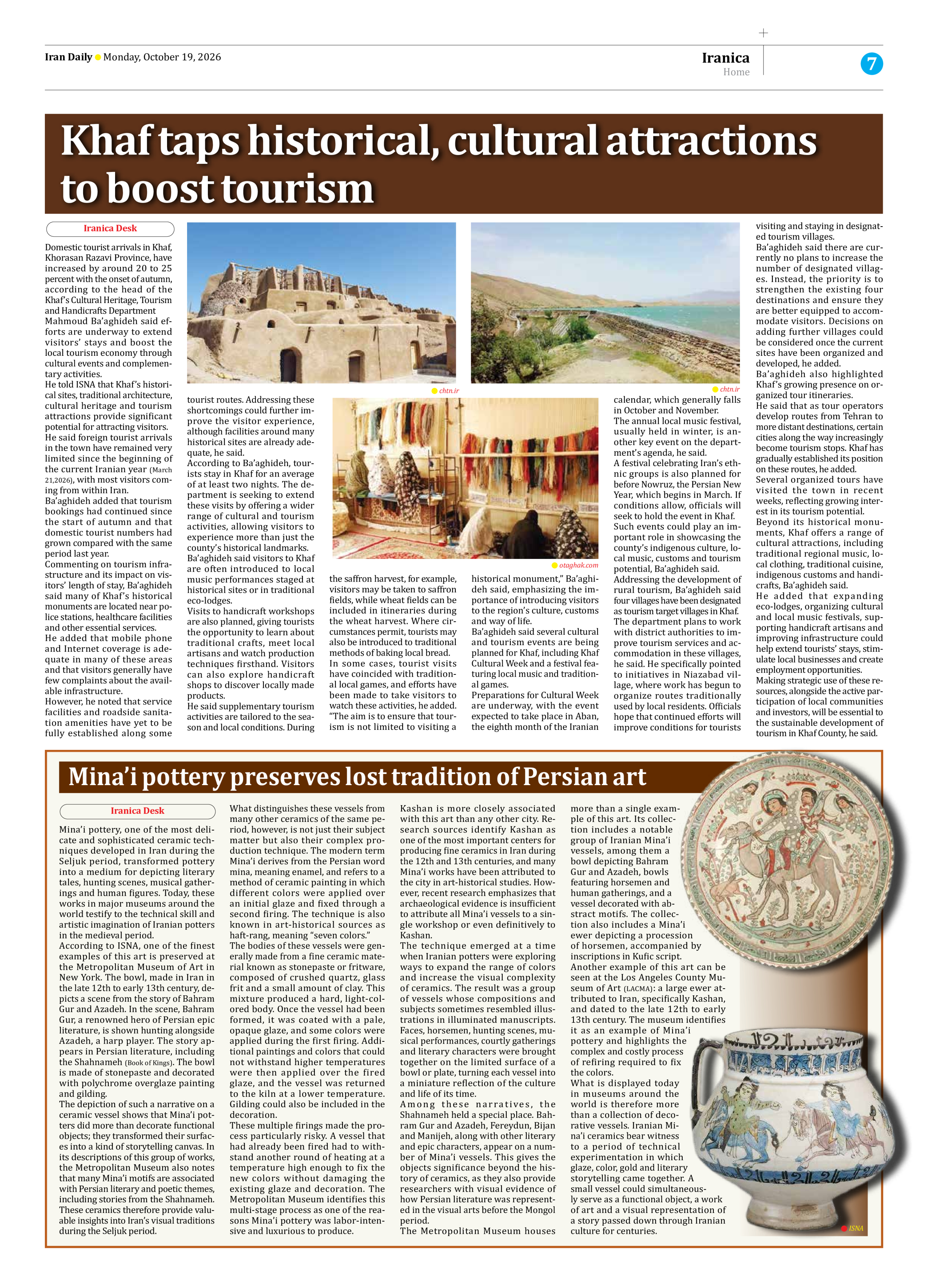
Visits to handicraft workshops are also planned, giving tourists the opportunity to learn about traditional crafts, meet local artisans and watch production techniques firsthand. Visitors can also explore handicraft shops to discover locally made products.
He said supplementary tourism activities are tailored to the season and local conditions. During the saffron harvest, for example, visitors may be taken to saffron fields, while wheat fields can be included in itineraries during the wheat harvest. Where circumstances permit, tourists may also be introduced to traditional methods of baking local bread.
In some cases, tourist visits have coincided with traditional local games, and efforts have been made to take visitors to watch these activities, he added.
“The aim is to ensure that tourism is not limited to visiting a historical monument,” Ba’aghideh said, emphasizing the importance of introducing visitors to the region’s culture, customs and way of life.
Ba’aghideh said several cultural and tourism events are being planned for Khaf, including Khaf Cultural Week and a festival featuring local music and traditional games.
Preparations for Cultural Week are underway, with the event expected to take place in Aban, the eighth month of the Iranian calendar, which generally falls in October and November.
The annual local music festival, usually held in winter, is another key event on the department’s agenda, he said.
A festival celebrating Iran’s ethnic groups is also planned for before Nowruz, the Persian New Year, which begins in March. If conditions allow, officials will seek to hold the event in Khaf.
Such events could play an important role in showcasing the county’s indigenous culture, local music, customs and tourism potential, Ba’aghideh said.
Addressing the development of rural tourism, Ba’aghideh said four villages have been designated as tourism target villages in Khaf.
The department plans to work with district authorities to improve tourism services and accommodation in these villages, he said. He specifically pointed to initiatives in Niazabad village, where work has begun to organize routes traditionally used by local residents. Officials hope that continued efforts will improve conditions for tourists visiting and staying in designated tourism villages.
Ba’aghideh said there are currently no plans to increase the number of designated villages. Instead, the priority is to strengthen the existing four destinations and ensure they are better equipped to accommodate visitors. Decisions on adding further villages could be considered once the current sites have been organized and developed, he added.
Ba’aghideh also highlighted Khaf’s growing presence on organized tour itineraries.
He said that as tour operators develop routes from Tehran to more distant destinations, certain cities along the way increasingly become tourism stops. Khaf has gradually established its position on these routes, he added.
Several organized tours have visited the town in recent weeks, reflecting growing interest in its tourism potential.
Beyond its historical monuments, Khaf offers a range of cultural attractions, including traditional regional music, local clothing, traditional cuisine, indigenous customs and handicrafts, Ba’aghideh said.
He added that expanding eco-lodges, organizing cultural and local music festivals, supporting handicraft artisans and improving infrastructure could help extend tourists’ stays, stimulate local businesses and create employment opportunities.
Making strategic use of these resources, alongside the active participation of local communities and investors, will be essential to the sustainable development of tourism in Khaf County, he said.