




Iran says its seven-day plan to reopen Strait of Hormuz still on table
Araghchi: Lebanon’s internal affairs a matter for Lebanese themselves
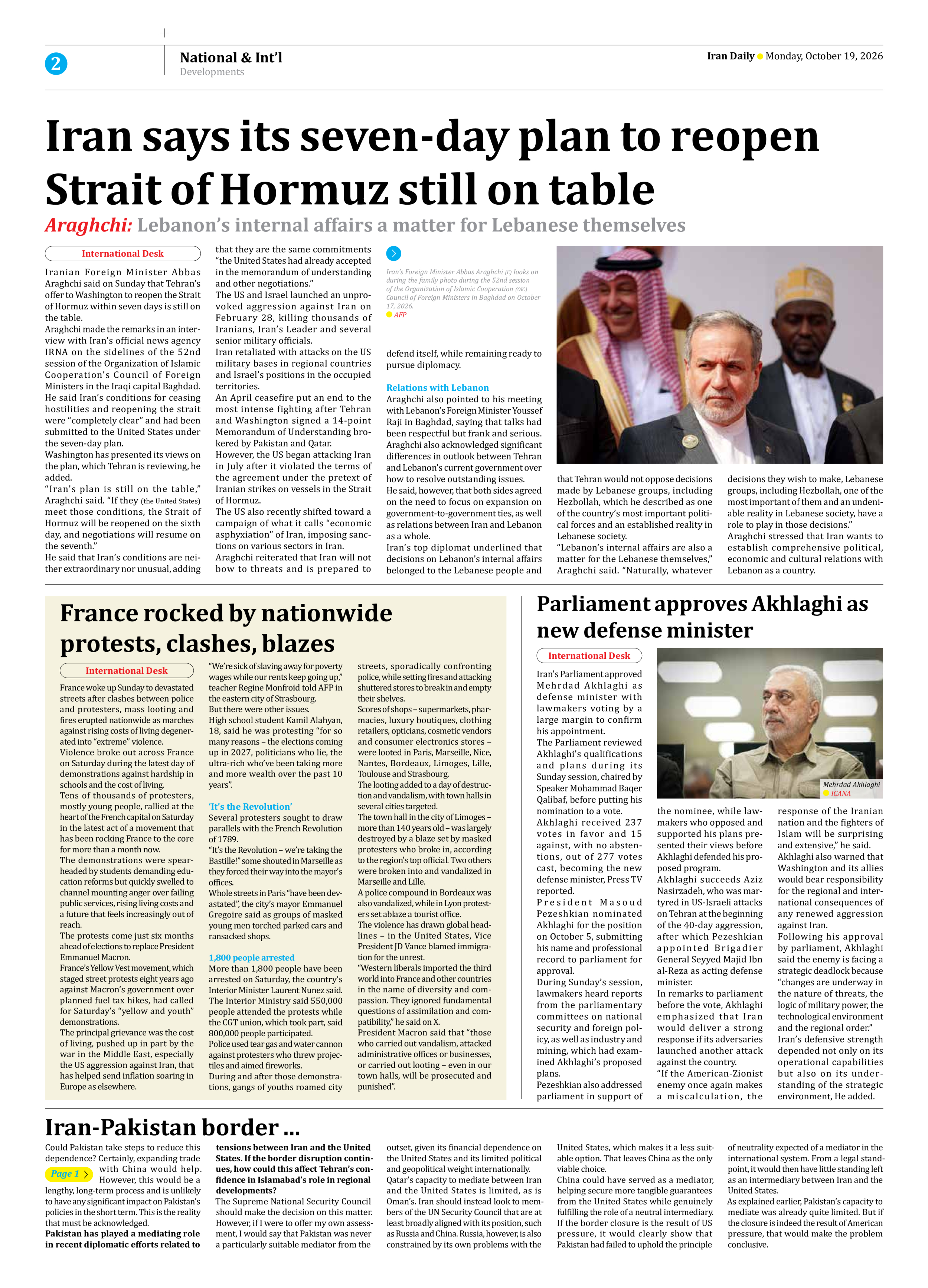
Iranian Foreign Minister Abbas Araghchi said on Sunday that Tehran’s offer to Washington to reopen the Strait of Hormuz within seven days is still on the table.
Araghchi made the remarks in an interview with Iran’s official news agency IRNA on the sidelines of the 52nd session of the Organization of Islamic Cooperation’s Council of Foreign Ministers in the Iraqi capital Baghdad.
He said Iran’s conditions for ceasing hostilities and reopening the strait were “completely clear” and had been submitted to the United States under the seven-day plan.
Washington has presented its views on the plan, which Tehran is reviewing, he added.
“Iran’s plan is still on the table,” Araghchi said. “If they (the United States) meet those conditions, the Strait of Hormuz will be reopened on the sixth day, and negotiations will resume on the seventh.”
He said that Iran’s conditions are neither extraordinary nor unusual, adding that they are the same commitments “the United States had already accepted in the memorandum of understanding and other negotiations.”
The US and Israel launched an unprovoked aggression against Iran on February 28, killing thousands of Iranians, Iran’s Leader and several senior military officials.
Iran retaliated with attacks on the US military bases in regional countries and Israel’s positions in the occupied territories.
An April ceasefire put an end to the most intense fighting after Tehran and Washington signed a 14-point Memorandum of Understanding brokered by Pakistan and Qatar.
However, the US began attacking Iran in July after it violated the terms of the agreement under the pretext of Iranian strikes on vessels in the Strait of Hormuz.
The US also recently shifted toward a campaign of what it calls “economic asphyxiation” of Iran, imposing sanctions on various sectors in Iran.
Araghchi reiterated that Iran will not bow to threats and is prepared to defend itself, while remaining ready to pursue diplomacy.
Relations with Lebanon
Araghchi also pointed to his meeting with Lebanon’s Foreign Minister Youssef Raji in Baghdad, saying that talks had been respectful but frank and serious. Araghchi also acknowledged significant differences in outlook between Tehran and Lebanon’s current government over how to resolve outstanding issues.
He said, however, that both sides agreed on the need to focus on expansion on government-to-government ties, as well as relations between Iran and Lebanon as a whole.
Iran’s top diplomat underlined that decisions on Lebanon’s internal affairs belonged to the Lebanese people and that Tehran would not oppose decisions made by Lebanese groups, including Hezbollah, which he described as one of the country’s most important political forces and an established reality in Lebanese society.
“Lebanon’s internal affairs are also a matter for the Lebanese themselves,” Araghchi said. “Naturally, whatever decisions they wish to make, Lebanese groups, including Hezbollah, one of the most important of them and an undeniable reality in Lebanese society, have a role to play in those decisions.”
Araghchi stressed that Iran wants to establish comprehensive political, economic and cultural relations with Lebanon as a country.