







Khoy highlights Shams Tabrizi’s role in transforming Rumi
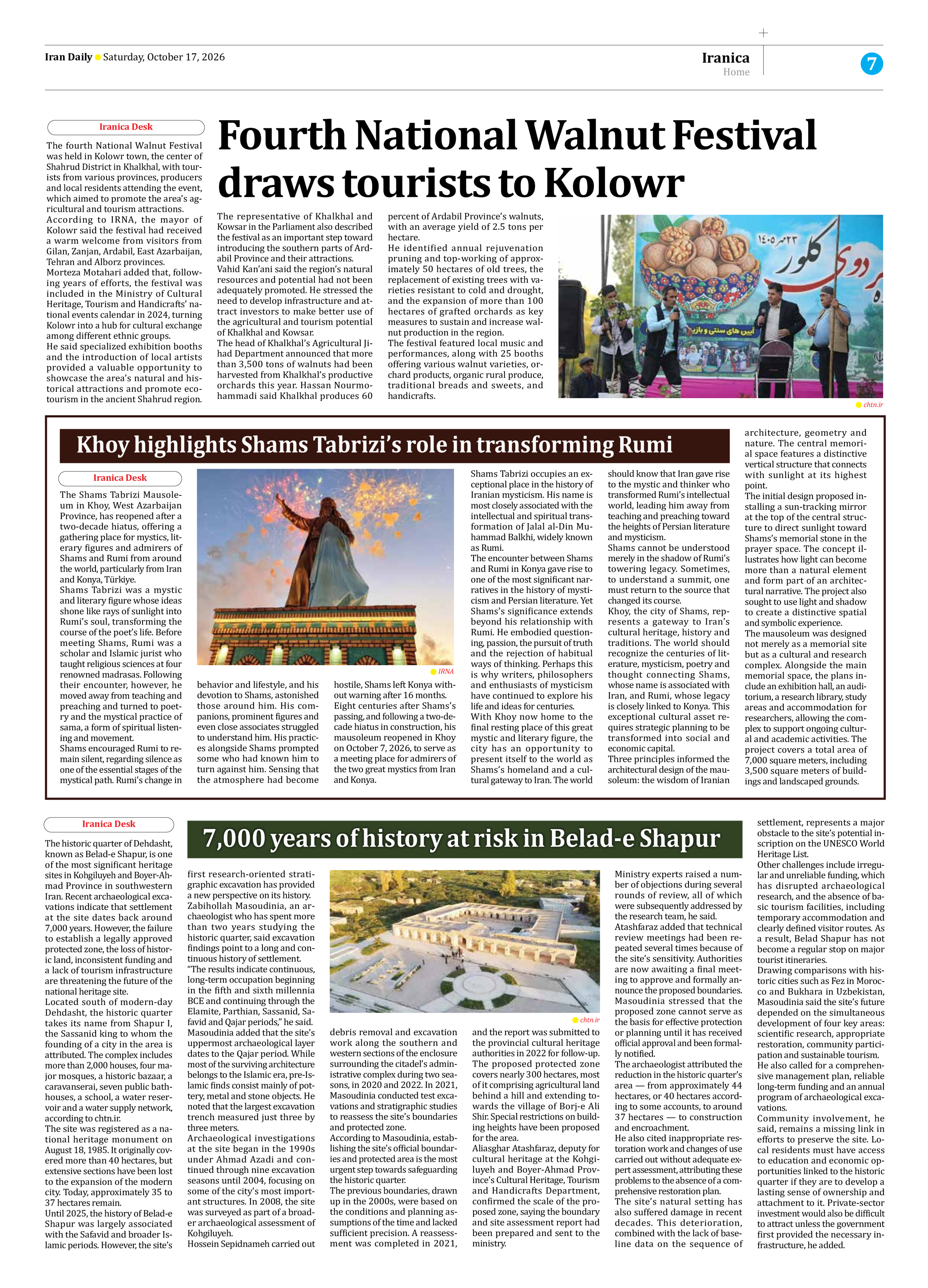
The Shams Tabrizi Mausoleum in Khoy, West Azarbaijan Province, has reopened after a two-decade hiatus, offering a gathering place for mystics, literary figures and admirers of Shams and Rumi from around the world, particularly from Iran and Konya, Türkiye.
Shams Tabrizi was a mystic and literary figure whose ideas shone like rays of sunlight into Rumi’s soul, transforming the course of the poet’s life. Before meeting Shams, Rumi was a scholar and Islamic jurist who taught religious sciences at four renowned madrasas. Following their encounter, however, he moved away from teaching and preaching and turned to poetry and the mystical practice of sama, a form of spiritual listening and movement.
Shams encouraged Rumi to remain silent, regarding silence as one of the essential stages of the mystical path. Rumi’s change in behavior and lifestyle, and his devotion to Shams, astonished those around him. His companions, prominent figures and even close associates struggled to understand him. His practices alongside Shams prompted some who had known him to turn against him. Sensing that the atmosphere had become hostile, Shams left Konya without warning after 16 months.
Eight centuries after Shams’s passing, and following a two-decade hiatus in construction, his mausoleum reopened in Khoy on October 7, 2026, to serve as a meeting place for admirers of the two great mystics from Iran and Konya.
Shams Tabrizi occupies an exceptional place in the history of Iranian mysticism. His name is most closely associated with the intellectual and spiritual transformation of Jalal al-Din Muhammad Balkhi, widely known as Rumi.
The encounter between Shams and Rumi in Konya gave rise to one of the most significant narratives in the history of mysticism and Persian literature. Yet Shams’s significance extends beyond his relationship with Rumi. He embodied questioning, passion, the pursuit of truth and the rejection of habitual ways of thinking. Perhaps this is why writers, philosophers and enthusiasts of mysticism have continued to explore his life and ideas for centuries.
With Khoy now home to the final resting place of this great mystic and literary figure, the city has an opportunity to present itself to the world as Shams’s homeland and a cultural gateway to Iran. The world should know that Iran gave rise to the mystic and thinker who transformed Rumi’s intellectual world, leading him away from teaching and preaching toward the heights of Persian literature and mysticism.
Shams cannot be understood merely in the shadow of Rumi’s towering legacy. Sometimes, to understand a summit, one must return to the source that changed its course.
Khoy, the city of Shams, represents a gateway to Iran’s cultural heritage, history and traditions. The world should recognize the centuries of literature, mysticism, poetry and thought connecting Shams, whose name is associated with Iran, and Rumi, whose legacy is closely linked to Konya. This exceptional cultural asset requires strategic planning to be transformed into social and economic capital.
Three principles informed the architectural design of the mausoleum: the wisdom of Iranian architecture, geometry and nature. The central memorial space features a distinctive vertical structure that connects with sunlight at its highest point.
The initial design proposed installing a sun-tracking mirror at the top of the central structure to direct sunlight toward Shams’s memorial stone in the prayer space. The concept illustrates how light can become more than a natural element and form part of an architectural narrative. The project also sought to use light and shadow to create a distinctive spatial and symbolic experience.
The mausoleum was designed not merely as a memorial site but as a cultural and research complex. Alongside the main memorial space, the plans include an exhibition hall, an auditorium, a research library, study areas and accommodation for researchers, allowing the complex to support ongoing cultural and academic activities. The project covers a total area of 7,000 square meters, including 3,500 square meters of buildings and landscaped grounds.