





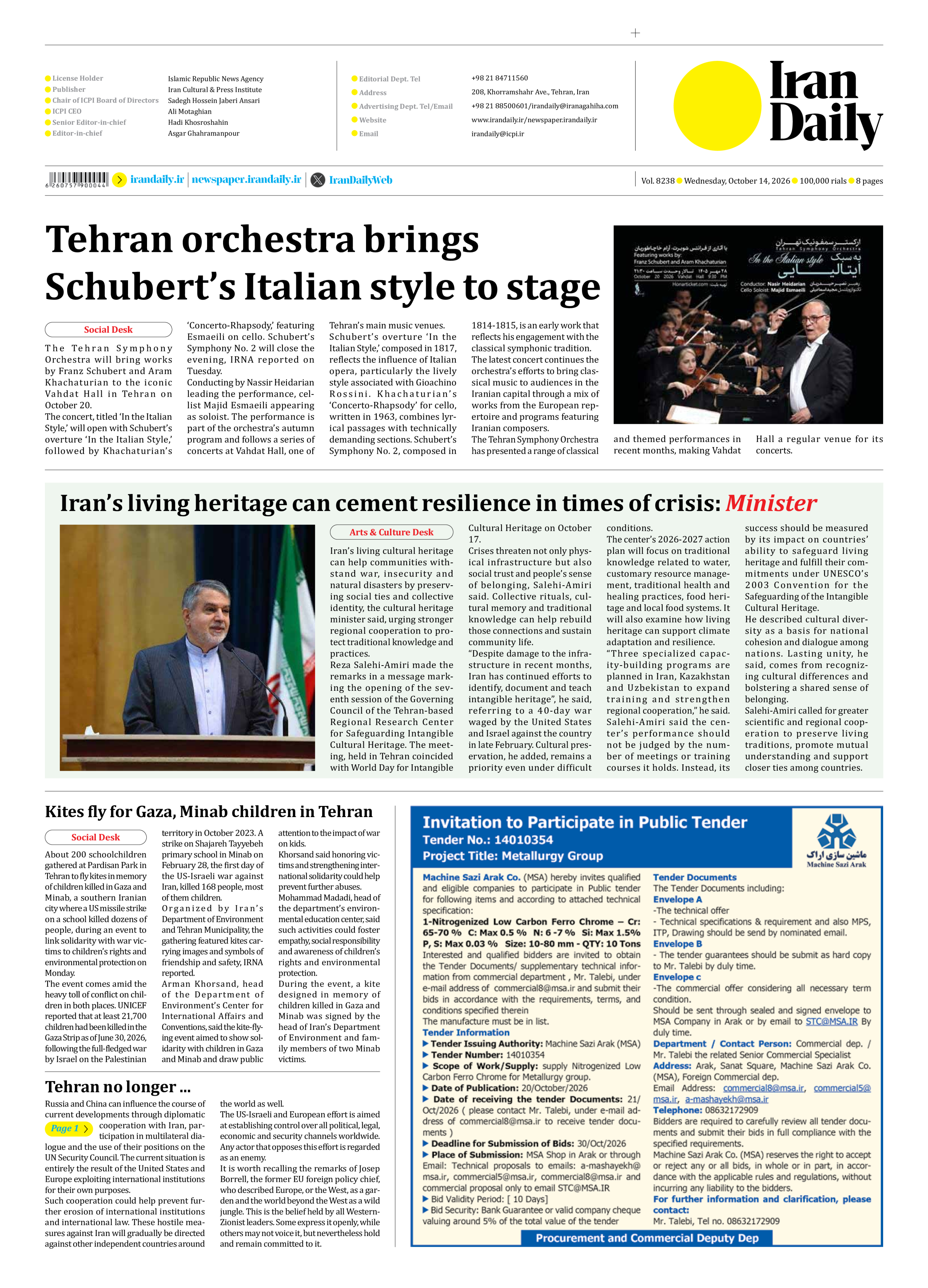


Iran’s living heritage can cement resilience in times of crisis: Minister
Iran’s living cultural heritage can help communities withstand war, insecurity and natural disasters by preserving social ties and collective identity, the cultural heritage minister said, urging stronger regional cooperation to protect traditional knowledge and practices.
Reza Salehi-Amiri made the remarks in a message marking the opening of the seventh session of the Governing Council of the Tehran-based Regional Research Center for Safeguarding Intangible Cultural Heritage. The meeting, held in Tehran coincided with World Day for Intangible Cultural Heritage on October 17.
Crises threaten not only physical infrastructure but also social trust and people’s sense of belonging, Salehi-Amiri said. Collective rituals, cultural memory and traditional knowledge can help rebuild those connections and sustain community life.
“Despite damage to the infrastructure in recent months, Iran has continued efforts to identify, document and teach intangible heritage”, he said, referring to a 40-day war waged by the United States and Israel against the country in late February. Cultural preservation, he added, remains a priority even under difficult conditions.
The center’s 2026-2027 action plan will focus on traditional knowledge related to water, customary resource management, traditional health and healing practices, food heritage and local food systems. It will also examine how living heritage can support climate adaptation and resilience.
“Three specialized capacity-building programs are planned in Iran, Kazakhstan and Uzbekistan to expand training and strengthen regional cooperation,” he said.
Salehi-Amiri said the center’s performance should not be judged by the number of meetings or training courses it holds. Instead, its success should be measured by its impact on countries’ ability to safeguard living heritage and fulfill their commitments under UNESCO’s 2003 Convention for the Safeguarding of the Intangible Cultural Heritage.
He described cultural diversity as a basis for national cohesion and dialogue among nations. Lasting unity, he said, comes from recognizing cultural differences and bolstering a shared sense of belonging.
Salehi-Amiri called for greater scientific and regional cooperation to preserve living traditions, promote mutual understanding and support closer ties among countries.