







Forgotten village discovered in Dasht-e Barm Forest
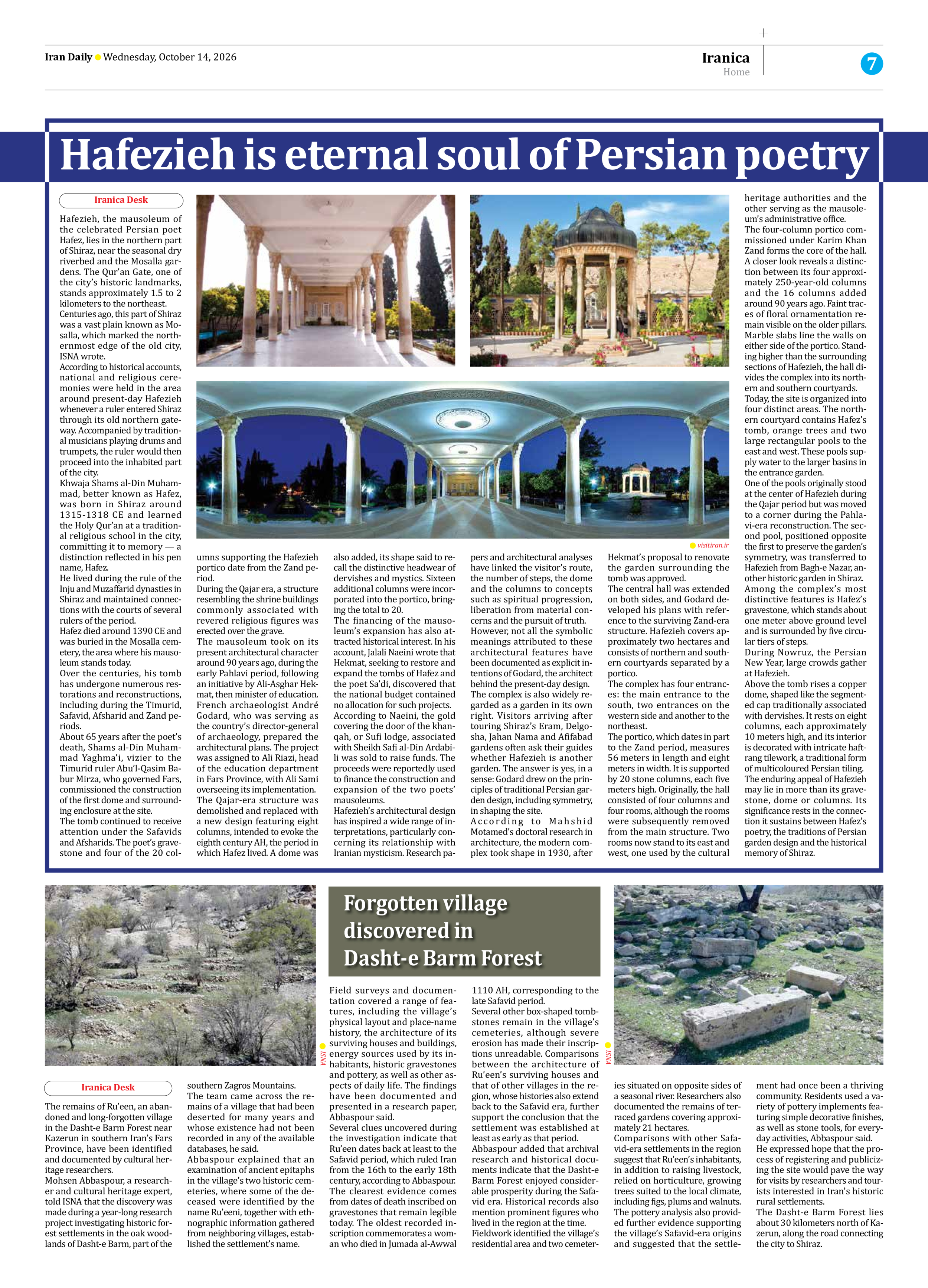
The remains of Ru’een, an abandoned and long-forgotten village in the Dasht-e Barm Forest near Kazerun in southern Iran’s Fars Province, have been identified and documented by cultural heritage researchers.
Mohsen Abbaspour, a researcher and cultural heritage expert, told ISNA that the discovery was made during a year-long research project investigating historic forest settlements in the oak woodlands of Dasht-e Barm, part of the southern Zagros Mountains.
The team came across the remains of a village that had been deserted for many years and whose existence had not been recorded in any of the available databases, he said.
Abbaspour explained that an examination of ancient epitaphs in the village’s two historic cemeteries, where some of the deceased were identified by the name Ru’eeni, together with ethnographic information gathered from neighboring villages, established the settlement’s name.
Field surveys and documentation covered a range of features, including the village’s physical layout and place-name history, the architecture of its surviving houses and buildings, energy sources used by its inhabitants, historic gravestones and pottery, as well as other aspects of daily life. The findings have been documented and presented in a research paper, Abbaspour said.
Several clues uncovered during the investigation indicate that Ru’een dates back at least to the Safavid period, which ruled Iran from the 16th to the early 18th century, according to Abbaspour.
The clearest evidence comes from dates of death inscribed on gravestones that remain legible today. The oldest recorded inscription commemorates a woman who died in Jumada al-Awwal 1110 AH, corresponding to the late Safavid period.
Several other box-shaped tombstones remain in the village’s cemeteries, although severe erosion has made their inscriptions unreadable. Comparisons between the architecture of Ru’een’s surviving houses and that of other villages in the region, whose histories also extend back to the Safavid era, further support the conclusion that the settlement was established at least as early as that period.
Abbaspour added that archival research and historical documents indicate that the Dasht-e Barm Forest enjoyed considerable prosperity during the Safavid era. Historical records also mention prominent figures who lived in the region at the time.
Fieldwork identified the village’s residential area and two cemeteries situated on opposite sides of a seasonal river. Researchers also documented the remains of terraced gardens covering approximately 21 hectares.
Comparisons with other Safavid-era settlements in the region suggest that Ru’een’s inhabitants, in addition to raising livestock, relied on horticulture, growing trees suited to the local climate, including figs, plums and walnuts.
The pottery analysis also provided further evidence supporting the village’s Safavid-era origins and suggested that the settlement had once been a thriving community. Residents used a variety of pottery implements featuring simple decorative finishes, as well as stone tools, for everyday activities, Abbaspour said.
He expressed hope that the process of registering and publicizing the site would pave the way for visits by researchers and tourists interested in Iran’s historic rural settlements.
The Dasht-e Barm Forest lies about 30 kilometers north of Kazerun, along the road connecting the city to Shiraz.