







Exploring changing city through Tehran in Travelogues
Tehran is a city that has breathed between grandeur and turmoil throughout its history. Its streets tell stories of an ancient civilization and deeply rooted traditions, while its bazaars reflect the dynamism of its people. Yet the history of Iran’s capital cannot be understood solely through official records, political events and the lives of kings. Much of the city’s past lies hidden in its alleyways, markets, homes and the details of everyday life — details that were sometimes recorded by travelers and foreign observers.
Tehran in Travelogues, by Mehrshad Kazemi, a researcher and cultural tourism professional, is a book that seeks to uncover lesser-known layers of the capital’s history. Drawing on approximately 200 travel accounts written by Iranian and foreign travelers, diplomats and religious missionaries, the book traces Tehran’s physical, social and cultural transformations from earlier periods through the first Pahlavi era. Published by Saless Publication, the book received a positive response upon the release of its first edition and has since reached a second edition, according to IBNA.
One of the most important features of travelogues is their ability to offer an outside perspective on a city. According to Kazemi, Tehran cannot be fully understood through official and domestic sources alone. Travelers arriving with different cultural, social and political backgrounds sometimes noticed details that local residents of the time considered so commonplace that they saw little reason to record them. Descriptions of streets, bazaars, houses, clothing, modes of transportation, social customs, public health, education and religious ceremonies can all provide a more tangible picture of life in Tehran in earlier times.
From this perspective, travelogues do not replace domestic sources; they complement them. While official records tend to focus on government, politics and major events, travel accounts also make it possible to explore social history and everyday life. A brief description of a market or neighborhood may reveal aspects of social relationships and people’s lifestyles that are rarely documented in official records.
Nevertheless, these historical sources must be approached with caution. Travel writers were not necessarily impartial observers. Each arrived in Iran with a particular cultural, political and religious background, and some were engaged in diplomatic, military, commercial or religious missions. It is therefore important to distinguish between what they actually observed, how they interpreted their observations and the judgments they formed through the lens of their own cultural assumptions.
The length of a traveler’s stay in Iran, their familiarity with Persian and the nature of their interactions with Iranian society also influenced their accounts. However, not every error or misunderstanding should be attributed to deliberate bias; cultural differences and limited information may also have shaped some narratives. Comparing travelogues with one another and examining them alongside documents, maps, memoirs, newspapers, photographs and architectural evidence is therefore essential to developing a more reliable picture of Tehran’s past.
Travelogues are, in effect, a two-way mirror: they provide information about Tehran while also revealing how foreign observers perceived Iranian society. A description of a neighborhood, bazaar, historic building or religious ceremony not only illuminates the subject itself but also reflects the writer’s values and assumptions. In this sense, travelogues are not merely sources for the history of Tehran; they are also part of the history of how the city came to be perceived around the world.
Although many travelers focused on the royal court, prominent figures, embassies and affluent social groups, their accounts also contain valuable information about ordinary people. Shopkeepers and artisans, markets, neighborhoods, public bathhouses, food, clothing, transportation and everyday social interactions all form part of Tehran’s social landscape that can be reconstructed through these writings. Descriptions of women and family life are equally significant. However, many foreign travelers had limited access to the private quarters of Iranian households, known as the Andaruni. Their accounts, therefore, cannot be regarded as complete or definitive representations of women’s lives during that period.
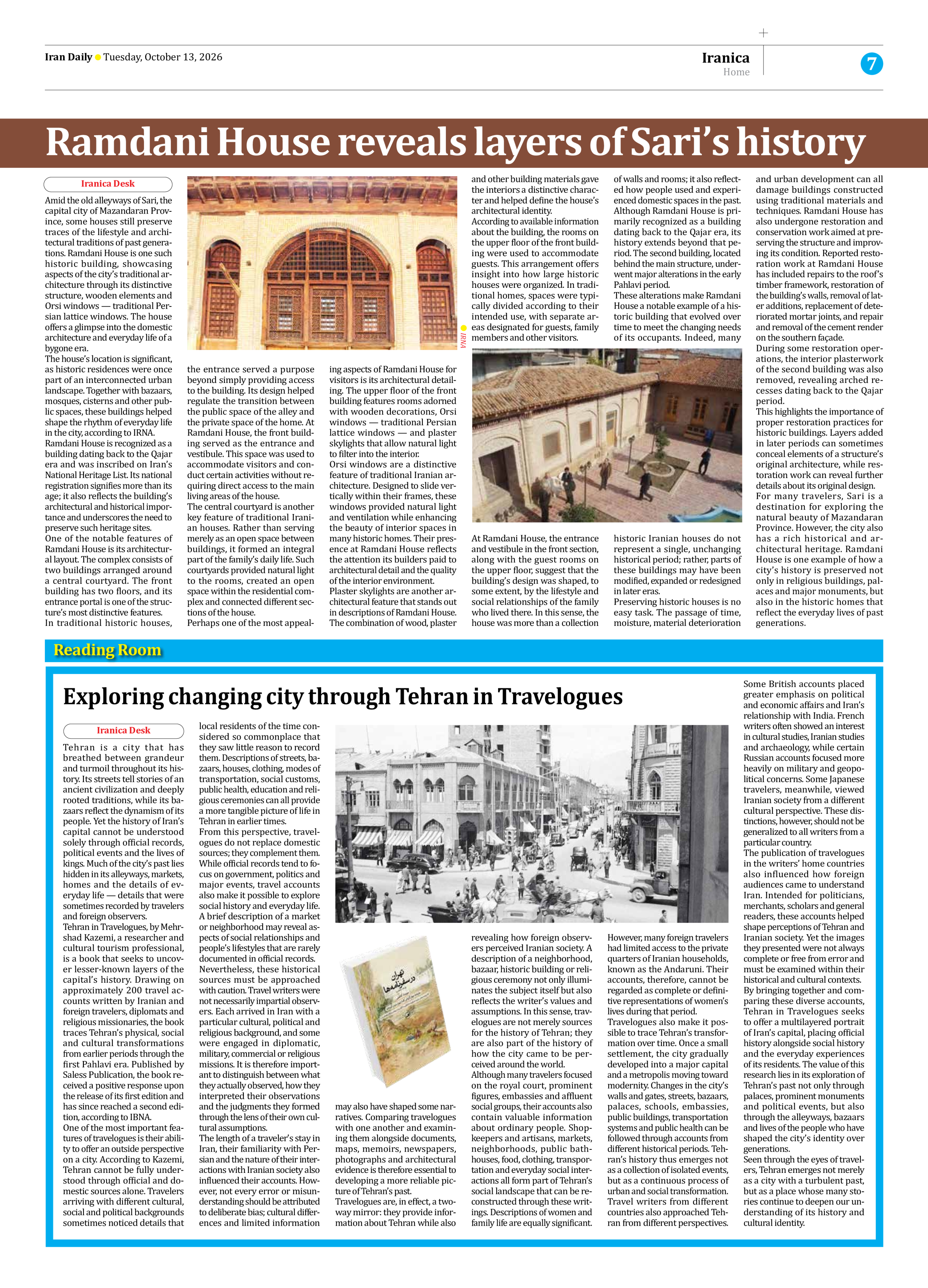
Travelogues also make it possible to trace Tehran’s transformation over time. Once a small settlement, the city gradually developed into a major capital and a metropolis moving toward modernity. Changes in the city’s walls and gates, streets, bazaars, palaces, schools, embassies, public buildings, transportation systems and public health can be followed through accounts from different historical periods. Tehran’s history thus emerges not as a collection of isolated events, but as a continuous process of urban and social transformation.
Travel writers from different countries also approached Tehran from different perspectives. Some British accounts placed greater emphasis on political and economic affairs and Iran’s relationship with India. French writers often showed an interest in cultural studies, Iranian studies and archaeology, while certain Russian accounts focused more heavily on military and geopolitical concerns. Some Japanese travelers, meanwhile, viewed Iranian society from a different cultural perspective. These distinctions, however, should not be generalized to all writers from a particular country.
The publication of travelogues in the writers’ home countries also influenced how foreign audiences came to understand Iran. Intended for politicians, merchants, scholars and general readers, these accounts helped shape perceptions of Tehran and Iranian society. Yet the images they presented were not always complete or free from error and must be examined within their historical and cultural contexts.
By bringing together and comparing these diverse accounts, Tehran in Travelogues seeks to offer a multilayered portrait of Iran’s capital, placing official history alongside social history and the everyday experiences of its residents. The value of this research lies in its exploration of Tehran’s past not only through palaces, prominent monuments and political events, but also through the alleyways, bazaars and lives of the people who have shaped the city’s identity over generations.
Seen through the eyes of travelers, Tehran emerges not merely as a city with a turbulent past, but as a place whose many stories continue to deepen our understanding of its history and cultural identity.