







Iran to press ahead with 20,000-MW nuclear power plan despite attacks
Iran will continue work on its plan to generate 20,000 megawatts of nuclear power, the head of the Atomic Energy Organization of Iran (AEOI) said on Sunday, describing attacks on sensitive nuclear and industrial facilities as war crimes.
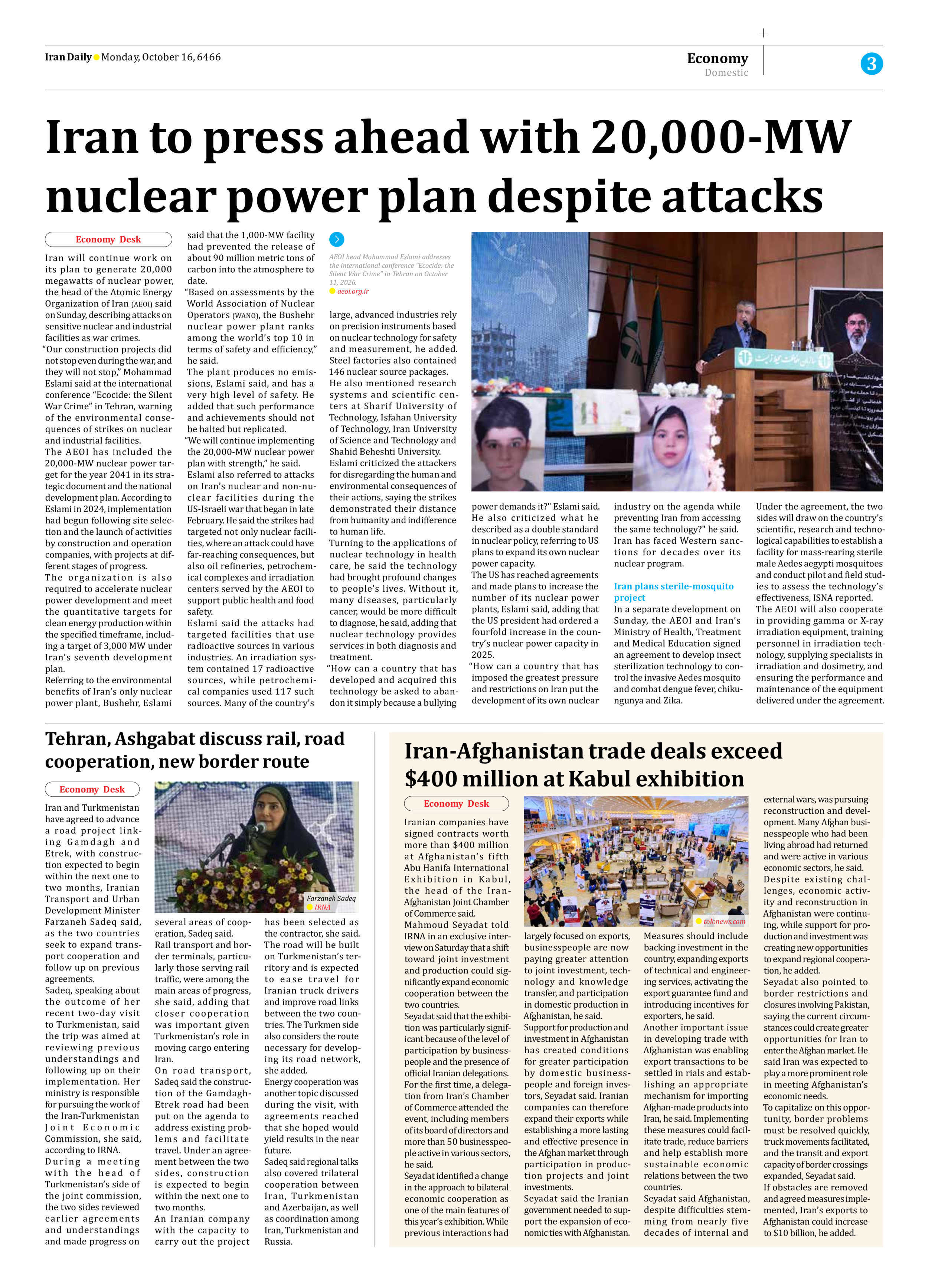
“Our construction projects did not stop even during the war, and they will not stop,” Mohammad Eslami said at the international conference “Ecocide: the Silent War Crime” in Tehran, warning of the environmental consequences of strikes on nuclear and industrial facilities.
The AEOI has included the 20,000-MW nuclear power target for the year 2041 in its strategic document and the national development plan. According to Eslami in 2024, implementation had begun following site selection and the launch of activities by construction and operation companies, with projects at different stages of progress.
The organization is also required to accelerate nuclear power development and meet the quantitative targets for clean energy production within the specified timeframe, including a target of 3,000 MW under Iran’s seventh development plan.
Referring to the environmental benefits of Iran’s only nuclear power plant, Bushehr, Eslami said that the 1,000-MW facility had prevented the release of about 90 million metric tons of carbon into the atmosphere to date.
“Based on assessments by the World Association of Nuclear Operators (WANO), the Bushehr nuclear power plant ranks among the world’s top 10 in terms of safety and efficiency,” he said.
The plant produces no emissions, Eslami said, and has a very high level of safety. He added that such performance and achievements should not be halted but replicated.
“We will continue implementing the 20,000-MW nuclear power plan with strength,” he said.
Eslami also referred to attacks on Iran’s nuclear and non-nuclear facilities during the US-Israeli war that began in late February. He said the strikes had targeted not only nuclear facilities, where an attack could have far-reaching consequences, but also oil refineries, petrochemical complexes and irradiation centers served by the AEOI to support public health and food safety.
Eslami said the attacks had targeted facilities that use radioactive sources in various industries. An irradiation system contained 17 radioactive sources, while petrochemical companies used 117 such sources. Many of the country’s large, advanced industries rely on precision instruments based on nuclear technology for safety and measurement, he added. Steel factories also contained 146 nuclear source packages.
He also mentioned research systems and scientific centers at Sharif University of Technology, Isfahan University of Technology, Iran University of Science and Technology and Shahid Beheshti University.
Eslami criticized the attackers for disregarding the human and environmental consequences of their actions, saying the strikes demonstrated their distance from humanity and indifference to human life.
Turning to the applications of nuclear technology in health care, he said the technology had brought profound changes to people’s lives. Without it, many diseases, particularly cancer, would be more difficult to diagnose, he said, adding that nuclear technology provides services in both diagnosis and treatment.
“How can a country that has developed and acquired this technology be asked to abandon it simply because a bullying power demands it?" Eslami said.
He also criticized what he described as a double standard in nuclear policy, referring to US plans to expand its own nuclear power capacity.
The US has reached agreements and made plans to increase the number of its nuclear power plants, Eslami said, adding that the US president had ordered a fourfold increase in the country’s nuclear power capacity in 2025.
“How can a country that has imposed the greatest pressure and restrictions on Iran put the development of its own nuclear industry on the agenda while preventing Iran from accessing the same technology?" he said.
Iran has faced Western sanctions for decades over its nuclear program.
Iran plans sterile-mosquito project
In a separate development on Sunday, the AEOI and Iran’s Ministry of Health, Treatment and Medical Education signed an agreement to develop insect sterilization technology to control the invasive Aedes mosquito and combat dengue fever, chikungunya and Zika.
Under the agreement, the two sides will draw on the country’s scientific, research and technological capabilities to establish a facility for mass-rearing sterile male Aedes aegypti mosquitoes and conduct pilot and field studies to assess the technology’s effectiveness, ISNA reported.
The AEOI will also cooperate in providing gamma or X-ray irradiation equipment, training personnel in irradiation technology, supplying specialists in irradiation and dosimetry, and ensuring the performance and maintenance of the equipment delivered under the agreement.