







‘Her Eyes’: A narrative of technical, emotional maturity in santur playing
By Alireza Sepahvand
Freelance journalist
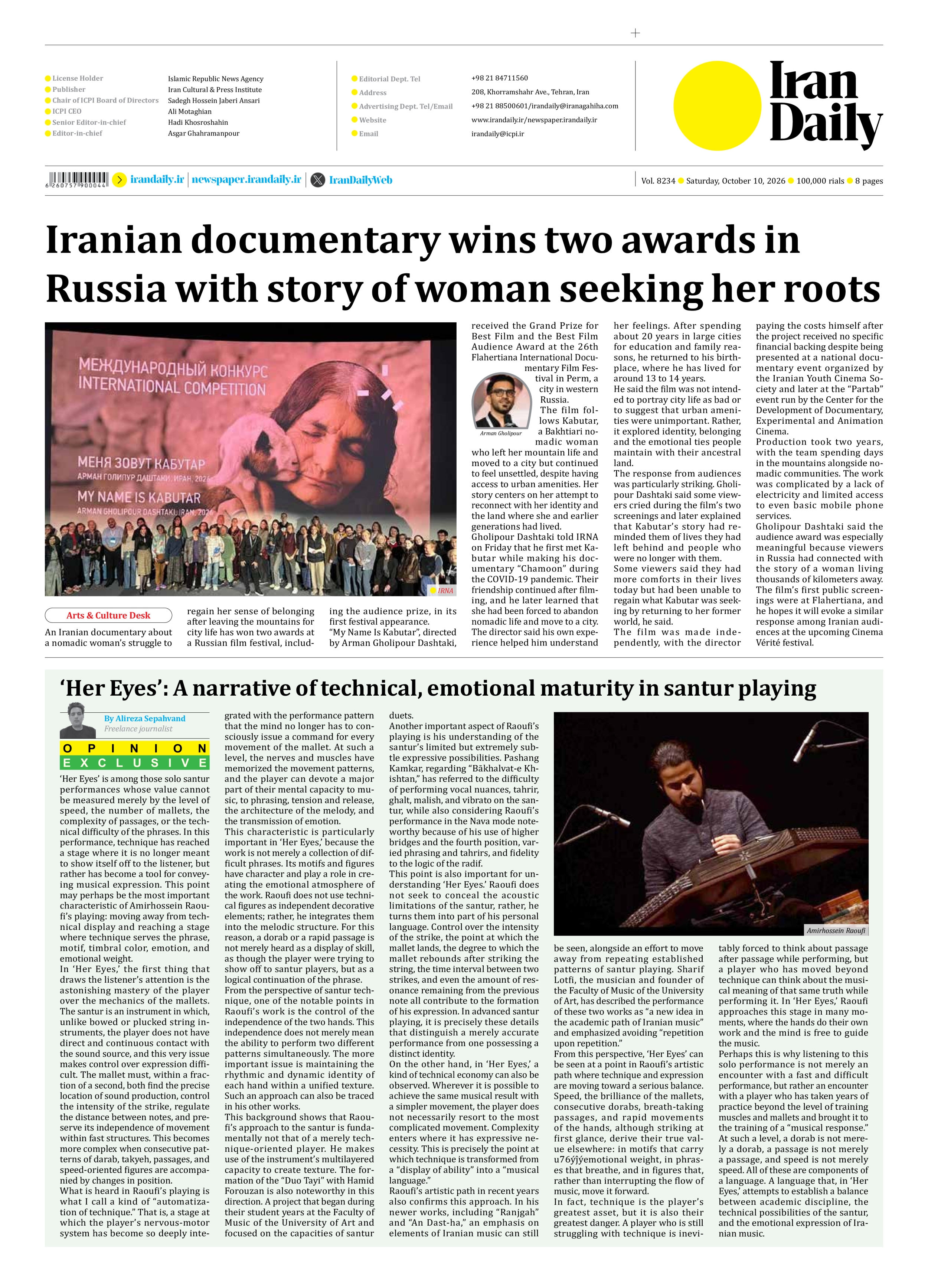
‘Her Eyes’ is among those solo santur performances whose value cannot be measured merely by the level of speed, the number of mallets, the complexity of passages, or the technical difficulty of the phrases. In this performance, technique has reached a stage where it is no longer meant to show itself off to the listener, but rather has become a tool for conveying musical expression. This point may perhaps be the most important characteristic of Amirhossein Raoufi’s playing: moving away from technical display and reaching a stage where technique serves the phrase, motif, timbral color, emotion, and emotional weight.
In ‘Her Eyes,’ the first thing that draws the listener’s attention is the astonishing mastery of the player over the mechanics of the mallets. The santur is an instrument in which, unlike bowed or plucked string instruments, the player does not have direct and continuous contact with the sound source, and this very issue makes control over expression difficult. The mallet must, within a fraction of a second, both find the precise location of sound production, control the intensity of the strike, regulate the distance between notes, and preserve its independence of movement within fast structures. This becomes more complex when consecutive patterns of darab, takyeh, passages, and speed-oriented figures are accompanied by changes in position.
What is heard in Raoufi’s playing is what I call a kind of “automatization of technique.” That is, a stage at which the player’s nervous-motor system has become so deeply integrated with the performance pattern that the mind no longer has to consciously issue a command for every movement of the mallet. At such a level, the nerves and muscles have memorized the movement patterns, and the player can devote a major part of their mental capacity to music, to phrasing, tension and release, the architecture of the melody, and the transmission of emotion.
This characteristic is particularly important in ‘Her Eyes,’ because the work is not merely a collection of difficult phrases. Its motifs and figures have character and play a role in creating the emotional atmosphere of the work. Raoufi does not use technical figures as independent decorative elements; rather, he integrates them into the melodic structure. For this reason, a dorab or a rapid passage is not merely heard as a display of skill, as though the player were trying to show off to santur players, but as a logical continuation of the phrase.
From the perspective of santur technique, one of the notable points in Raoufi’s work is the control of the independence of the two hands. This independence does not merely mean the ability to perform two different patterns simultaneously. The more important issue is maintaining the rhythmic and dynamic identity of each hand within a unified texture. Such an approach can also be traced in his other works.
This background shows that Raoufi’s approach to the santur is fundamentally not that of a merely technique-oriented player. He makes use of the instrument’s multilayered capacity to create texture. The formation of the “Duo Tayi” with Hamid Forouzan is also noteworthy in this direction. A project that began during their student years at the Faculty of Music of the University of Art and focused on the capacities of santur duets.
Another important aspect of Raoufi’s playing is his understanding of the santur’s limited but extremely subtle expressive possibilities. Pashang Kamkar, regarding “Bākhalvat-e Khishtan,” has referred to the difficulty of performing vocal nuances, tahrir, ghalt, malish, and vibrato on the santur, while also considering Raoufi’s performance in the Nava mode noteworthy because of his use of higher bridges and the fourth position, varied phrasing and tahrirs, and fidelity to the logic of the radif.
This point is also important for understanding ‘Her Eyes.’ Raoufi does not seek to conceal the acoustic limitations of the santur, rather, he turns them into part of his personal language. Control over the intensity of the strike, the point at which the mallet lands, the degree to which the mallet rebounds after striking the string, the time interval between two strikes, and even the amount of resonance remaining from the previous note all contribute to the formation of his expression. In advanced santur playing, it is precisely these details that distinguish a merely accurate performance from one possessing a distinct identity.
On the other hand, in ‘Her Eyes,’ a kind of technical economy can also be observed. Wherever it is possible to achieve the same musical result with a simpler movement, the player does not necessarily resort to the most complicated movement. Complexity enters where it has expressive necessity. This is precisely the point at which technique is transformed from a “display of ability” into a “musical language.”
Raoufi’s artistic path in recent years also confirms this approach. In his newer works, including “Ranjgah” and “An Dast-ha,” an emphasis on elements of Iranian music can still be seen, alongside an effort to move away from repeating established patterns of santur playing. Sharif Lotfi, the musician and founder of the Faculty of Music of the University of Art, has described the performance of these two works as “a new idea in the academic path of Iranian music” and emphasized avoiding “repetition upon repetition.”
From this perspective, ‘Her Eyes’ can be seen at a point in Raoufi’s artistic path where technique and expression are moving toward a serious balance. Speed, the brilliance of the mallets, consecutive dorabs, breath-taking passages, and rapid movements of the hands, although striking at first glance, derive their true value elsewhere: in motifs that carry u76ýĵýemotional weight, in phrases that breathe, and in figures that, rather than interrupting the flow of music, move it forward.
In fact, technique is the player’s greatest asset, but it is also their greatest danger. A player who is still struggling with technique is inevitably forced to think about passage after passage while performing, but a player who has moved beyond technique can think about the musical meaning of that same truth while performing it. In ‘Her Eyes,’ Raoufi approaches this stage in many moments, where the hands do their own work and the mind is free to guide the music.
Perhaps this is why listening to this solo performance is not merely an encounter with a fast and difficult performance, but rather an encounter with a player who has taken years of practice beyond the level of training muscles and mallets and brought it to the training of a “musical response.” At such a level, a dorab is not merely a dorab, a passage is not merely a passage, and speed is not merely speed. All of these are components of a language. A language that, in ‘Her Eyes,’ attempts to establish a balance between academic discipline, the technical possibilities of the santur, and the emotional expression of Iranian music.