





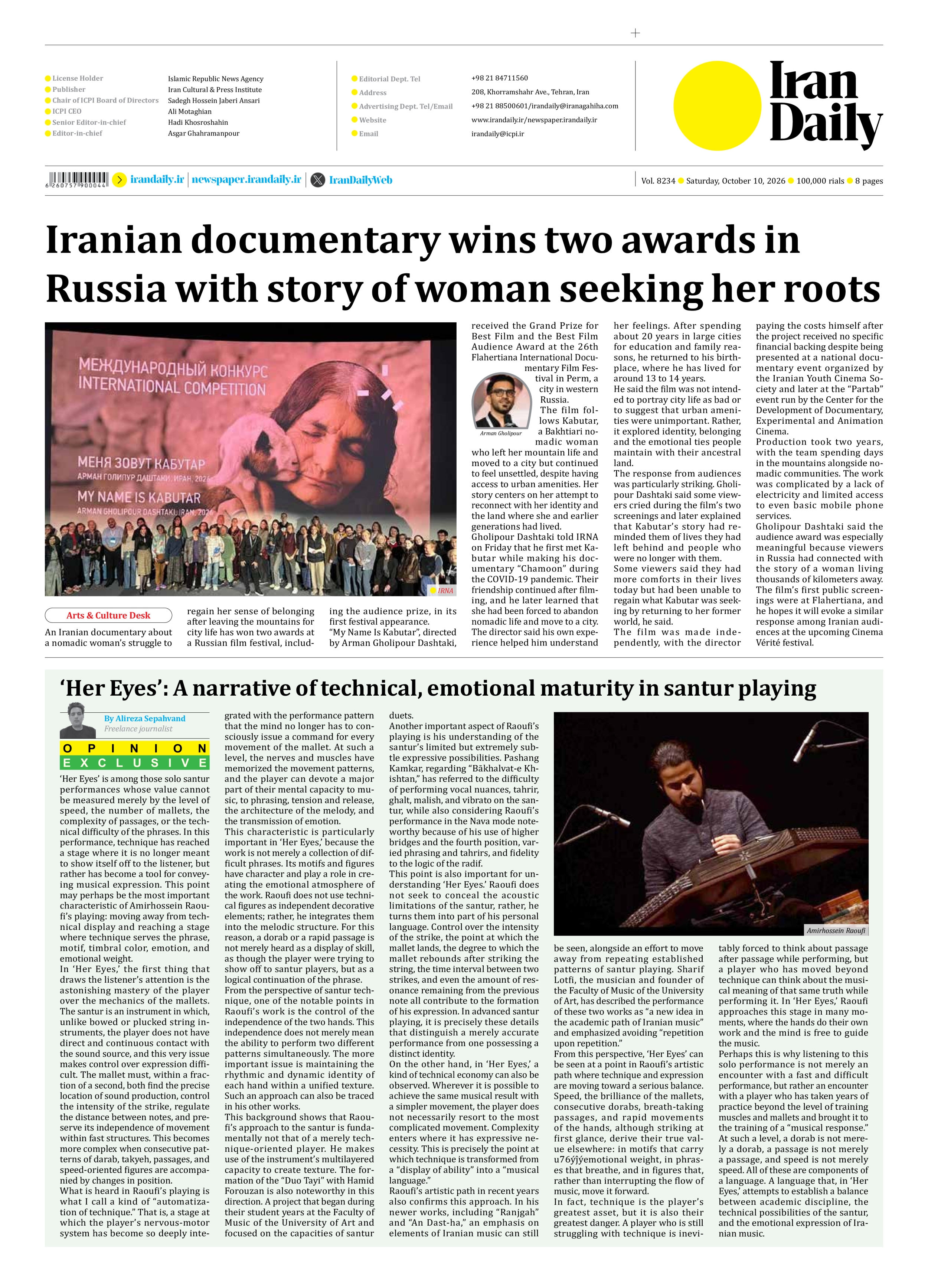


Iranian documentary wins two awards in Russia with story of woman seeking her roots
An Iranian documentary about a nomadic woman’s struggle to regain her sense of belonging after leaving the mountains for city life has won two awards at a Russian film festival, including the audience prize, in its first festival appearance.
“My Name Is Kabutar”, directed by Arman Gholipour Dashtaki, received the Grand Prize for Best Film and the Best Film Audience Award at the 26th Flahertiana International Documentary Film Festival in Perm, a city in western Russia.
The film follows Kabutar, a Bakhtiari nomadic woman who left her mountain life and moved to a city but continued to feel unsettled, despite having access to urban amenities. Her story centers on her attempt to reconnect with her identity and the land where she and earlier generations had lived.
Gholipour Dashtaki told IRNA on Friday that he first met Kabutar while making his documentary “Chamoon” during the COVID-19 pandemic. Their friendship continued after filming, and he later learned that she had been forced to abandon nomadic life and move to a city.
The director said his own experience helped him understand her feelings. After spending about 20 years in large cities for education and family reasons, he returned to his birthplace, where he has lived for around 13 to 14 years.
He said the film was not intended to portray city life as bad or to suggest that urban amenities were unimportant. Rather, it explored identity, belonging and the emotional ties people maintain with their ancestral land.
The response from audiences was particularly striking. Gholipour Dashtaki said some viewers cried during the film’s two screenings and later explained that Kabutar’s story had reminded them of lives they had left behind and people who were no longer with them.
Some viewers said they had more comforts in their lives today but had been unable to regain what Kabutar was seeking by returning to her former world, he said.
The film was made independently, with the director paying the costs himself after the project received no specific financial backing despite being presented at a national documentary event organized by the Iranian Youth Cinema Society and later at the “Partab” event run by the Center for the Development of Documentary, Experimental and Animation Cinema.
Production took two years, with the team spending days in the mountains alongside nomadic communities. The work was complicated by a lack of electricity and limited access to even basic mobile phone services.
Gholipour Dashtaki said the audience award was especially meaningful because viewers in Russia had connected with the story of a woman living thousands of kilometers away. The film’s first public screenings were at Flahertiana, and he hopes it will evoke a similar response among Iranian audiences at the upcoming Cinema Vérité festival.