







Telesm Cave captivates visitors, frightens locals
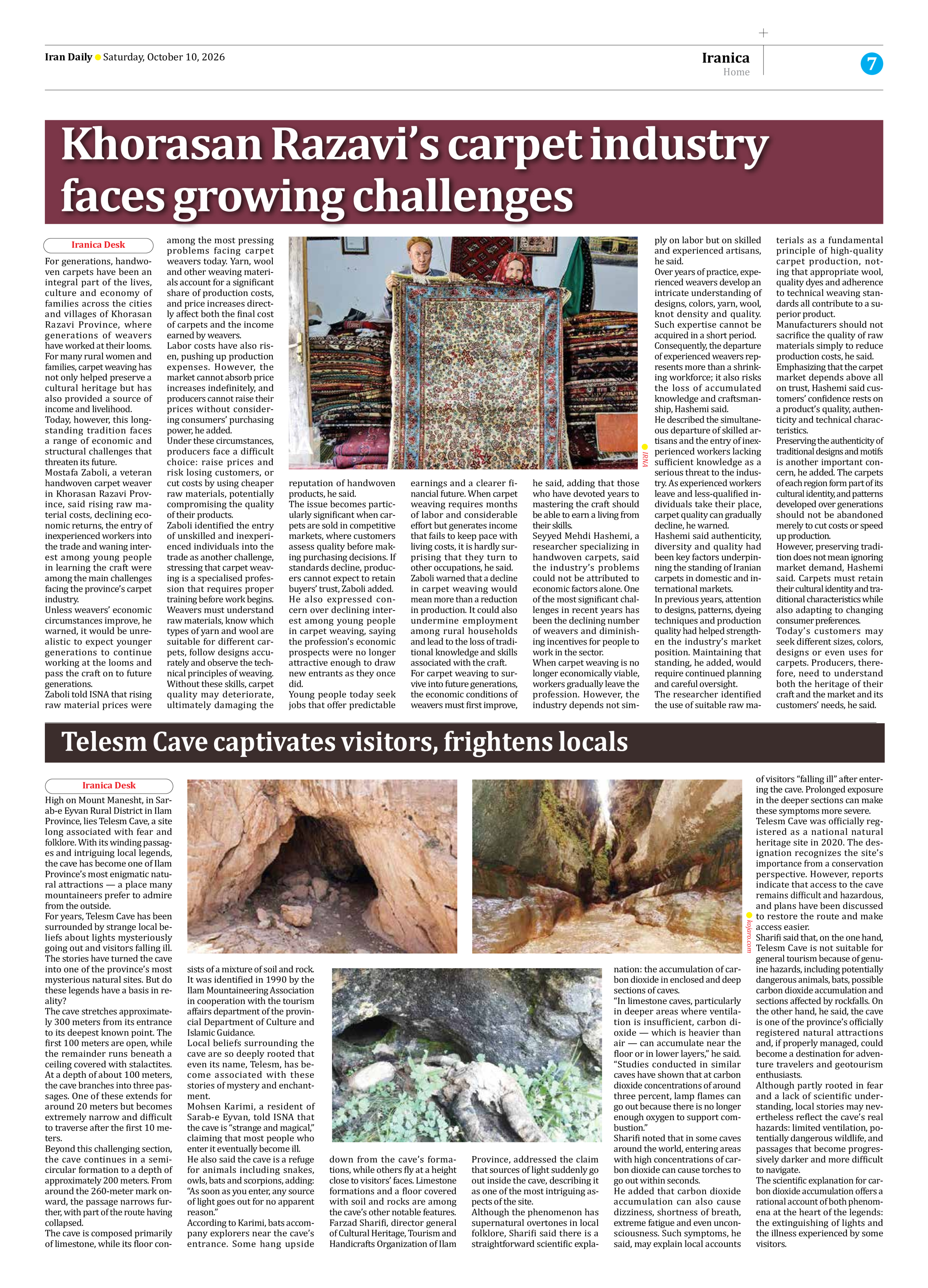
High on Mount Manesht, in Sarab-e Eyvan Rural District in Ilam Province, lies Telesm Cave, a site long associated with fear and folklore. With its winding passages and intriguing local legends, the cave has become one of Ilam Province’s most enigmatic natural attractions — a place many mountaineers prefer to admire from the outside.
For years, Telesm Cave has been surrounded by strange local beliefs about lights mysteriously going out and visitors falling ill. The stories have turned the cave into one of the province’s most mysterious natural sites. But do these legends have a basis in reality?
The cave stretches approximately 300 meters from its entrance to its deepest known point. The first 100 meters are open, while the remainder runs beneath a ceiling covered with stalactites. At a depth of about 100 meters, the cave branches into three passages. One of these extends for around 20 meters but becomes extremely narrow and difficult to traverse after the first 10 meters.
Beyond this challenging section, the cave continues in a semicircular formation to a depth of approximately 200 meters. From around the 260-meter mark onward, the passage narrows further, with part of the route having collapsed.
The cave is composed primarily of limestone, while its floor consists of a mixture of soil and rock. It was identified in 1990 by the Ilam Mountaineering Association in cooperation with the tourism affairs department of the provincial Department of Culture and Islamic Guidance.
Local beliefs surrounding the cave are so deeply rooted that even its name, Telesm, has become associated with these stories of mystery and enchantment.
Mohsen Karimi, a resident of Sarab-e Eyvan, told ISNA that the cave is “strange and magical,” claiming that most people who enter it eventually become ill.
He also said the cave is a refuge for animals including snakes, owls, bats and scorpions, adding: “As soon as you enter, any source of light goes out for no apparent reason.”
According to Karimi, bats accompany explorers near the cave’s entrance. Some hang upside down from the cave’s formations, while others fly at a height close to visitors’ faces. Limestone formations and a floor covered with soil and rocks are among the cave’s other notable features.
Farzad Sharifi, director general of Cultural Heritage, Tourism and Handicrafts Organization of Ilam Province, addressed the claim that sources of light suddenly go out inside the cave, describing it as one of the most intriguing aspects of the site.
Although the phenomenon has supernatural overtones in local folklore, Sharifi said there is a straightforward scientific explanation: the accumulation of carbon dioxide in enclosed and deep sections of caves.
“In limestone caves, particularly in deeper areas where ventilation is insufficient, carbon dioxide — which is heavier than air — can accumulate near the floor or in lower layers,” he said. “Studies conducted in similar caves have shown that at carbon dioxide concentrations of around three percent, lamp flames can go out because there is no longer enough oxygen to support combustion.”
Sharifi noted that in some caves around the world, entering areas with high concentrations of carbon dioxide can cause torches to go out within seconds.
He added that carbon dioxide accumulation can also cause dizziness, shortness of breath, extreme fatigue and even unconsciousness. Such symptoms, he said, may explain local accounts of visitors “falling ill” after entering the cave. Prolonged exposure in the deeper sections can make these symptoms more severe.
Telesm Cave was officially registered as a national natural heritage site in 2020. The designation recognizes the site’s importance from a conservation perspective. However, reports indicate that access to the cave remains difficult and hazardous, and plans have been discussed to restore the route and make access easier.
Sharifi said that, on the one hand, Telesm Cave is not suitable for general tourism because of genuine hazards, including potentially dangerous animals, bats, possible carbon dioxide accumulation and sections affected by rockfalls. On the other hand, he said, the cave is one of the province’s officially registered natural attractions and, if properly managed, could become a destination for adventure travelers and geotourism enthusiasts.
Although partly rooted in fear and a lack of scientific understanding, local stories may nevertheless reflect the cave’s real hazards: limited ventilation, potentially dangerous wildlife, and passages that become progressively darker and more difficult to navigate.
The scientific explanation for carbon dioxide accumulation offers a rational account of both phenomena at the heart of the legends: the extinguishing of lights and the illness experienced by some visitors.