







Khorasan Razavi’s carpet industry faces growing challenges
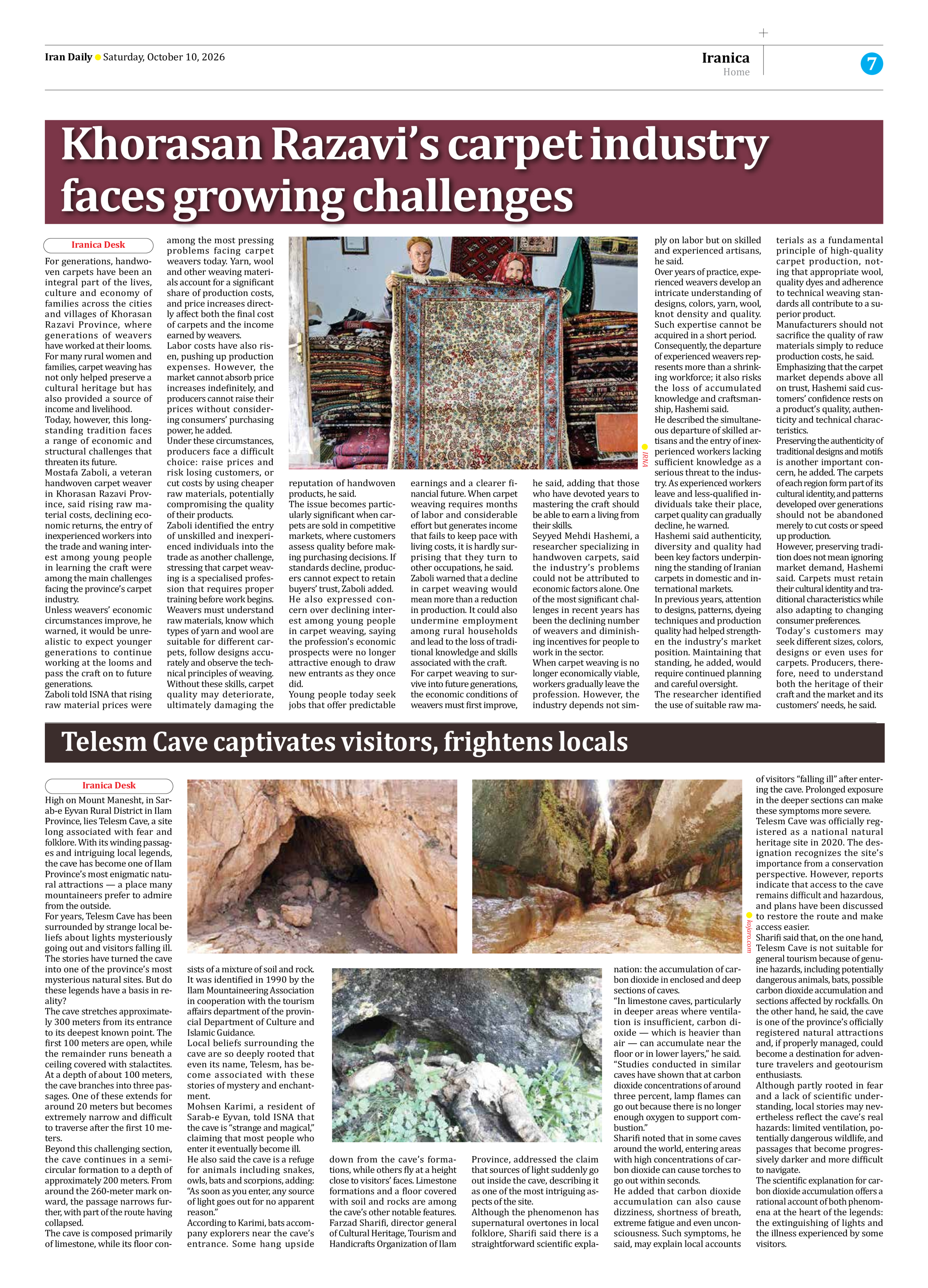
For generations, handwoven carpets have been an integral part of the lives, culture and economy of families across the cities and villages of Khorasan Razavi Province, where generations of weavers have worked at their looms. For many rural women and families, carpet weaving has not only helped preserve a cultural heritage but has also provided a source of income and livelihood.
Today, however, this longstanding tradition faces a range of economic and structural challenges that threaten its future.
Mostafa Zaboli, a veteran handwoven carpet weaver in Khorasan Razavi Province, said rising raw material costs, declining economic returns, the entry of inexperienced workers into the trade and waning interest among young people in learning the craft were among the main challenges facing the province’s carpet industry.
Unless weavers’ economic circumstances improve, he warned, it would be unrealistic to expect younger generations to continue working at the looms and pass the craft on to future generations.
Zaboli told ISNA that rising raw material prices were among the most pressing problems facing carpet weavers today. Yarn, wool and other weaving materials account for a significant share of production costs, and price increases directly affect both the final cost of carpets and the income earned by weavers.
Labor costs have also risen, pushing up production expenses. However, the market cannot absorb price increases indefinitely, and producers cannot raise their prices without considering consumers’ purchasing power, he added.
Under these circumstances, producers face a difficult choice: raise prices and risk losing customers, or cut costs by using cheaper raw materials, potentially compromising the quality of their products.
Zaboli identified the entry of unskilled and inexperienced individuals into the trade as another challenge, stressing that carpet weaving is a specialised profession that requires proper training before work begins.
Weavers must understand raw materials, know which types of yarn and wool are suitable for different carpets, follow designs accurately and observe the technical principles of weaving. Without these skills, carpet quality may deteriorate, ultimately damaging the reputation of handwoven products, he said.
The issue becomes particularly significant when carpets are sold in competitive markets, where customers assess quality before making purchasing decisions. If standards decline, producers cannot expect to retain buyers’ trust, Zaboli added.
He also expressed concern over declining interest among young people in carpet weaving, saying the profession’s economic prospects were no longer attractive enough to draw new entrants as they once did.
Young people today seek jobs that offer predictable earnings and a clearer financial future. When carpet weaving requires months of labor and considerable effort but generates income that fails to keep pace with living costs, it is hardly surprising that they turn to other occupations, he said.
Zaboli warned that a decline in carpet weaving would mean more than a reduction in production. It could also undermine employment among rural households and lead to the loss of traditional knowledge and skills associated with the craft.
For carpet weaving to survive into future generations, the economic conditions of weavers must first improve, he said, adding that those who have devoted years to mastering the craft should be able to earn a living from their skills.
Seyyed Mehdi Hashemi, a researcher specializing in handwoven carpets, said the industry’s problems could not be attributed to economic factors alone. One of the most significant challenges in recent years has been the declining number of weavers and diminishing incentives for people to work in the sector.
When carpet weaving is no longer economically viable, workers gradually leave the profession. However, the industry depends not simply on labor but on skilled and experienced artisans, he said.
Over years of practice, experienced weavers develop an intricate understanding of designs, colors, yarn, wool, knot density and quality. Such expertise cannot be acquired in a short period.
Consequently, the departure of experienced weavers represents more than a shrinking workforce; it also risks the loss of accumulated knowledge and craftsmanship, Hashemi said.
He described the simultaneous departure of skilled artisans and the entry of inexperienced workers lacking sufficient knowledge as a serious threat to the industry. As experienced workers leave and less-qualified individuals take their place, carpet quality can gradually decline, he warned.
Hashemi said authenticity, diversity and quality had been key factors underpinning the standing of Iranian carpets in domestic and international markets.
In previous years, attention to designs, patterns, dyeing techniques and production quality had helped strengthen the industry’s market position. Maintaining that standing, he added, would require continued planning and careful oversight.
The researcher identified the use of suitable raw materials as a fundamental principle of high-quality carpet production, noting that appropriate wool, quality dyes and adherence to technical weaving standards all contribute to a superior product.
Manufacturers should not sacrifice the quality of raw materials simply to reduce production costs, he said.
Emphasizing that the carpet market depends above all on trust, Hashemi said customers’ confidence rests on a product’s quality, authenticity and technical characteristics.
Preserving the authenticity of traditional designs and motifs is another important concern, he added. The carpets of each region form part of its cultural identity, and patterns developed over generations should not be abandoned merely to cut costs or speed up production.
However, preserving tradition does not mean ignoring market demand, Hashemi said. Carpets must retain their cultural identity and traditional characteristics while also adapting to changing consumer preferences.
Today’s customers may seek different sizes, colors, designs or even uses for carpets. Producers, therefore, need to understand both the heritage of their craft and the market and its customers’ needs, he said.