





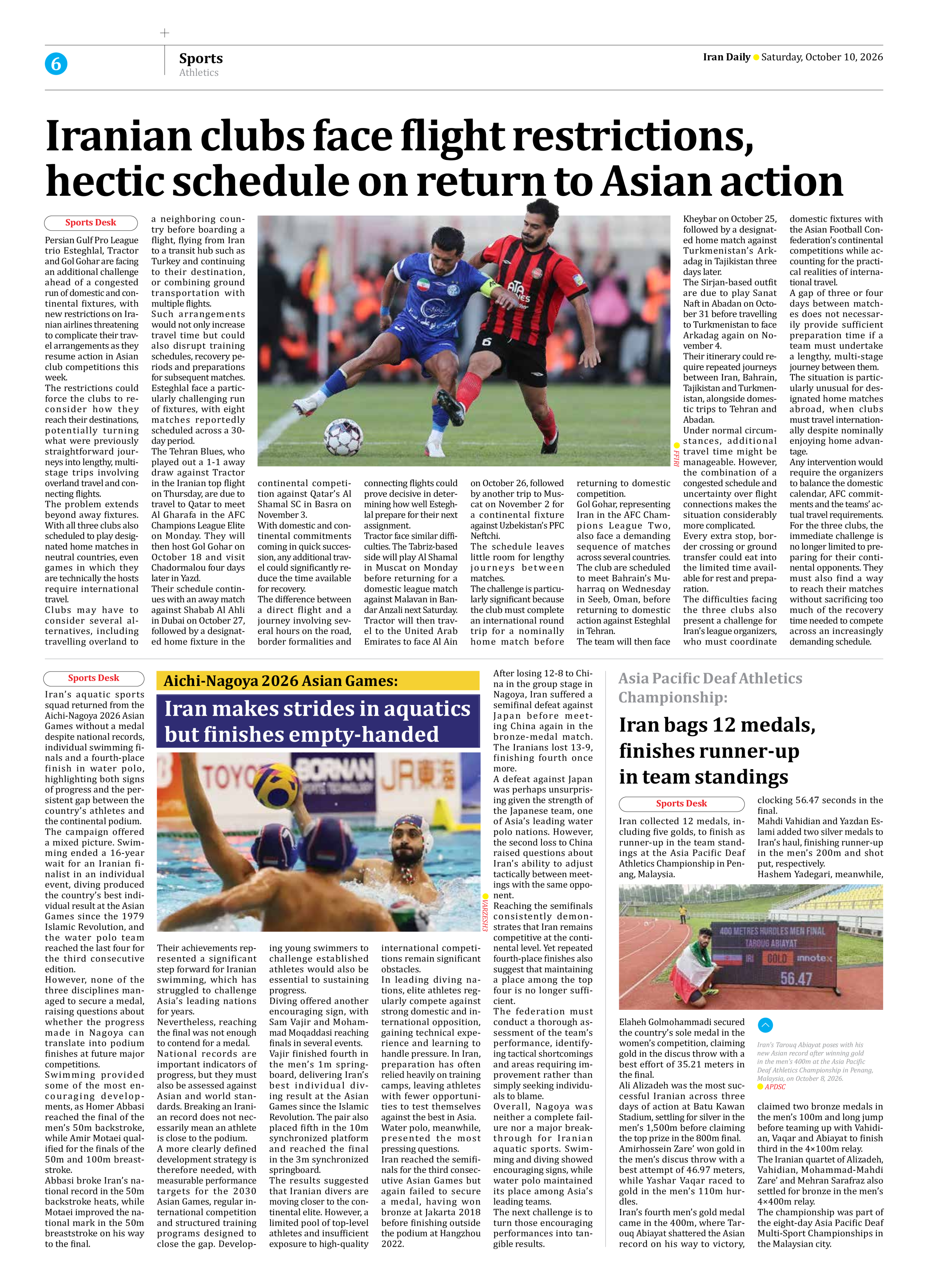


Aichi-Nagoya 2026 Asian Games:
Iran makes strides in aquatics but finishes empty-handed
Iran’s aquatic sports squad returned from the Aichi-Nagoya 2026 Asian Games without a medal despite national records, individual swimming finals and a fourth-place finish in water polo, highlighting both signs of progress and the persistent gap between the country’s athletes and the continental podium.
The campaign offered a mixed picture. Swimming ended a 16-year wait for an Iranian finalist in an individual event, diving produced the country’s best individual result at the Asian Games since the 1979 Islamic Revolution, and the water polo team reached the last four for the third consecutive edition.
However, none of the three disciplines managed to secure a medal, raising questions about whether the progress made in Nagoya can translate into podium finishes at future major competitions.
Swimming provided some of the most encouraging developments, as Homer Abbasi reached the final of the men’s 50m backstroke, while Amir Motaei qualified for the finals of the 50m and 100m breaststroke.
Abbasi broke Iran’s national record in the 50m backstroke heats, while Motaei improved the national mark in the 50m breaststroke on his way to the final.
Their achievements represented a significant step forward for Iranian swimming, which has struggled to challenge Asia’s leading nations for years.
Nevertheless, reaching the final was not enough to contend for a medal.
National records are important indicators of progress, but they must also be assessed against Asian and world standards. Breaking an Iranian record does not necessarily mean an athlete is close to the podium.
A more clearly defined development strategy is therefore needed, with measurable performance targets for the 2030 Asian Games, regular international competition and structured training programs designed to close the gap. Developing young swimmers to challenge established athletes would also be essential to sustaining progress.
Diving offered another encouraging sign, with Sam Vajir and Mohammad Moqaddasi reaching finals in several events.
Vajir finished fourth in the men’s 1m springboard, delivering Iran’s best individual diving result at the Asian Games since the Islamic Revolution. The pair also placed fifth in the 10m synchronized platform and reached the final in the 3m synchronized springboard.
The results suggested that Iranian divers are moving closer to the continental elite. However, a limited pool of top-level athletes and insufficient exposure to high-quality international competitions remain significant obstacles.
In leading diving nations, elite athletes regularly compete against strong domestic and international opposition, gaining technical experience and learning to handle pressure. In Iran, preparation has often relied heavily on training camps, leaving athletes with fewer opportunities to test themselves against the best in Asia.
Water polo, meanwhile, presented the most pressing questions.
Iran reached the semifinals for the third consecutive Asian Games but again failed to secure a medal, having won bronze at Jakarta 2018 before finishing outside the podium at Hangzhou 2022.
After losing 12-8 to China in the group stage in Nagoya, Iran suffered a semifinal defeat against Japan before meeting China again in the bronze-medal match. The Iranians lost 13-9, finishing fourth once more.
A defeat against Japan was perhaps unsurprising given the strength of the Japanese team, one of Asia’s leading water polo nations. However, the second loss to China raised questions about Iran’s ability to adjust tactically between meetings with the same opponent.
Reaching the semifinals consistently demonstrates that Iran remains competitive at the continental level. Yet repeated fourth-place finishes also suggest that maintaining a place among the top four is no longer sufficient.
The federation must conduct a thorough assessment of the team’s performance, identifying tactical shortcomings and areas requiring improvement rather than simply seeking individuals to blame.
Overall, Nagoya was neither a complete failure nor a major breakthrough for Iranian aquatic sports. Swimming and diving showed encouraging signs, while water polo maintained its place among Asia’s leading teams.
The next challenge is to turn those encouraging performances into tangible results.
----------------