







Iranian clubs face flight restrictions, hectic schedule on return to Asian action
Persian Gulf Pro League trio Esteghlal, Tractor and Gol Gohar are facing an additional challenge ahead of a congested run of domestic and continental fixtures, with new restrictions on Iranian airlines threatening to complicate their travel arrangements as they resume action in Asian club competitions this week.
The restrictions could force the clubs to reconsider how they reach their destinations, potentially turning what were previously straightforward journeys into lengthy, multi-stage trips involving overland travel and connecting flights.
The problem extends beyond away fixtures. With all three clubs also scheduled to play designated home matches in neutral countries, even games in which they are technically the hosts require international travel.
Clubs may have to consider several alternatives, including travelling overland to a neighboring country before boarding a flight, flying from Iran to a transit hub such as Turkey and continuing to their destination, or combining ground transportation with multiple flights.
Such arrangements would not only increase travel time but could also disrupt training schedules, recovery periods and preparations for subsequent matches.
Esteghlal face a particularly challenging run of fixtures, with eight matches reportedly scheduled across a 30-day period.
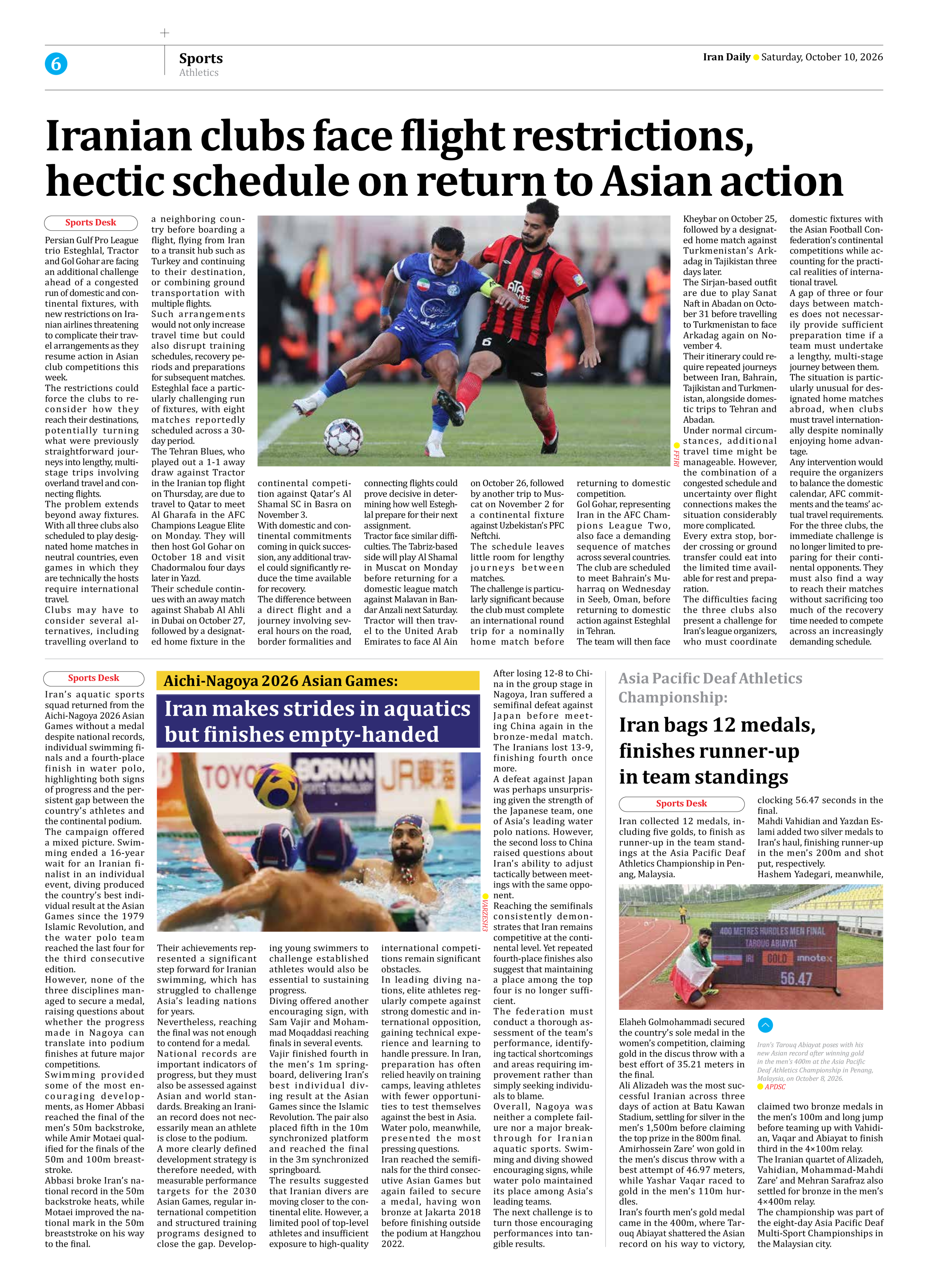
The Tehran Blues, who played out a 1-1 away draw against Tractor in the Iranian top flight on Thursday, are due to travel to Qatar to meet Al Gharafa in the AFC Champions League Elite on Monday. They will then host Gol Gohar on October 18 and visit Chadormalou four days later in Yazd.
Their schedule continues with an away match against Shabab Al Ahli in Dubai on October 27, followed by a designated home fixture in the continental competition against Qatar’s Al Shamal SC in Basra on November 3.
With domestic and continental commitments coming in quick succession, any additional travel could significantly reduce the time available for recovery.
The difference between a direct flight and a journey involving several hours on the road, border formalities and connecting flights could prove decisive in determining how well Esteghlal prepare for their next assignment.
Tractor face similar difficulties. The Tabriz-based side will play Al Shamal in Muscat on Monday before returning for a domestic league match against Malavan in Bandar Anzali next Saturday.
Tractor will then travel to the United Arab Emirates to face Al Ain on October 26, followed by another trip to Muscat on November 2 for a continental fixture against Uzbekistan’s PFC Neftchi.
The schedule leaves little room for lengthy journeys between matches.
The challenge is particularly significant because the club must complete an international round trip for a nominally home match before returning to domestic competition.
Gol Gohar, representing Iran in the AFC Champions League Two, also face a demanding sequence of matches across several countries.
The club are scheduled to meet Bahrain’s Muharraq on Wednesday in Seeb, Oman, before returning to domestic action against Esteghlal in Tehran.
The team will then face Kheybar on October 25, followed by a designated home match against Turkmenistan’s Arkadag in Tajikistan three days later.
The Sirjan-based outfit are due to play Sanat Naft in Abadan on October 31 before travelling to Turkmenistan to face Arkadag again on November 4.
Their itinerary could require repeated journeys between Iran, Bahrain, Tajikistan and Turkmenistan, alongside domestic trips to Tehran and Abadan.
Under normal circumstances, additional travel time might be manageable. However, the combination of a congested schedule and uncertainty over flight connections makes the situation considerably more complicated.
Every extra stop, border crossing or ground transfer could eat into the limited time available for rest and preparation.
The difficulties facing the three clubs also present a challenge for Iran’s league organizers, who must coordinate domestic fixtures with the Asian Football Confederation’s continental competitions while accounting for the practical realities of international travel.
A gap of three or four days between matches does not necessarily provide sufficient preparation time if a team must undertake a lengthy, multi-stage journey between them.
The situation is particularly unusual for designated home matches abroad, when clubs must travel internationally despite nominally enjoying home advantage.
Any intervention would require the organizers to balance the domestic calendar, AFC commitments and the teams’ actual travel requirements.
For the three clubs, the immediate challenge is no longer limited to preparing for their continental opponents. They must also find a way to reach their matches without sacrificing too much of the recovery time needed to compete across an increasingly demanding schedule.