







Gerivan women weave memory into wool, color
In a corner of North Khorasan Province, where mountains merge with the morning mist and the silence of village life blends with the sound of wind moving through the trees, an ancient art continues to shape the lives of local women while preserving its identity across generations.
In the village of Gerivan, kilim weaving is more than a job or pastime. It is a form of meditation, a silent language and a way of recording memories, brought to life through the woolen warp and weft.
Kilim weaving can be regarded as one of the oldest connections between people and nature. The word “kilim,” derived from the Turkic root kil, meaning wool, reflects the close relationship between the craft and the wool-bearing flocks that roam the mountain slopes of the province. Unlike pile carpets, which are formed through numerous knots, kilims emerge from the direct interlacing of warp and weft, combining striking simplicity with profound complexity.
There are no formal patterns or maps here. The weaver is an artist who paints with her mind, engraving designs not on paper but deep within her memory and spirit before turning those visions into reality with every beat of the beater and every movement of the weft.
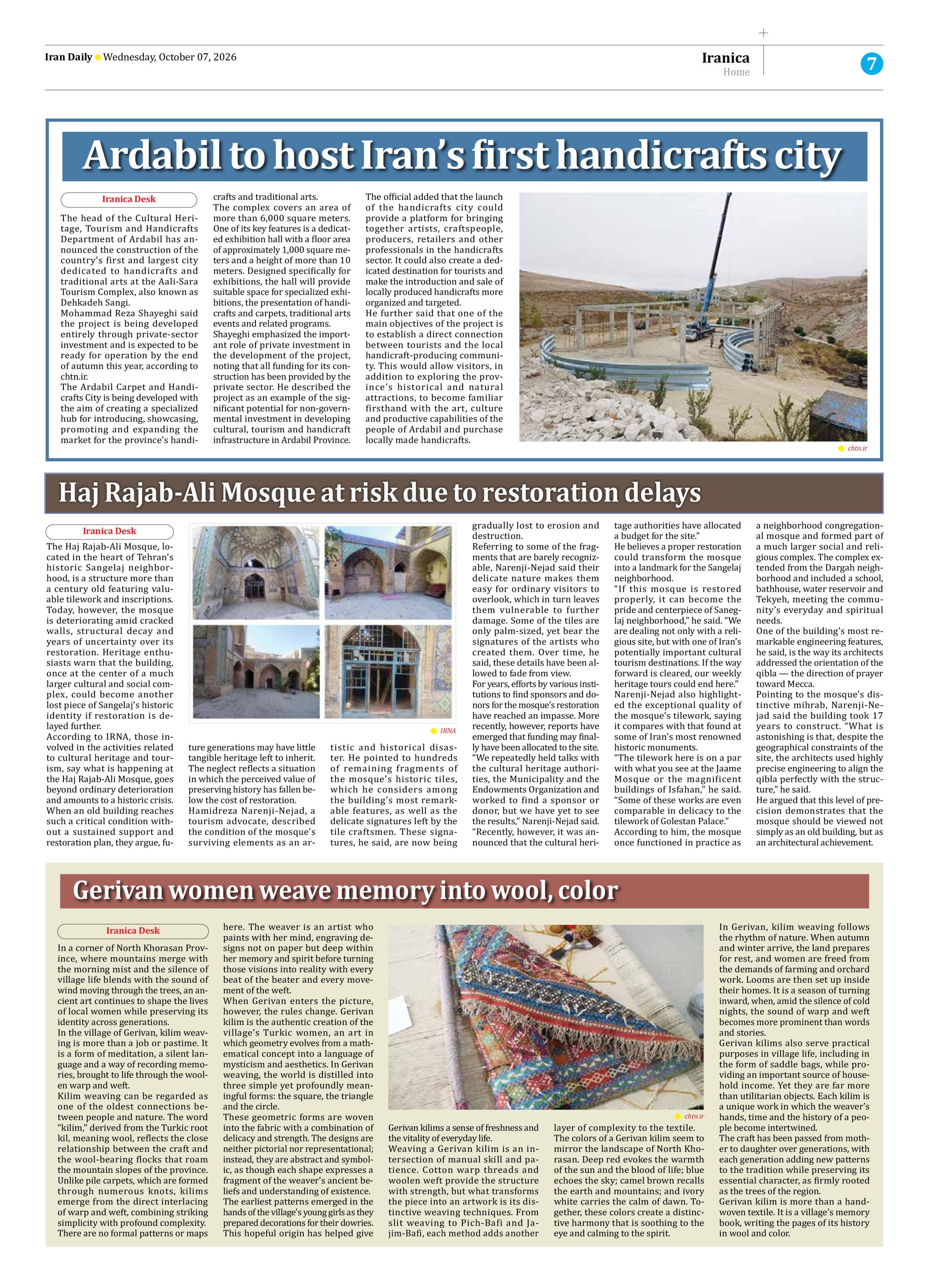
When Gerivan enters the picture, however, the rules change. Gerivan kilim is the authentic creation of the village’s Turkic women, an art in which geometry evolves from a mathematical concept into a language of mysticism and aesthetics. In Gerivan weaving, the world is distilled into three simple yet profoundly meaningful forms: the square, the triangle and the circle.
These geometric forms are woven into the fabric with a combination of delicacy and strength. The designs are neither pictorial nor representational; instead, they are abstract and symbolic, as though each shape expresses a fragment of the weaver’s ancient beliefs and understanding of existence.
The earliest patterns emerged in the hands of the village’s young girls as they prepared decorations for their dowries. This hopeful origin has helped give Gerivan kilims a sense of freshness and the vitality of everyday life.
Weaving a Gerivan kilim is an intersection of manual skill and patience. Cotton warp threads and woolen weft provide the structure with strength, but what transforms the piece into an artwork is its distinctive weaving techniques. From slit weaving to Pich-Bafi and Jajim-Bafi, each method adds another layer of complexity to the textile.
The colors of a Gerivan kilim seem to mirror the landscape of North Khorasan. Deep red evokes the warmth of the sun and the blood of life; blue echoes the sky; camel brown recalls the earth and mountains; and ivory white carries the calm of dawn. Together, these colors create a distinctive harmony that is soothing to the eye and calming to the spirit.
In Gerivan, kilim weaving follows the rhythm of nature. When autumn and winter arrive, the land prepares for rest, and women are freed from the demands of farming and orchard work. Looms are then set up inside their homes. It is a season of turning inward, when, amid the silence of cold nights, the sound of warp and weft becomes more prominent than words and stories.
Gerivan kilims also serve practical purposes in village life, including in the form of saddle bags, while providing an important source of household income. Yet they are far more than utilitarian objects. Each kilim is a unique work in which the weaver’s hands, time and the history of a people become intertwined.
The craft has been passed from mother to daughter over generations, with each generation adding new patterns to the tradition while preserving its essential character, as firmly rooted as the trees of the region.
Gerivan kilim is more than a handwoven textile. It is a village’s memory book, writing the pages of its history in wool and color.