







Haj Rajab-Ali Mosque at risk due to restoration delays
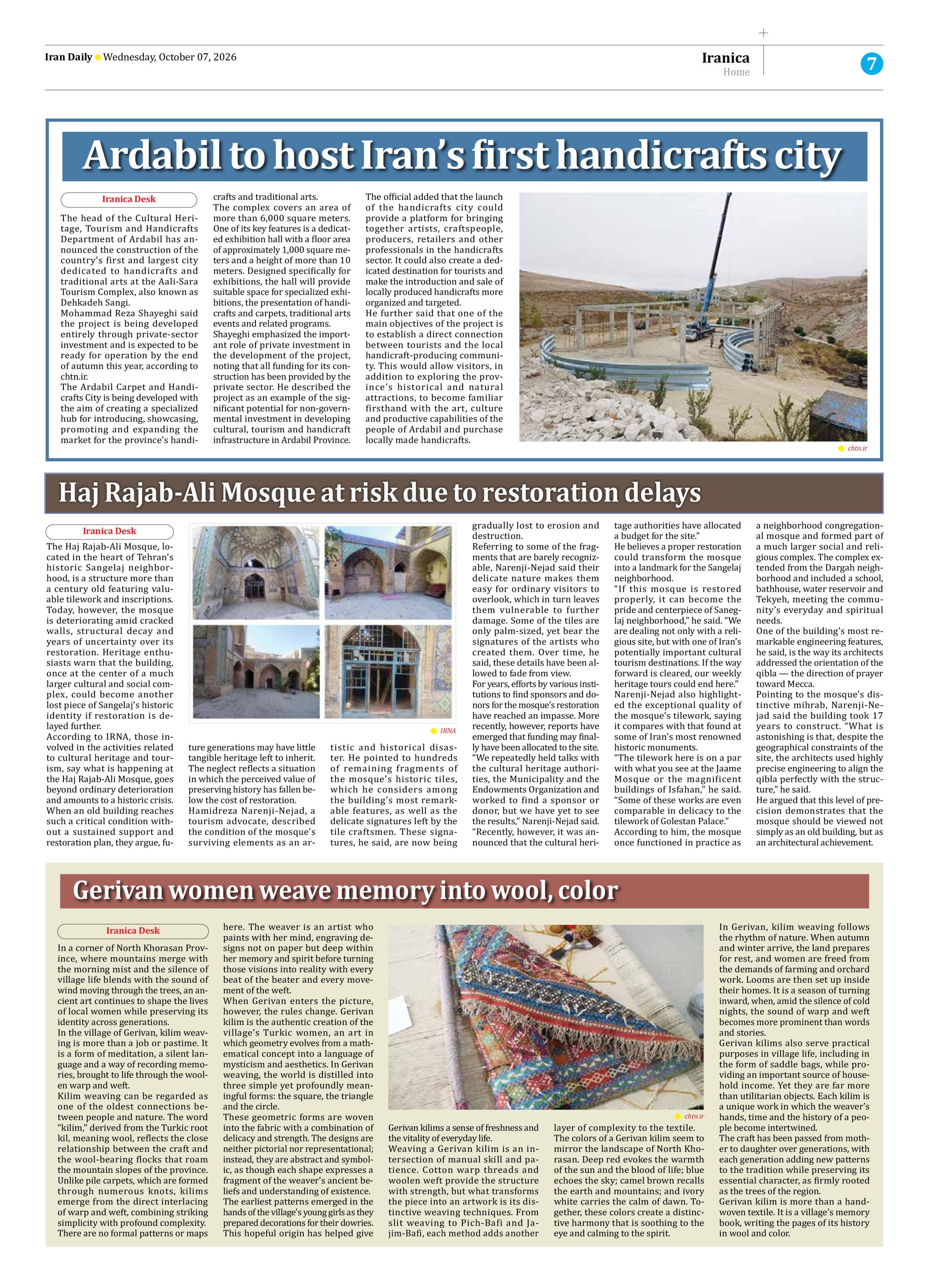
The Haj Rajab-Ali Mosque, located in the heart of Tehran’s historic Sangelaj neighborhood, is a structure more than a century old featuring valuable tilework and inscriptions. Today, however, the mosque is deteriorating amid cracked walls, structural decay and years of uncertainty over its restoration. Heritage enthusiasts warn that the building, once at the center of a much larger cultural and social complex, could become another lost piece of Sangelaj’s historic identity if restoration is delayed further.
According to IRNA, those involved in the activities related to cultural heritage and tourism, say what is happening at the Haj Rajab-Ali Mosque, goes beyond ordinary deterioration and amounts to a historic crisis. When an old building reaches such a critical condition without a sustained support and restoration plan, they argue, future generations may have little tangible heritage left to inherit. The neglect reflects a situation in which the perceived value of preserving history has fallen below the cost of restoration.
Hamidreza Narenji-Nejad, a tourism advocate, described the condition of the mosque’s surviving elements as an artistic and historical disaster. He pointed to hundreds of remaining fragments of the mosque’s historic tiles, which he considers among the building’s most remarkable features, as well as the delicate signatures left by the tile craftsmen. These signatures, he said, are now being gradually lost to erosion and destruction.
Referring to some of the fragments that are barely recognizable, Narenji-Nejad said their delicate nature makes them easy for ordinary visitors to overlook, which in turn leaves them vulnerable to further damage. Some of the tiles are only palm-sized, yet bear the signatures of the artists who created them. Over time, he said, these details have been allowed to fade from view.
For years, efforts by various institutions to find sponsors and donors for the mosque’s restoration have reached an impasse. More recently, however, reports have emerged that funding may finally have been allocated to the site.
“We repeatedly held talks with the cultural heritage authorities, the Municipality and the Endowments Organization and worked to find a sponsor or donor, but we have yet to see the results,” Narenji-Nejad said. “Recently, however, it was announced that the cultural heritage authorities have allocated a budget for the site.”
He believes a proper restoration could transform the mosque into a landmark for the Sangelaj neighborhood.
“If this mosque is restored properly, it can become the pride and centerpiece of Saneglaj neighborhood,” he said. “We are dealing not only with a religious site, but with one of Iran’s potentially important cultural tourism destinations. If the way forward is cleared, our weekly heritage tours could end here.”
Narenji-Nejad also highlighted the exceptional quality of the mosque’s tilework, saying it compares with that found at some of Iran’s most renowned historic monuments.
“The tilework here is on a par with what you see at the Jaame Mosque or the magnificent buildings of Isfahan,” he said. “Some of these works are even comparable in delicacy to the tilework of Golestan Palace.”
According to him, the mosque once functioned in practice as a neighborhood congregational mosque and formed part of a much larger social and religious complex. The complex extended from the Dargah neighborhood and included a school, bathhouse, water reservoir and Tekyeh, meeting the community’s everyday and spiritual needs.
One of the building’s most remarkable engineering features, he said, is the way its architects addressed the orientation of the qibla — the direction of prayer toward Mecca.
Pointing to the mosque’s distinctive mihrab, Narenji-Nejad said the building took 17 years to construct. “What is astonishing is that, despite the geographical constraints of the site, the architects used highly precise engineering to align the qibla perfectly with the structure,” he said.
He argued that this level of precision demonstrates that the mosque should be viewed not simply as an old building, but as an architectural achievement.