







Aichi-Nagoya 2026 Asian Games:
Iran’s campaign summed up by historic highs, reality checks
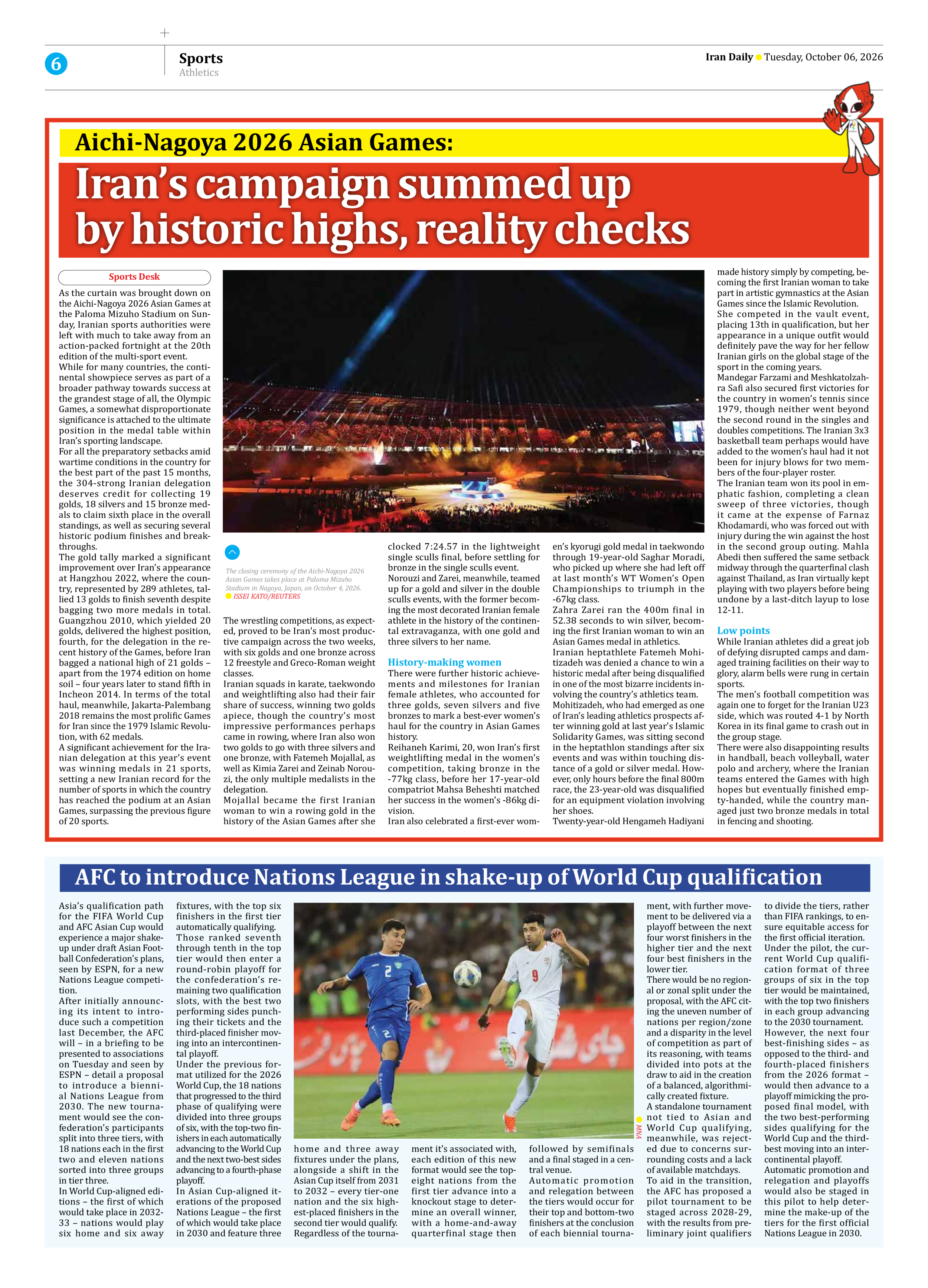
As the curtain was brought down on the Aichi-Nagoya 2026 Asian Games at the Paloma Mizuho Stadium on Sunday, Iranian sports authorities were left with much to take away from an action-packed fortnight at the 20th edition of the multi-sport event.
While for many countries, the continental showpiece serves as part of a broader pathway towards success at the grandest stage of all, the Olympic Games, a somewhat disproportionate significance is attached to the ultimate position in the medal table within Iran’s sporting landscape.
For all the preparatory setbacks amid wartime conditions in the country for the best part of the past 15 months, the 304-strong Iranian delegation deserves credit for collecting 19 golds, 18 silvers and 15 bronze medals to claim sixth place in the overall standings, as well as securing several historic podium finishes and breakthroughs.
The gold tally marked a significant improvement over Iran’s appearance at Hangzhou 2022, where the country, represented by 289 athletes, tallied 13 golds to finish seventh despite bagging two more medals in total. Guangzhou 2010, which yielded 20 golds, delivered the highest position, fourth, for the delegation in the recent history of the Games, before Iran bagged a national high of 21 golds – apart from the 1974 edition on home soil – four years later to stand fifth in Incheon 2014. In terms of the total haul, meanwhile, Jakarta-Palembang 2018 remains the most prolific Games for Iran since the 1979 Islamic Revolution, with 62 medals.
A significant achievement for the Iranian delegation at this year’s event was winning medals in 21 sports, setting a new Iranian record for the number of sports in which the country has reached the podium at an Asian Games, surpassing the previous figure of 20 sports.
The wrestling competitions, as expected, proved to be Iran’s most productive campaign across the two weeks, with six golds and one bronze across 12 freestyle and Greco-Roman weight classes.
Iranian squads in karate, taekwondo and weightlifting also had their fair share of success, winning two golds apiece, though the country’s most impressive performances perhaps came in rowing, where Iran also won two golds to go with three silvers and one bronze, with Fatemeh Mojallal, as well as Kimia Zarei and Zeinab Norouzi, the only multiple medalists in the delegation.
Mojallal became the first Iranian woman to win a rowing gold in the history of the Asian Games after she clocked 7:24.57 in the lightweight single sculls final, before settling for bronze in the single sculls event.
Norouzi and Zarei, meanwhile, teamed up for a gold and silver in the double sculls events, with the former becoming the most decorated Iranian female athlete in the history of the continental extravaganza, with one gold and three silvers to her name.
History-making women
There were further historic achievements and milestones for Iranian female athletes, who accounted for three golds, seven silvers and five bronzes to mark a best-ever women’s haul for the country in Asian Games history.
Reihaneh Karimi, 20, won Iran’s first weightlifting medal in the women’s competition, taking bronze in the -77kg class, before her 17-year-old compatriot Mahsa Beheshti matched her success in the women’s -86kg division.
Iran also celebrated a first-ever women’s kyorugi gold medal in taekwondo through 19-year-old Saghar Moradi, who picked up where she had left off at last month’s WT Women’s Open Championships to triumph in the -67kg class.
Zahra Zarei ran the 400m final in 52.38 seconds to win silver, becoming the first Iranian woman to win an Asian Games medal in athletics.
Iranian heptathlete Fatemeh Mohitizadeh was denied a chance to win a historic medal after being disqualified in one of the most bizarre incidents involving the country’s athletics team.
Mohitizadeh, who had emerged as one of Iran’s leading athletics prospects after winning gold at last year’s Islamic Solidarity Games, was sitting second in the heptathlon standings after six events and was within touching distance of a gold or silver medal. However, only hours before the final 800m race, the 23-year-old was disqualified for an equipment violation involving her shoes.
Twenty-year-old Hengameh Hadiyani made history simply by competing, becoming the first Iranian woman to take part in artistic gymnastics at the Asian Games since the Islamic Revolution.
She competed in the vault event, placing 13th in qualification, but her appearance in a unique outfit would definitely pave the way for her fellow Iranian girls on the global stage of the sport in the coming years.
Mandegar Farzami and Meshkatolzahra Safi also secured first victories for the country in women’s tennis since 1979, though neither went beyond the second round in the singles and doubles competitions. The Iranian 3x3 basketball team perhaps would have added to the women’s haul had it not been for injury blows for two members of the four-player roster.
The Iranian team won its pool in emphatic fashion, completing a clean sweep of three victories, though it came at the expense of Farnaz Khodamardi, who was forced out with injury during the win against the host in the second group outing. Mahla Abedi then suffered the same setback midway through the quarterfinal clash against Thailand, as Iran virtually kept playing with two players before being undone by a last-ditch layup to lose 12-11.
Low points
While Iranian athletes did a great job of defying disrupted camps and damaged training facilities on their way to glory, alarm bells were rung in certain sports.
The men’s football competition was again one to forget for the Iranian U23 side, which was routed 4-1 by North Korea in its final game to crash out in the group stage.
There were also disappointing results in handball, beach volleyball, water polo and archery, where the Iranian teams entered the Games with high hopes but eventually finished empty-handed, while the country managed just two bronze medals in total in fencing and shooting.