





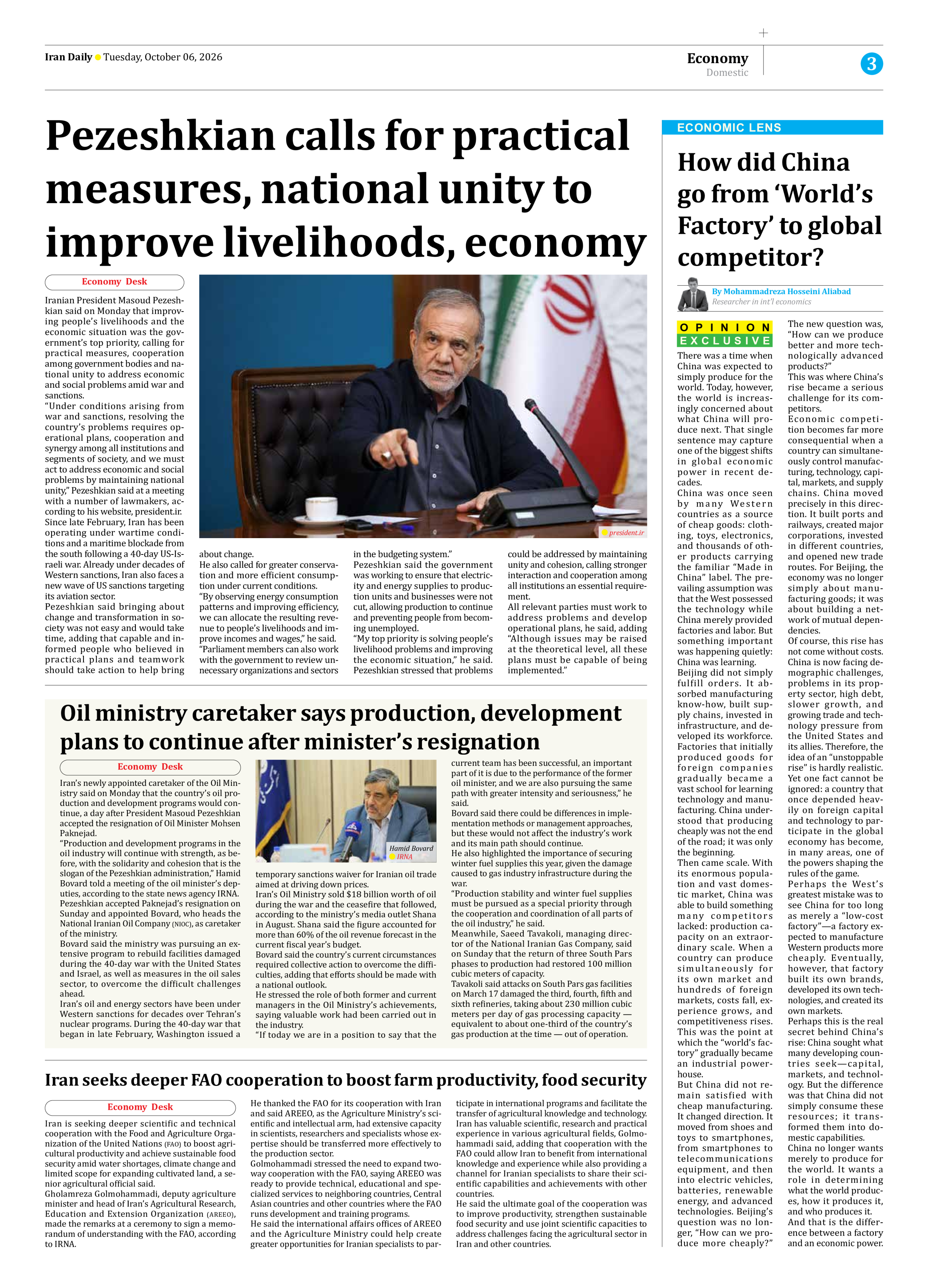


Oil ministry caretaker says production, development plans to continue after minister’s resignation
Iran’s newly appointed caretaker of the Oil Ministry said on Monday that the country’s oil production and development programs would continue, a day after President Masoud Pezeshkian accepted the resignation of Oil Minister Mohsen Paknejad.
“Production and development programs in the oil industry will continue with strength, as before, with the solidarity and cohesion that is the slogan of the Pezeshkian administration,” Hamid Bovard told a meeting of the oil minister’s deputies, according to the state news agency IRNA.
Pezeshkian accepted Paknejad’s resignation on Sunday and appointed Bovard, who heads the National Iranian Oil Company (NIOC), as caretaker of the ministry.
Bovard said the ministry was pursuing an extensive program to rebuild facilities damaged during the 40-day war with the United States and Israel, as well as measures in the oil sales sector, to overcome the difficult challenges ahead.
Iran’s oil and energy sectors have been under Western sanctions for decades over Tehran’s nuclear programs. During the 40-day war that began in late February, Washington issued a temporary sanctions waiver for Iranian oil trade aimed at driving down prices.
Iran’s Oil Ministry sold $18 billion worth of oil during the war and the ceasefire that followed, according to the ministry’s media outlet Shana in August. Shana said the figure accounted for more than 60% of the oil revenue forecast in the current fiscal year’s budget.
Bovard said the country’s current circumstances required collective action to overcome the difficulties, adding that efforts should be made with a national outlook.
He stressed the role of both former and current managers in the Oil Ministry’s achievements, saying valuable work had been carried out in the industry.
“If today we are in a position to say that the current team has been successful, an important part of it is due to the performance of the former oil minister, and we are also pursuing the same path with greater intensity and seriousness,” he said.
Bovard said there could be differences in implementation methods or management approaches, but these would not affect the industry’s work and its main path should continue.
He also highlighted the importance of securing winter fuel supplies this year, given the damage caused to gas industry infrastructure during the war.
“Production stability and winter fuel supplies must be pursued as a special priority through the cooperation and coordination of all parts of the oil industry,” he said.
Meanwhile, Saeed Tavakoli, managing director of the National Iranian Gas Company, said on Sunday that the return of three South Pars phases to production had restored 100 million cubic meters of capacity.
Tavakoli said attacks on South Pars gas facilities on March 17 damaged the third, fourth, fifth and sixth refineries, taking about 230 million cubic meters per day of gas processing capacity — equivalent to about one-third of the country’s gas production at the time — out of operation.