







Zanjan keeps its centuries-old knife-making tradition alive
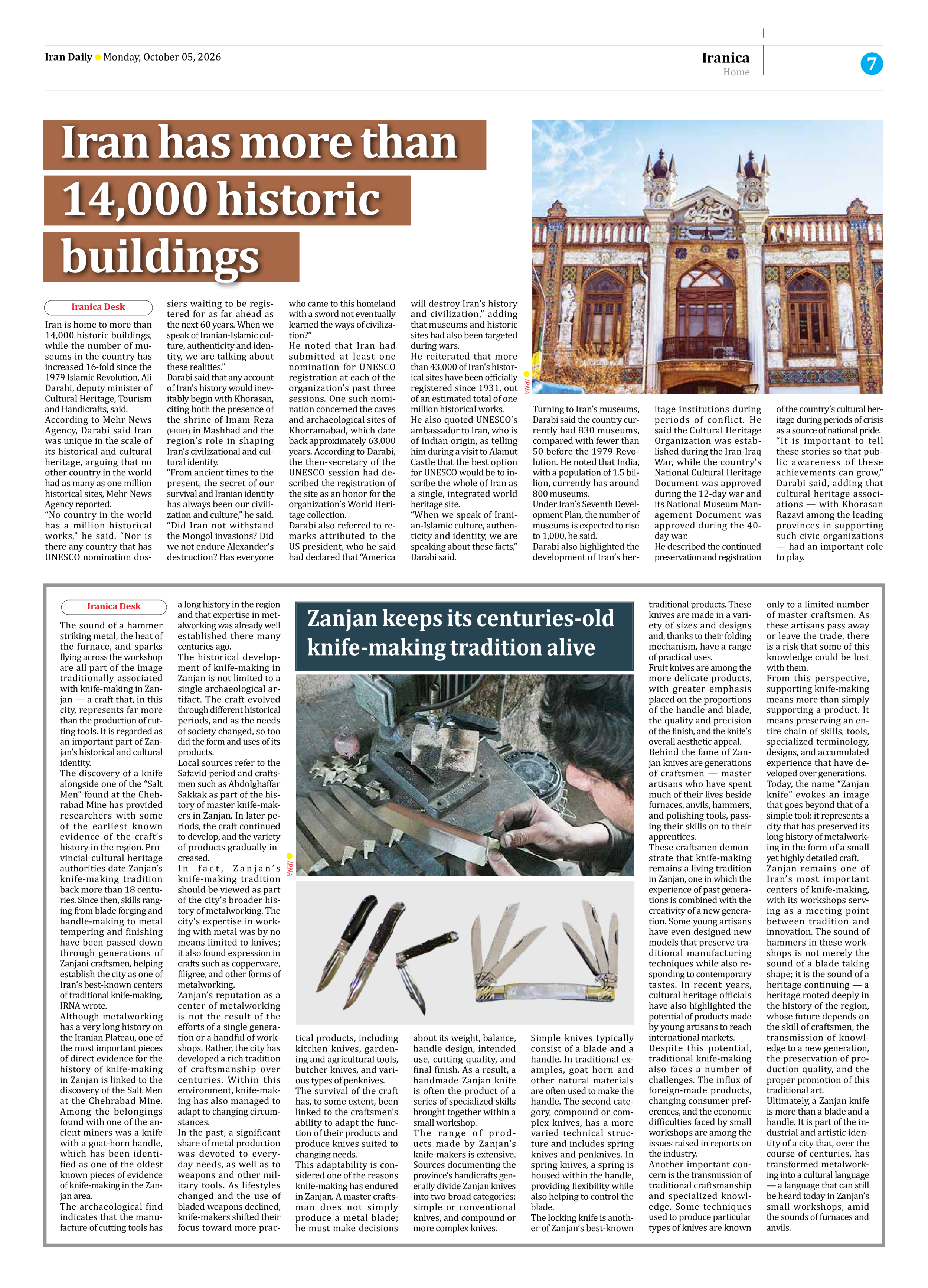
The sound of a hammer striking metal, the heat of the furnace, and sparks flying across the workshop are all part of the image traditionally associated with knife-making in Zanjan — a craft that, in this city, represents far more than the production of cutting tools. It is regarded as an important part of Zanjan’s historical and cultural identity.
The discovery of a knife alongside one of the “Salt Men” found at the Chehrabad Mine has provided researchers with some of the earliest known evidence of the craft’s history in the region. Provincial cultural heritage authorities date Zanjan’s knife-making tradition back more than 18 centuries. Since then, skills ranging from blade forging and handle-making to metal tempering and finishing have been passed down through generations of Zanjani craftsmen, helping establish the city as one of Iran’s best-known centers of traditional knife-making, IRNA wrote.
Although metalworking has a very long history on the Iranian Plateau, one of the most important pieces of direct evidence for the history of knife-making in Zanjan is linked to the discovery of the Salt Men at the Chehrabad Mine. Among the belongings found with one of the ancient miners was a knife with a goat-horn handle, which has been identified as one of the oldest known pieces of evidence of knife-making in the Zanjan area.
The archaeological find indicates that the manufacture of cutting tools has a long history in the region and that expertise in metalworking was already well established there many centuries ago.
The historical development of knife-making in Zanjan is not limited to a single archaeological artifact. The craft evolved through different historical periods, and as the needs of society changed, so too did the form and uses of its products.
Local sources refer to the Safavid period and craftsmen such as Abdolghaffar Sakkak as part of the history of master knife-makers in Zanjan. In later periods, the craft continued to develop, and the variety of products gradually increased.
In fact, Zanjan’s knife-making tradition should be viewed as part of the city’s broader history of metalworking. The city’s expertise in working with metal was by no means limited to knives; it also found expression in crafts such as copperware, filigree, and other forms of metalworking.
Zanjan’s reputation as a center of metalworking is not the result of the efforts of a single generation or a handful of workshops. Rather, the city has developed a rich tradition of craftsmanship over centuries. Within this environment, knife-making has also managed to adapt to changing circumstances.
In the past, a significant share of metal production was devoted to everyday needs, as well as to weapons and other military tools. As lifestyles changed and the use of bladed weapons declined, knife-makers shifted their focus toward more practical products, including kitchen knives, gardening and agricultural tools, butcher knives, and various types of penknives.
The survival of the craft has, to some extent, been linked to the craftsmen’s ability to adapt the function of their products and produce knives suited to changing needs.
This adaptability is considered one of the reasons knife-making has endured in Zanjan. A master craftsman does not simply produce a metal blade; he must make decisions about its weight, balance, handle design, intended use, cutting quality, and final finish. As a result, a handmade Zanjan knife is often the product of a series of specialized skills brought together within a small workshop.
The range of products made by Zanjan’s knife-makers is extensive. Sources documenting the province’s handicrafts generally divide Zanjan knives into two broad categories: simple or conventional knives, and compound or more complex knives.
Simple knives typically consist of a blade and a handle. In traditional examples, goat horn and other natural materials are often used to make the handle. The second category, compound or complex knives, has a more varied technical structure and includes spring knives and penknives. In spring knives, a spring is housed within the handle, providing flexibility while also helping to control the blade.
The locking knife is another of Zanjan’s best-known traditional products. These knives are made in a variety of sizes and designs and, thanks to their folding mechanism, have a range of practical uses.
Fruit knives are among the more delicate products, with greater emphasis placed on the proportions of the handle and blade, the quality and precision of the finish, and the knife’s overall aesthetic appeal.
Behind the fame of Zanjan knives are generations of craftsmen — master artisans who have spent much of their lives beside furnaces, anvils, hammers, and polishing tools, passing their skills on to their apprentices.
These craftsmen demonstrate that knife-making remains a living tradition in Zanjan, one in which the experience of past generations is combined with the creativity of a new generation. Some young artisans have even designed new models that preserve traditional manufacturing techniques while also responding to contemporary tastes. In recent years, cultural heritage officials have also highlighted the potential of products made by young artisans to reach international markets.
Despite this potential, traditional knife-making also faces a number of challenges. The influx of foreign-made products, changing consumer preferences, and the economic difficulties faced by small workshops are among the issues raised in reports on the industry.
Another important concern is the transmission of traditional craftsmanship and specialized knowledge. Some techniques used to produce particular types of knives are known only to a limited number of master craftsmen. As these artisans pass away or leave the trade, there is a risk that some of this knowledge could be lost with them.
From this perspective, supporting knife-making means more than simply supporting a product. It means preserving an entire chain of skills, tools, specialized terminology, designs, and accumulated experience that have developed over generations.
Today, the name “Zanjan knife” evokes an image that goes beyond that of a simple tool: it represents a city that has preserved its long history of metalworking in the form of a small yet highly detailed craft.
Zanjan remains one of Iran’s most important centers of knife-making, with its workshops serving as a meeting point between tradition and innovation. The sound of hammers in these workshops is not merely the sound of a blade taking shape; it is the sound of a heritage continuing — a heritage rooted deeply in the history of the region, whose future depends on the skill of craftsmen, the transmission of knowledge to a new generation, the preservation of production quality, and the proper promotion of this traditional art.
Ultimately, a Zanjan knife is more than a blade and a handle. It is part of the industrial and artistic identity of a city that, over the course of centuries, has transformed metalworking into a cultural language — a language that can still be heard today in Zanjan’s small workshops, amid the sounds of furnaces and anvils.