





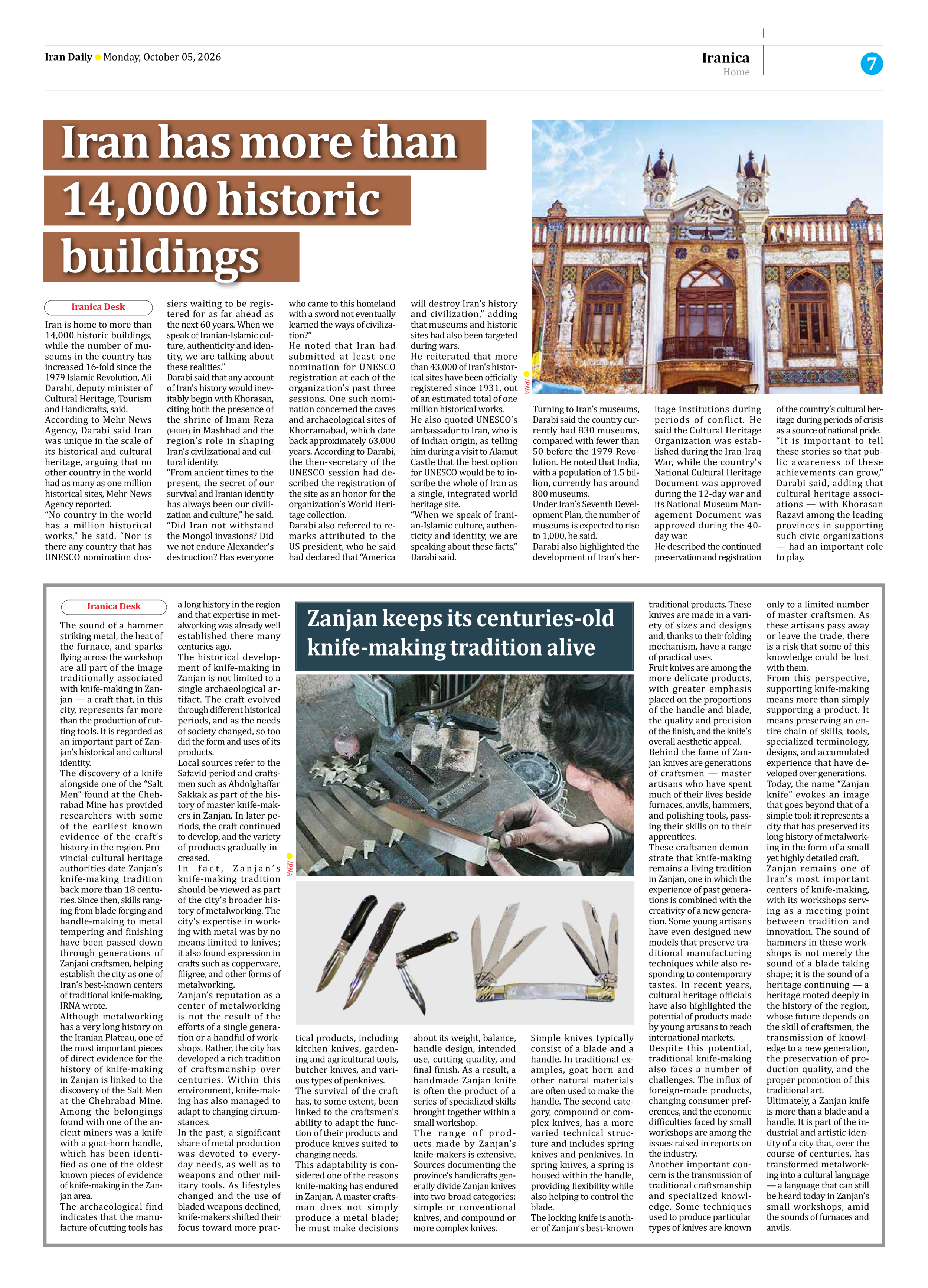


Iran has more than 14,000 historic buildings
Iran is home to more than 14,000 historic buildings, while the number of museums in the country has increased 16-fold since the 1979 Islamic Revolution, Ali Darabi, deputy minister of Cultural Heritage, Tourism and Handicrafts, said.
According to Mehr News Agency, Darabi said Iran was unique in the scale of its historical and cultural heritage, arguing that no other country in the world had as many as one million historical sites, Mehr News Agency reported.
“No country in the world has a million historical works,” he said. “Nor is there any country that has UNESCO nomination dossiers waiting to be registered for as far ahead as the next 60 years. When we speak of Iranian-Islamic culture, authenticity and identity, we are talking about these realities.”
Darabi said that any account of Iran’s history would inevitably begin with Khorasan, citing both the presence of the shrine of Imam Reza (PBUH) in Mashhad and the region’s role in shaping Iran’s civilizational and cultural identity.
“From ancient times to the present, the secret of our survival and Iranian identity has always been our civilization and culture,” he said. “Did Iran not withstand the Mongol invasions? Did we not endure Alexander’s destruction? Has everyone who came to this homeland with a sword not eventually learned the ways of civilization?”
He noted that Iran had submitted at least one nomination for UNESCO registration at each of the organization’s past three sessions. One such nomination concerned the caves and archaeological sites of Khorramabad, which date back approximately 63,000 years. According to Darabi, the then-secretary of the UNESCO session had described the registration of the site as an honor for the organization’s World Heritage collection.
Darabi also referred to remarks attributed to the US president, who he said had declared that “America will destroy Iran’s history and civilization,” adding that museums and historic sites had also been targeted during wars.
He reiterated that more than 43,000 of Iran’s historical sites have been officially registered since 1931, out of an estimated total of one million historical works.
He also quoted UNESCO’s ambassador to Iran, who is of Indian origin, as telling him during a visit to Alamut Castle that the best option for UNESCO would be to inscribe the whole of Iran as a single, integrated world heritage site.
“When we speak of Iranian-Islamic culture, authenticity and identity, we are speaking about these facts,” Darabi said.
Turning to Iran’s museums, Darabi said the country currently had 830 museums, compared with fewer than 50 before the 1979 Revolution. He noted that India, with a population of 1.5 billion, currently has around 800 museums.
Under Iran’s Seventh Development Plan, the number of museums is expected to rise to 1,000, he said.
Darabi also highlighted the development of Iran’s heritage institutions during periods of conflict. He said the Cultural Heritage Organization was established during the Iran-Iraq War, while the country’s National Cultural Heritage Document was approved during the 12-day war and its National Museum Management Document was approved during the 40-day war.
He described the continued preservation and registration of the country’s cultural heritage during periods of crisis as a source of national pride.
“It is important to tell these stories so that public awareness of these achievements can grow,” Darabi said, adding that cultural heritage associations — with Khorasan Razavi among the leading provinces in supporting such civic organizations — had an important role to play.