





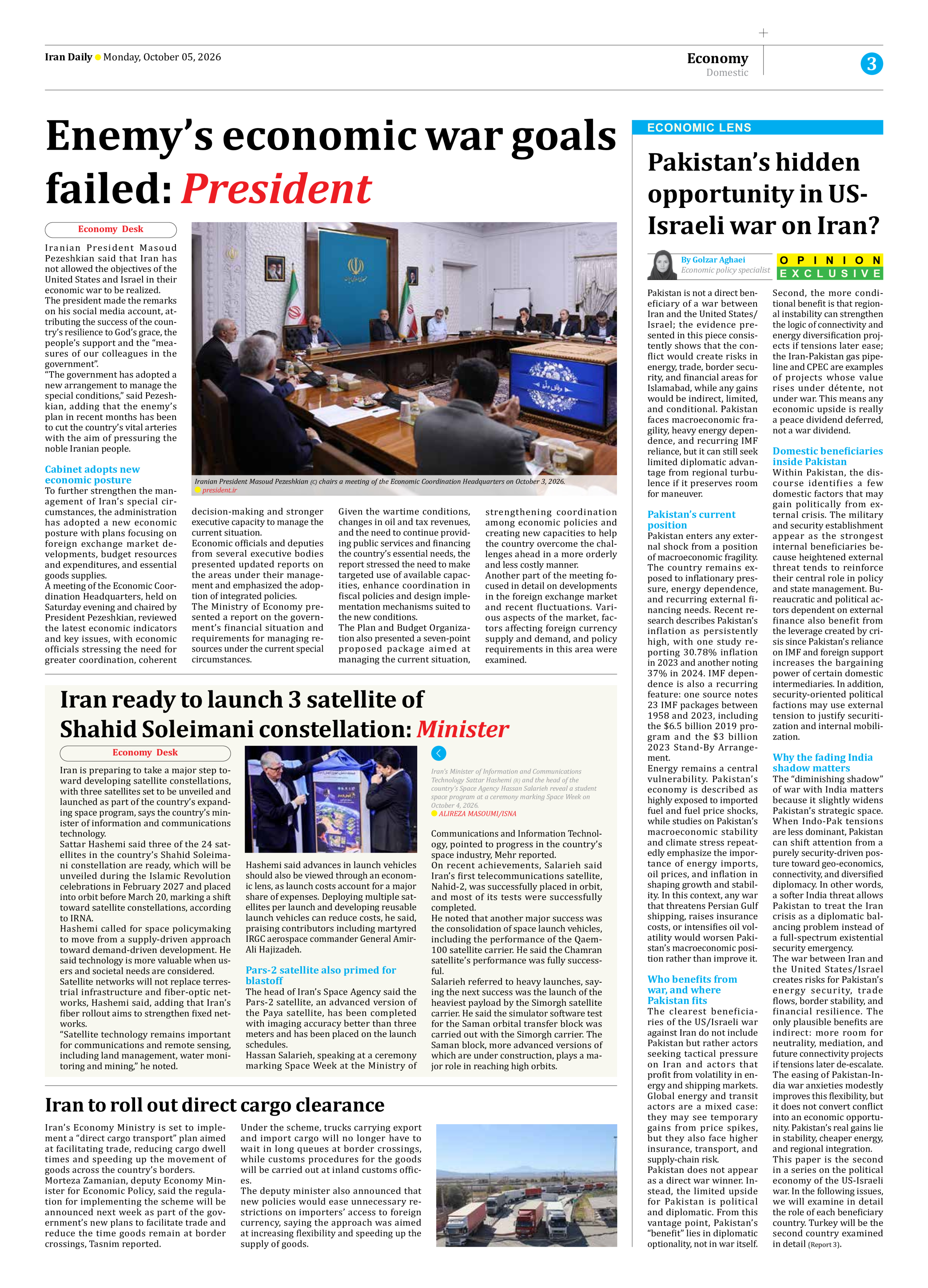


Iran ready to launch 3 satellite of Shahid Soleimani constellation: Minister
Iran is preparing to take a major step toward developing satellite constellations, with three satellites set to be unveiled and launched as part of the country’s expanding space program, says the country’s minister of information and communications technology.
Sattar Hashemi said three of the 24 satellites in the country’s Shahid Soleimani constellation are ready, which will be unveiled during the Islamic Revolution celebrations in February 2027 and placed into orbit before March 20, marking a shift toward satellite constellations, according to IRNA.
Hashemi called for space policymaking to move from a supply-driven approach toward demand-driven development. He said technology is more valuable when users and societal needs are considered.
Satellite networks will not replace terrestrial infrastructure and fiber-optic networks, Hashemi said, adding that Iran’s fiber rollout aims to strengthen fixed networks.
“Satellite technology remains important for communications and remote sensing, including land management, water monitoring and mining,” he noted.
Hashemi said advances in launch vehicles should also be viewed through an economic lens, as launch costs account for a major share of expenses. Deploying multiple satellites per launch and developing reusable launch vehicles can reduce costs, he said, praising contributors including martyred IRGC aerospace commander General Amir-Ali Hajizadeh.
Pars-2 satellite also primed for blastoff
The head of Iran’s Space Agency said the Pars-2 satellite, an advanced version of the Paya satellite, has been completed with imaging accuracy better than three meters and has been placed on the launch schedules.
Hassan Salarieh, speaking at a ceremony marking Space Week at the Ministry of Communications and Information Technology, pointed to progress in the country’s space industry, Mehr reported.
On recent achievements, Salarieh said Iran’s first telecommunications satellite, Nahid-2, was successfully placed in orbit, and most of its tests were successfully completed.
He noted that another major success was the consolidation of space launch vehicles, including the performance of the Qaem-100 satellite carrier. He said the Chamran satellite’s performance was fully successful.
Salarieh referred to heavy launches, saying the next success was the launch of the heaviest payload by the Simorgh satellite carrier. He said the simulator software test for the Saman orbital transfer block was carried out with the Simorgh carrier. The Saman block, more advanced versions of which are under construction, plays a major role in reaching high orbits.