







Copy in clipboard...
Ancient fortresses preserve Sistan and Baluchestan’s historic legacy
Having withstood the passage of centuries, these imposing structures have preserved a tangible link between generations past and future. The architectural remains of the fortresses point to sophisticated knowledge of defensive architecture, resource management and systems of governance, reflecting the historical importance of the region across different periods.
Many of these historic sites remain relatively untouched, unexplored and little known. Their structures are believed to hold important clues to the region’s past, awaiting further archaeological and historical research, according to IRNA.
Castles and fortifications are scattered throughout the province, from the mountains of Nikshahr to the Hamun area and the plains around Iranshahr. Among the notable sites are Dezak Castle in Saravan, Seh Kohe Castle in Hamun, Bampur Castle in Bampur and Naseri Castle in Iranshahr.
Other historic fortifications include Qasr-e Qand Castle, Espakeh Castle in Nikshahr, Sardar Mohammad Khan Naroui Castle in the village of Qaleh Now in Sistan, Paskuh Castle in Sib and Suran, and Kuhkan Castle in Hiduj, Iranshahr.
The sites are considered important elements of the region’s historical and cultural heritage and have the potential to contribute to heritage tourism and the preservation of local cultural traditions. Conservation and restoration efforts are also seen as important to ensuring that the structures remain accessible to future generations.
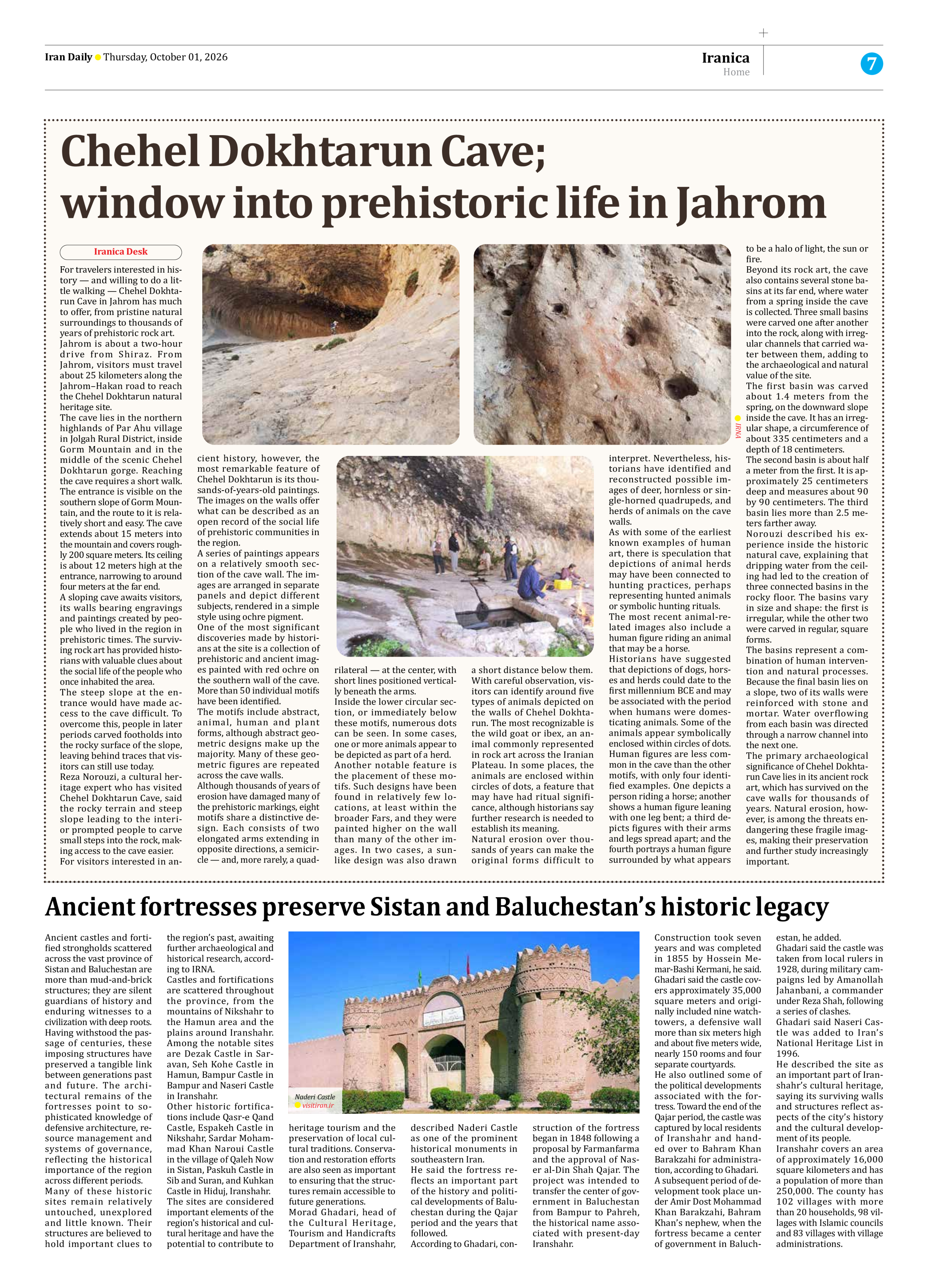
Morad Ghadari, head of the Cultural Heritage, Tourism and Handicrafts Department of Iranshahr, described Naderi Castle as one of the prominent historical monuments in southeastern Iran.
He said the fortress reflects an important part of the history and political developments of Baluchestan during the Qajar period and the years that followed.
According to Ghadari, construction of the fortress began in 1848 following a proposal by Farmanfarma and the approval of Naser al-Din Shah Qajar. The project was intended to transfer the center of government in Baluchestan from Bampur to Pahreh, the historical name associated with present-day Iranshahr.
Construction took seven years and was completed in 1855 by Hossein Memar-Bashi Kermani, he said.
Ghadari said the castle covers approximately 35,000 square meters and originally included nine watchtowers, a defensive wall more than six meters high and about five meters wide, nearly 150 rooms and four separate courtyards.
He also outlined some of the political developments associated with the fortress. Toward the end of the Qajar period, the castle was captured by local residents of Iranshahr and handed over to Bahram Khan Barakzahi for administration, according to Ghadari.
A subsequent period of development took place under Amir Dost Mohammad Khan Barakzahi, Bahram Khan’s nephew, when the fortress became a center of government in Baluchestan, he added.
Ghadari said the castle was taken from local rulers in 1928, during military campaigns led by Amanollah Jahanbani, a commander under Reza Shah, following a series of clashes.
Ghadari said Naseri Castle was added to Iran’s National Heritage List in 1996.
He described the site as an important part of Iranshahr’s cultural heritage, saying its surviving walls and structures reflect aspects of the city’s history and the cultural development of its people.
Iranshahr covers an area of approximately 16,000 square kilometers and has a population of more than 250,000. The county has 102 villages with more than 20 households, 98 villages with Islamic councils and 83 villages with village administrations.