







Chehel Dokhtarun Cave; window into prehistoric life in Jahrom
For travelers interested in history — and willing to do a little walking — Chehel Dokhtarun Cave in Jahrom has much to offer, from pristine natural surroundings to thousands of years of prehistoric rock art.
Jahrom is about a two-hour drive from Shiraz. From Jahrom, visitors must travel about 25 kilometers along the Jahrom–Hakan road to reach the Chehel Dokhtarun natural heritage site.
The cave lies in the northern highlands of Par Ahu village in Jolgah Rural District, inside Gorm Mountain and in the middle of the scenic Chehel Dokhtarun gorge. Reaching the cave requires a short walk.
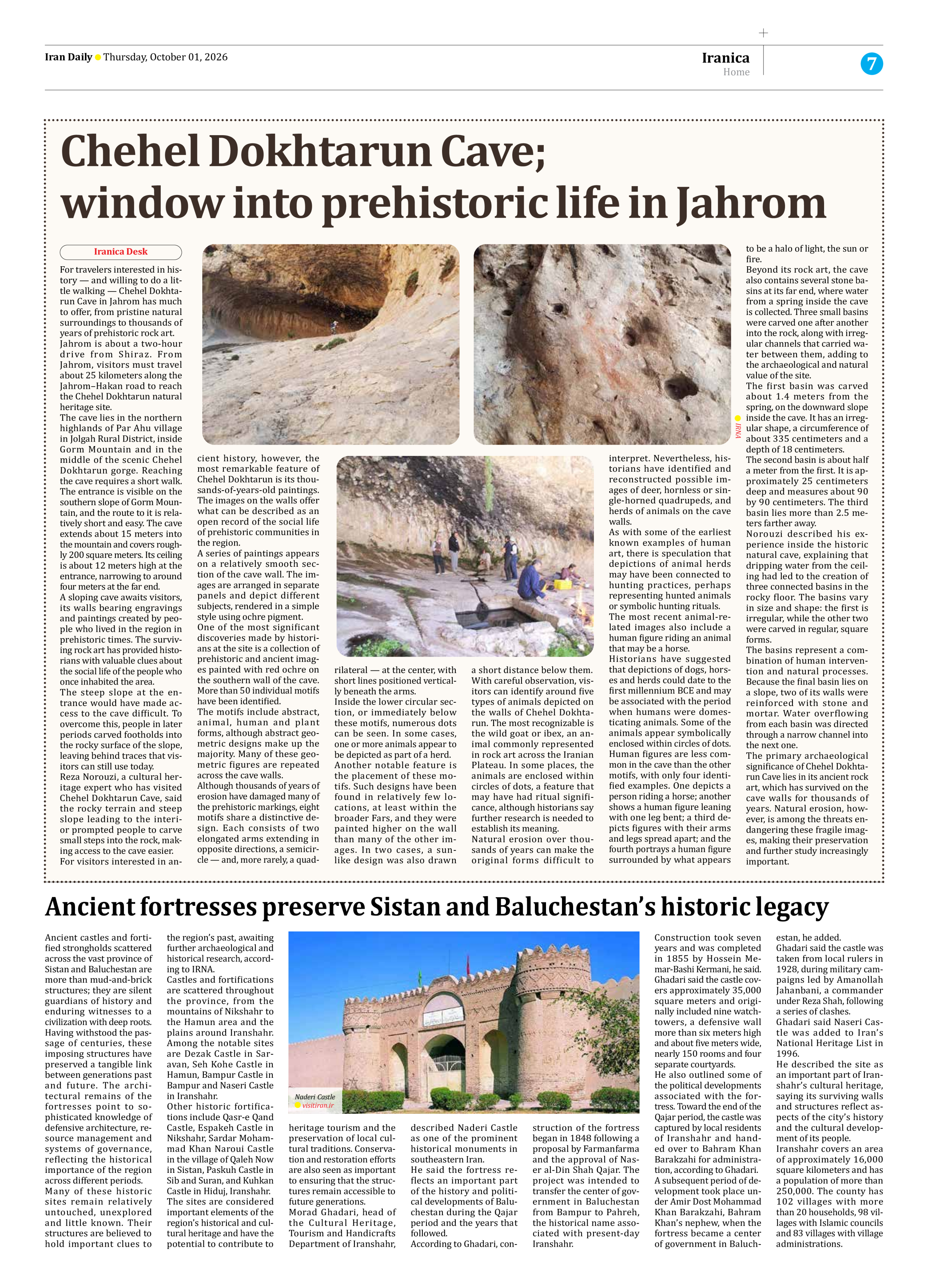
The entrance is visible on the southern slope of Gorm Mountain, and the route to it is relatively short and easy. The cave extends about 15 meters into the mountain and covers roughly 200 square meters. Its ceiling is about 12 meters high at the entrance, narrowing to around four meters at the far end.
A sloping cave awaits visitors, its walls bearing engravings and paintings created by people who lived in the region in prehistoric times. The surviving rock art has provided historians with valuable clues about the social life of the people who once inhabited the area.
The steep slope at the entrance would have made access to the cave difficult. To overcome this, people in later periods carved footholds into the rocky surface of the slope, leaving behind traces that visitors can still use today.
Reza Norouzi, a cultural heritage expert who has visited Chehel Dokhtarun Cave, said the rocky terrain and steep slope leading to the interior prompted people to carve small steps into the rock, making access to the cave easier.
For visitors interested in ancient history, however, the most remarkable feature of Chehel Dokhtarun is its thousands-of-years-old paintings. The images on the walls offer what can be described as an open record of the social life of prehistoric communities in the region.
A series of paintings appears on a relatively smooth section of the cave wall. The images are arranged in separate panels and depict different subjects, rendered in a simple style using ochre pigment.
One of the most significant discoveries made by historians at the site is a collection of prehistoric and ancient images painted with red ochre on the southern wall of the cave. More than 50 individual motifs have been identified.
The motifs include abstract, animal, human and plant forms, although abstract geometric designs make up the majority. Many of these geometric figures are repeated across the cave walls.
Although thousands of years of erosion have damaged many of the prehistoric markings, eight motifs share a distinctive design. Each consists of two elongated arms extending in opposite directions, a semicircle — and, more rarely, a quadrilateral — at the center, with short lines positioned vertically beneath the arms.
Inside the lower circular section, or immediately below these motifs, numerous dots can be seen. In some cases, one or more animals appear to be depicted as part of a herd.
Another notable feature is the placement of these motifs. Such designs have been found in relatively few locations, at least within the broader Fars, and they were painted higher on the wall than many of the other images. In two cases, a sun-like design was also drawn a short distance below them.
With careful observation, visitors can identify around five types of animals depicted on the walls of Chehel Dokhtarun. The most recognizable is the wild goat or ibex, an animal commonly represented in rock art across the Iranian Plateau. In some places, the animals are enclosed within circles of dots, a feature that may have had ritual significance, although historians say further research is needed to establish its meaning.
Natural erosion over thousands of years can make the original forms difficult to interpret. Nevertheless, historians have identified and reconstructed possible images of deer, hornless or single-horned quadrupeds, and herds of animals on the cave walls.
As with some of the earliest known examples of human art, there is speculation that depictions of animal herds may have been connected to hunting practices, perhaps representing hunted animals or symbolic hunting rituals.
The most recent animal-related images also include a human figure riding an animal that may be a horse.
Historians have suggested that depictions of dogs, horses and herds could date to the first millennium BCE and may be associated with the period when humans were domesticating animals. Some of the animals appear symbolically enclosed within circles of dots.
Human figures are less common in the cave than the other motifs, with only four identified examples. One depicts a person riding a horse; another shows a human figure leaning with one leg bent; a third depicts figures with their arms and legs spread apart; and the fourth portrays a human figure surrounded by what appears to be a halo of light, the sun or fire.
Beyond its rock art, the cave also contains several stone basins at its far end, where water from a spring inside the cave is collected. Three small basins were carved one after another into the rock, along with irregular channels that carried water between them, adding to the archaeological and natural value of the site.
The first basin was carved about 1.4 meters from the spring, on the downward slope inside the cave. It has an irregular shape, a circumference of about 335 centimeters and a depth of 18 centimeters.
The second basin is about half a meter from the first. It is approximately 25 centimeters deep and measures about 90 by 90 centimeters. The third basin lies more than 2.5 meters farther away.
Norouzi described his experience inside the historic natural cave, explaining that dripping water from the ceiling had led to the creation of three connected basins in the rocky floor. The basins vary in size and shape: the first is irregular, while the other two were carved in regular, square forms.
The basins represent a combination of human intervention and natural processes. Because the final basin lies on a slope, two of its walls were reinforced with stone and mortar. Water overflowing from each basin was directed through a narrow channel into the next one.
The primary archaeological significance of Chehel Dokhtarun Cave lies in its ancient rock art, which has survived on the cave walls for thousands of years. Natural erosion, however, is among the threats endangering these fragile images, making their preservation and further study increasingly important.