







President says Tehran welcomes int’l frameworks on energy consumption reform
Iranian President Masoud Pezeshkian said on Tuesday that Tehran welcomes international programs and frameworks on reforming energy consumption patterns, including in the gas sector, particularly in the areas of tooling, regulation and pricing.
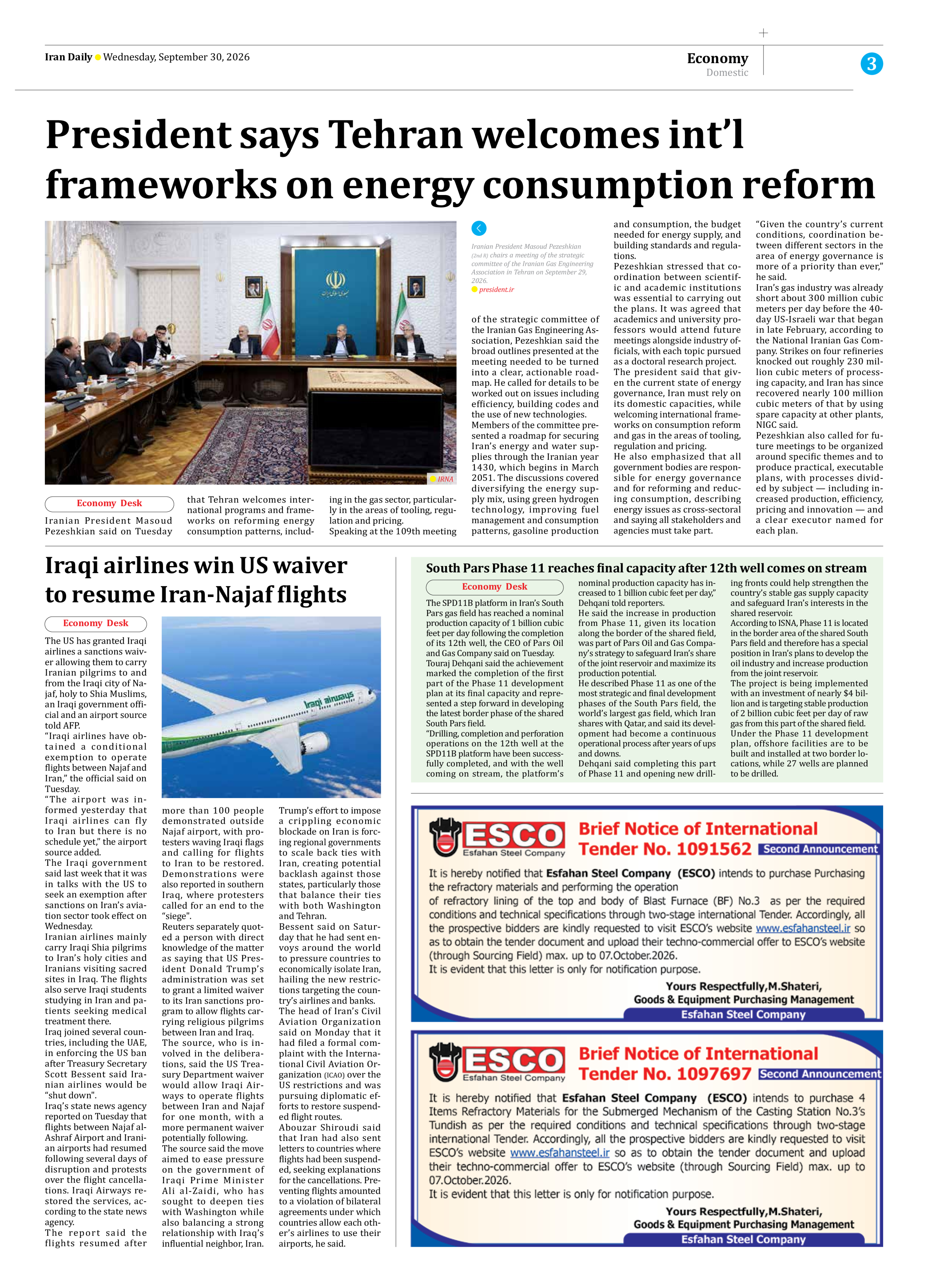
Speaking at the 109th meeting of the strategic committee of the Iranian Gas Engineering Association, Pezeshkian said the broad outlines presented at the meeting needed to be turned into a clear, actionable roadmap. He called for details to be worked out on issues including efficiency, building codes and the use of new technologies.
Members of the committee presented a roadmap for securing Iran’s energy and water supplies through the Iranian year 1430, which begins in March 2051. The discussions covered diversifying the energy supply mix, using green hydrogen technology, improving fuel management and consumption patterns, gasoline production and consumption, the budget needed for energy supply, and building standards and regulations.
Pezeshkian stressed that coordination between scientific and academic institutions was essential to carrying out the plans. It was agreed that academics and university professors would attend future meetings alongside industry officials, with each topic pursued as a doctoral research project.
The president said that given the current state of energy governance, Iran must rely on its domestic capacities, while welcoming international frameworks on consumption reform and gas in the areas of tooling, regulation and pricing.
He also emphasized that all government bodies are responsible for energy governance and for reforming and reducing consumption, describing energy issues as cross-sectoral and saying all stakeholders and agencies must take part.
“Given the country’s current conditions, coordination between different sectors in the area of energy governance is more of a priority than ever,” he said.
Iran’s gas industry was already short about 300 million cubic meters per day before the 40-day US-Israeli war that began in late February, according to the National Iranian Gas Company. Strikes on four refineries knocked out roughly 230 million cubic meters of processing capacity, and Iran has since recovered nearly 100 million cubic meters of that by using spare capacity at other plants, NIGC said.
Pezeshkian also called for future meetings to be organized around specific themes and to produce practical, executable plans, with processes divided by subject — including increased production, efficiency, pricing and innovation — and a clear executor named for each plan.