





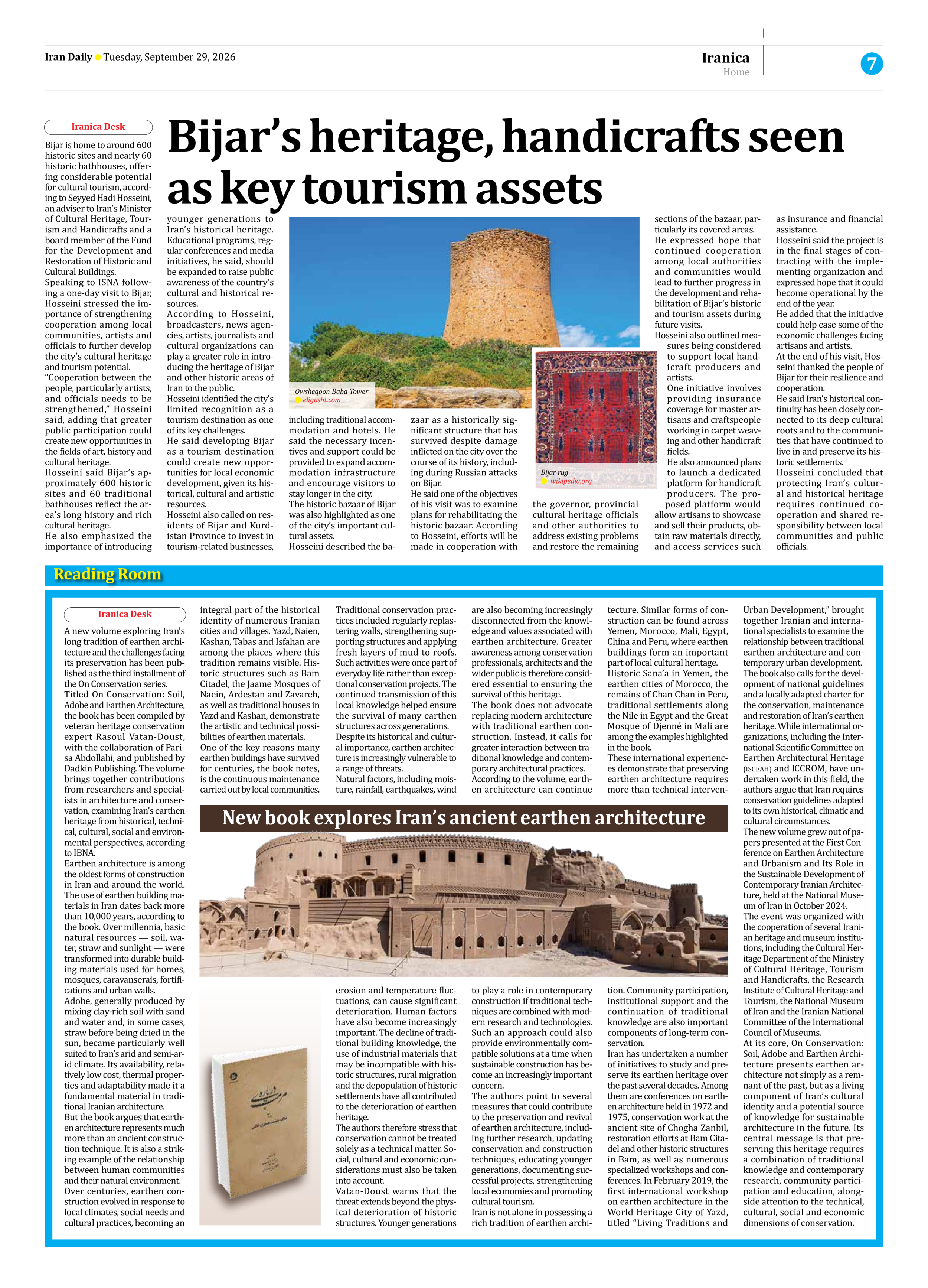


New book explores Iran’s ancient earthen architecture
A new volume exploring Iran’s long tradition of earthen architecture and the challenges facing its preservation has been published as the third installment of the On Conservation series.
Titled On Conservation: Soil, Adobe and Earthen Architecture, the book has been compiled by veteran heritage conservation expert Rasoul Vatan-Doust, with the collaboration of Parisa Abdollahi, and published by Dadkin Publishing. The volume brings together contributions from researchers and specialists in architecture and conservation, examining Iran’s earthen heritage from historical, technical, cultural, social and environmental perspectives, according to IBNA.
Earthen architecture is among the oldest forms of construction in Iran and around the world. The use of earthen building materials in Iran dates back more than 10,000 years, according to the book. Over millennia, basic natural resources — soil, water, straw and sunlight — were transformed into durable building materials used for homes, mosques, caravanserais, fortifications and urban walls.
Adobe, generally produced by mixing clay-rich soil with sand and water and, in some cases, straw before being dried in the sun, became particularly well suited to Iran’s arid and semi-arid climate. Its availability, relatively low cost, thermal properties and adaptability made it a fundamental material in traditional Iranian architecture.
But the book argues that earthen architecture represents much more than an ancient construction technique. It is also a striking example of the relationship between human communities and their natural environment.
Over centuries, earthen construction evolved in response to local climates, social needs and cultural practices, becoming an integral part of the historical identity of numerous Iranian cities and villages. Yazd, Naien, Kashan, Tabas and Isfahan are among the places where this tradition remains visible. Historic structures such as Bam Citadel, the Jaame Mosques of Naein, Ardestan and Zavareh, as well as traditional houses in Yazd and Kashan, demonstrate the artistic and technical possibilities of earthen materials.
One of the key reasons many earthen buildings have survived for centuries, the book notes, is the continuous maintenance carried out by local communities.
Traditional conservation practices included regularly replastering walls, strengthening supporting structures and applying fresh layers of mud to roofs. Such activities were once part of everyday life rather than exceptional conservation projects. The continued transmission of this local knowledge helped ensure the survival of many earthen structures across generations.
Despite its historical and cultural importance, earthen architecture is increasingly vulnerable to a range of threats.
Natural factors, including moisture, rainfall, earthquakes, wind erosion and temperature fluctuations, can cause significant deterioration. Human factors have also become increasingly important. The decline of traditional building knowledge, the use of industrial materials that may be incompatible with historic structures, rural migration and the depopulation of historic settlements have all contributed to the deterioration of earthen heritage.
The authors therefore stress that conservation cannot be treated solely as a technical matter. Social, cultural and economic considerations must also be taken into account.
Vatan-Doust warns that the threat extends beyond the physical deterioration of historic structures. Younger generations are also becoming increasingly disconnected from the knowledge and values associated with earthen architecture. Greater awareness among conservation professionals, architects and the wider public is therefore considered essential to ensuring the survival of this heritage.
The book does not advocate replacing modern architecture with traditional earthen construction. Instead, it calls for greater interaction between traditional knowledge and contemporary architectural practices.
According to the volume, earthen architecture can continue to play a role in contemporary construction if traditional techniques are combined with modern research and technologies. Such an approach could also provide environmentally compatible solutions at a time when sustainable construction has become an increasingly important concern.
The authors point to several measures that could contribute to the preservation and revival of earthen architecture, including further research, updating conservation and construction techniques, educating younger generations, documenting successful projects, strengthening local economies and promoting cultural tourism.
Iran is not alone in possessing a rich tradition of earthen architecture. Similar forms of construction can be found across Yemen, Morocco, Mali, Egypt, China and Peru, where earthen buildings form an important part of local cultural heritage.
Historic Sana’a in Yemen, the earthen cities of Morocco, the remains of Chan Chan in Peru, traditional settlements along the Nile in Egypt and the Great Mosque of Djenné in Mali are among the examples highlighted in the book.
These international experiences demonstrate that preserving earthen architecture requires more than technical intervention. Community participation, institutional support and the continuation of traditional knowledge are also important components of long-term conservation.
Iran has undertaken a number of initiatives to study and preserve its earthen heritage over the past several decades. Among them are conferences on earthen architecture held in 1972 and 1975, conservation work at the ancient site of Chogha Zanbil, restoration efforts at Bam Citadel and other historic structures in Bam, as well as numerous specialized workshops and conferences. In February 2019, the first international workshop on earthen architecture in the World Heritage City of Yazd, titled “Living Traditions and Urban Development,” brought together Iranian and international specialists to examine the relationship between traditional earthen architecture and contemporary urban development.
The book also calls for the development of national guidelines and a locally adapted charter for the conservation, maintenance and restoration of Iran’s earthen heritage. While international organizations, including the International Scientific Committee on Earthen Architectural Heritage (ISCEAH) and ICCROM, have undertaken work in this field, the authors argue that Iran requires conservation guidelines adapted to its own historical, climatic and cultural circumstances.
The new volume grew out of papers presented at the First Conference on Earthen Architecture and Urbanism and Its Role in the Sustainable Development of Contemporary Iranian Architecture, held at the National Museum of Iran in October 2024.
The event was organized with the cooperation of several Iranian heritage and museum institutions, including the Cultural Heritage Department of the Ministry of Cultural Heritage, Tourism and Handicrafts, the Research Institute of Cultural Heritage and Tourism, the National Museum of Iran and the Iranian National Committee of the International Council of Museums.
At its core, On Conservation: Soil, Adobe and Earthen Architecture presents earthen architecture not simply as a remnant of the past, but as a living component of Iran’s cultural identity and a potential source of knowledge for sustainable architecture in the future. Its central message is that preserving this heritage requires a combination of traditional knowledge and contemporary research, community participation and education, alongside attention to the technical, cultural, social and economic dimensions of conservation.