







Iran boosts border terminals, northern ports to keep goods flowing under maritime blockade
Essential goods discharges jump more than 90%, ports chief says
Iran's roads minister said the country has strengthened rail and road border terminals and northern ports to keep goods entering and moving across the country after a US maritime blockade from the south, while the head of the Ports and Maritime Organization said essential goods discharges at northern ports rose more than 90%.
"With the cooperation of various agencies, increasing the transfer of goods through some rail borders was put on the agenda," Roads and Urban Development Minister Farzaneh Sadeq said, according to the Mehr news agency.
Sadeq said that when the maritime blockade was imposed, Iran had to find routes that could break the blockade and keep goods flowing into the country without disruption. She said this required special attention to Iran's territorial capacities, prompting the country to focus on rail and road border terminals as well as northern ports and to use those capacities to keep goods moving.
Sadeq noted the difference in capacity between Iran's northern and southern ports, saying the volume of goods entering through southern ports, particularly containerized cargo, is not comparable to the capacity of northern ports. However, she said, using northern port capacity became important once maritime routes were restricted.
Since late February, when a US-Israeli coalition launched a 40-day war, Iran has been operating under wartime conditions as well as a US maritime blockade from the south.
Iran, already under decades of Western sanctions over its nuclear activities, has faced a new wave of US sanctions, with Treasury Secretary Scott Bessent saying last week that Iranian airlines would be shut down from Sept. 23 through secondary sanctions on foreign aviation service providers.
Relatedly, the head of the Ports and Maritime Organization said on Monday that essential goods discharges at northern ports had risen more than 90%, pointing to 24-hour port and customs operations and a significant drop in the time needed to unload vessels and the dwell time of goods at port terminals and transit borders.
Mohammad Shakibi-Nasab, speaking to reporters on Monday, outlined the organization's latest steps to develop capacity and improve efficiency at Iranian ports, especially in the north, according to the IRNA.
"In the area of cargo storage, in addition to operational capacity inside the ports, more than 55% of storage capacity now exists in areas around the ports under customs supervision, and optimal use of these facilities has eased the process of warehousing and storing goods," he said.
"One of the main concerns of traders was the supply of strategic equipment at northern ports, and in this regard, part of the loading and unloading equipment was transferred from southern ports to the north of the country," he said.
The deputy roads minister, citing figures recorded this year, said that compared with the same period last year, northern ports saw a rise of more than 90% in essential goods discharges and a roughly 65% increase in the discharge and loading of other goods.
He said northern ports accounted for about 18% of the country's total essential goods discharges in previous years, but that share has now jumped to about 31%, a bright horizon that will become clearer with continued software and hardware programs and the equipping of northern ports.
Ship unloading time cut from 10 days to under 3
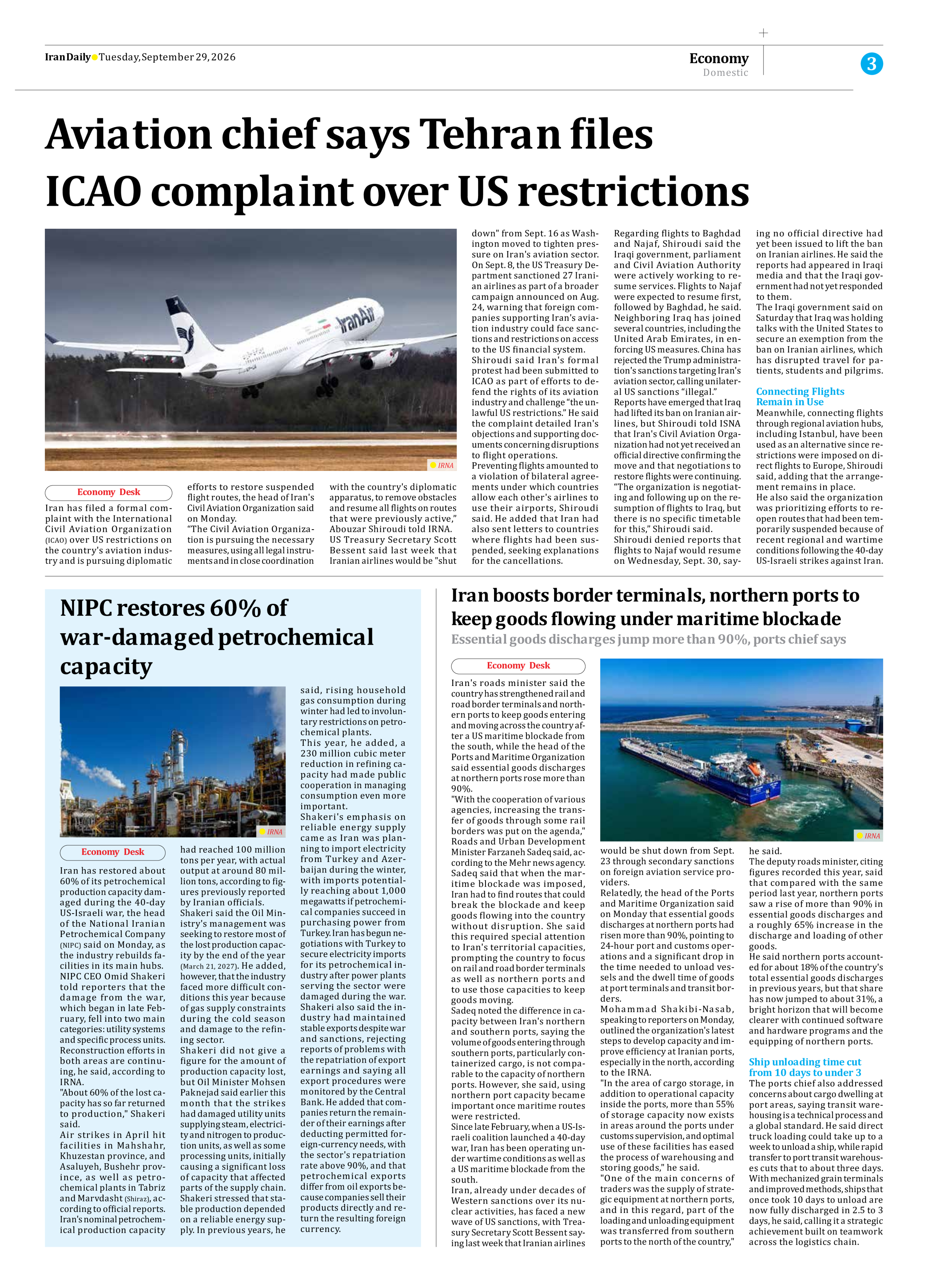
The ports chief also addressed concerns about cargo dwelling at port areas, saying transit warehousing is a technical process and a global standard. He said direct truck loading could take up to a week to unload a ship, while rapid transfer to port transit warehouses cuts that to about three days. With mechanized grain terminals and improved methods, ships that once took 10 days to unload are now fully discharged in 2.5 to 3 days, he said, calling it a strategic achievement built on teamwork across the logistics chain.