







Shabestar connects history, nature, culture
Shabestar, in East Azarbaijan Province, may at first glance be defined by a handful of well-known historic landmarks. Yet the region’s tourism potential extends far beyond a single monument or a particular historical period. A diverse collection of historical, natural and cultural attractions, along with traditional handicrafts, is scattered across the towns and villages of the city. If properly introduced and connected, these assets could turn Shabestar into one of northwestern Iran’s most diverse tourism destinations.
According to available information, 45 historical, natural and cultural sites in Shabestar have been registered on Iran’s National Heritage List. In addition, four natural sites and two examples of intangible cultural heritage have been included on national registers. However, what could further highlight Shabestar’s tourism potential is not simply increasing visitor numbers at individual attractions, but creating a coherent tourism route linking the city’s various destinations, according to chtn.ir.
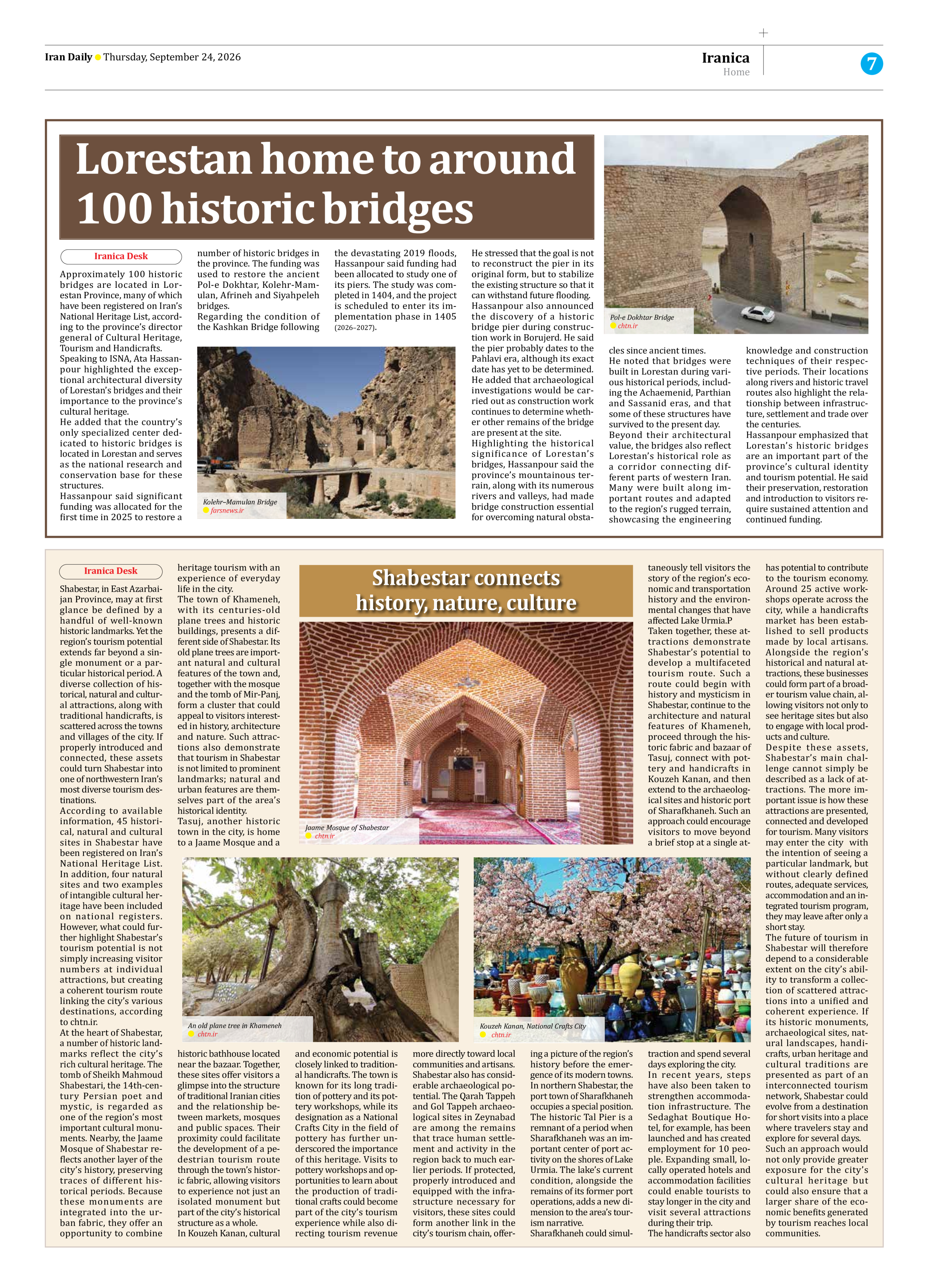
At the heart of Shabestar, a number of historic landmarks reflect the city’s rich cultural heritage. The tomb of Sheikh Mahmoud Shabestari, the 14th-century Persian poet and mystic, is regarded as one of the region’s most important cultural monuments. Nearby, the Jaame Mosque of Shabestar reflects another layer of the city’s history, preserving traces of different historical periods. Because these monuments are integrated into the urban fabric, they offer an opportunity to combine heritage tourism with an experience of everyday life in the city.
The town of Khameneh, with its centuries-old plane trees and historic buildings, presents a different side of Shabestar. Its old plane trees are important natural and cultural features of the town and, together with the mosque and the tomb of Mir-Panj, form a cluster that could appeal to visitors interested in history, architecture and nature. Such attractions also demonstrate that tourism in Shabestar is not limited to prominent landmarks; natural and urban features are themselves part of the area’s historical identity.
Tasuj, another historic town in the city, is home to a Jaame Mosque and a historic bathhouse located near the bazaar. Together, these sites offer visitors a glimpse into the structure of traditional Iranian cities and the relationship between markets, mosques and public spaces. Their proximity could facilitate the development of a pedestrian tourism route through the town’s historic fabric, allowing visitors to experience not just an isolated monument but part of the city’s historical structure as a whole.
In Kouzeh Kanan, cultural and economic potential is closely linked to traditional handicrafts. The town is known for its long tradition of pottery and its pottery workshops, while its designation as a National Crafts City in the field of pottery has further underscored the importance of this heritage. Visits to pottery workshops and opportunities to learn about the production of traditional crafts could become part of the city’s tourism experience while also directing tourism revenue more directly toward local communities and artisans.
Shabestar also has considerable archaeological potential. The Qarah Tappeh and Gol Tappeh archaeological sites in Zeynabad are among the remains that trace human settlement and activity in the region back to much earlier periods. If protected, properly introduced and equipped with the infrastructure necessary for visitors, these sites could form another link in the city’s tourism chain, offering a picture of the region’s history before the emergence of its modern towns.
In northern Shabestar, the port town of Sharafkhaneh occupies a special position. The historic Tal Pier is a remnant of a period when Sharafkhaneh was an important center of port activity on the shores of Lake Urmia. The lake’s current condition, alongside the remains of its former port operations, adds a new dimension to the area’s tourism narrative.
Sharafkhaneh could simultaneously tell visitors the story of the region’s economic and transportation history and the environmental changes that have affected Lake Urmia.P
Taken together, these attractions demonstrate Shabestar’s potential to develop a multifaceted tourism route. Such a route could begin with history and mysticism in Shabestar, continue to the architecture and natural features of Khameneh, proceed through the historic fabric and bazaar of Tasuj, connect with pottery and handicrafts in Kouzeh Kanan, and then extend to the archaeological sites and historic port of Sharafkhaneh. Such an approach could encourage visitors to move beyond a brief stop at a single attraction and spend several days exploring the city.
In recent years, steps have also been taken to strengthen accommodation infrastructure. The Sedaghat Boutique Hotel, for example, has been launched and has created employment for 10 people. Expanding small, locally operated hotels and accommodation facilities could enable tourists to stay longer in the city and visit several attractions during their trip.
The handicrafts sector also has potential to contribute to the tourism economy. Around 25 active workshops operate across the city, while a handicrafts market has been established to sell products made by local artisans. Alongside the region’s historical and natural attractions, these businesses could form part of a broader tourism value chain, allowing visitors not only to see heritage sites but also to engage with local products and culture.
Despite these assets, Shabestar’s main challenge cannot simply be described as a lack of attractions. The more important issue is how these attractions are presented, connected and developed for tourism. Many visitors may enter the city with the intention of seeing a particular landmark, but without clearly defined routes, adequate services, accommodation and an integrated tourism program, they may leave after only a short stay.
The future of tourism in Shabestar will therefore depend to a considerable extent on the city’s ability to transform a collection of scattered attractions into a unified and coherent experience. If its historic monuments, archaeological sites, natural landscapes, handicrafts, urban heritage and cultural traditions are presented as part of an interconnected tourism network, Shabestar could evolve from a destination for short visits into a place where travelers stay and explore for several days.
Such an approach would not only provide greater exposure for the city’s cultural heritage but could also ensure that a larger share of the economic benefits generated by tourism reaches local communities.