







Lorestan home to around 100 historic bridges
Approximately 100 historic bridges are located in Lorestan Province, many of which have been registered on Iran’s National Heritage List, according to the province’s director general of Cultural Heritage, Tourism and Handicrafts.
Speaking to ISNA, Ata Hassanpour highlighted the exceptional architectural diversity of Lorestan’s bridges and their importance to the province’s cultural heritage.
He added that the country’s only specialized center dedicated to historic bridges is located in Lorestan and serves as the national research and conservation base for these structures.
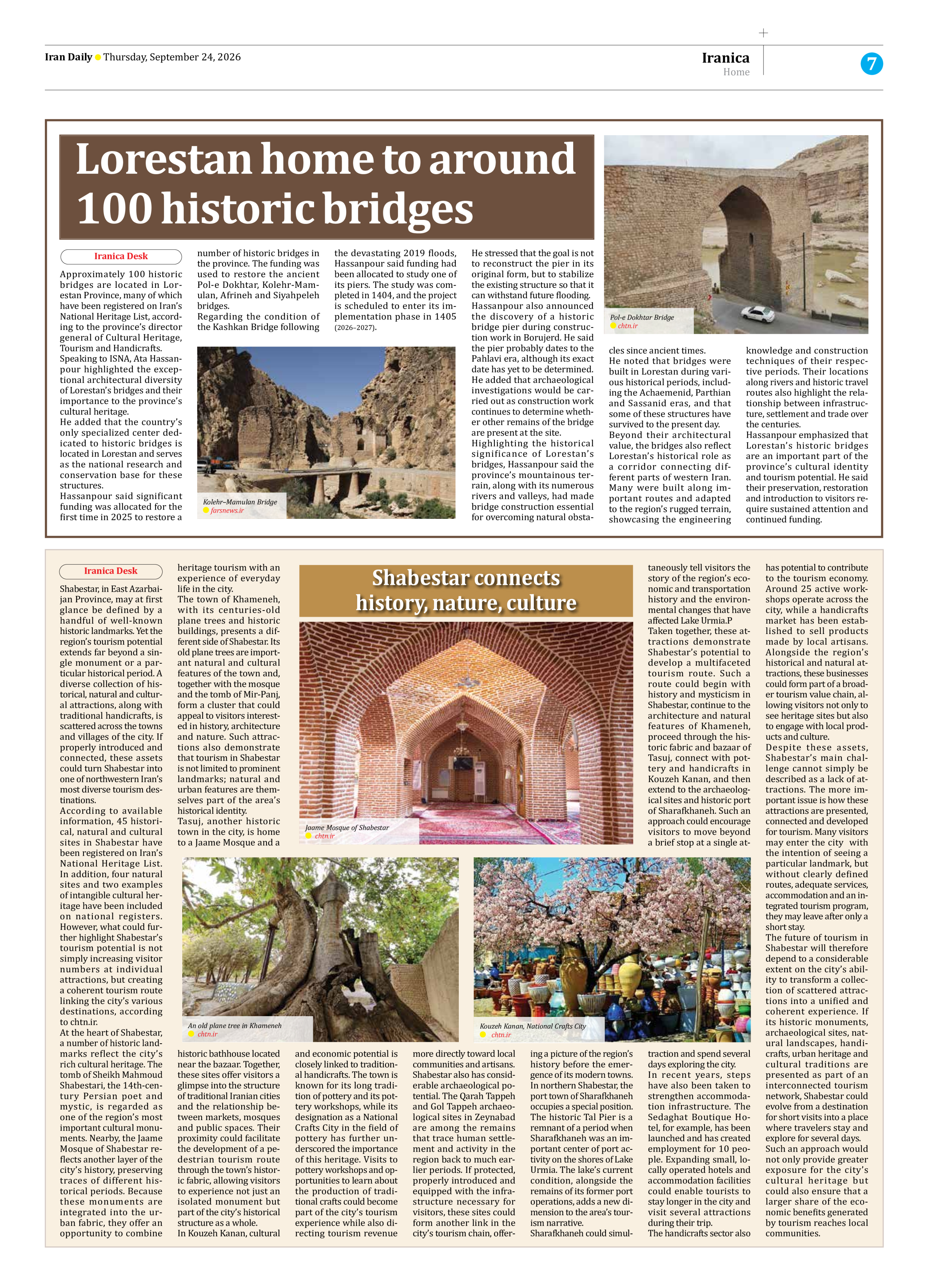
Hassanpour said significant funding was allocated for the first time in 2025 to restore a number of historic bridges in the province. The funding was used to restore the ancient Pol-e Dokhtar, Kolehr-Mamulan, Afrineh and Siyahpeleh bridges.
Regarding the condition of the Kashkan Bridge following the devastating 2019 floods, Hassanpour said funding had been allocated to study one of its piers. The study was completed in 1404, and the project is scheduled to enter its implementation phase in 1405 (2026–2027).
He stressed that the goal is not to reconstruct the pier in its original form, but to stabilize the existing structure so that it can withstand future flooding.
Hassanpour also announced the discovery of a historic bridge pier during construction work in Borujerd. He said the pier probably dates to the Pahlavi era, although its exact date has yet to be determined.
He added that archaeological investigations would be carried out as construction work continues to determine whether other remains of the bridge are present at the site.
Highlighting the historical significance of Lorestan’s bridges, Hassanpour said the province’s mountainous terrain, along with its numerous rivers and valleys, had made bridge construction essential for overcoming natural obstacles since ancient times.
He noted that bridges were built in Lorestan during various historical periods, including the Achaemenid, Parthian and Sassanid eras, and that some of these structures have survived to the present day.
Beyond their architectural value, the bridges also reflect Lorestan’s historical role as a corridor connecting different parts of western Iran. Many were built along important routes and adapted to the region’s rugged terrain, showcasing the engineering knowledge and construction techniques of their respective periods. Their locations along rivers and historic travel routes also highlight the relationship between infrastructure, settlement and trade over the centuries.
Hassanpour emphasized that Lorestan’s historic bridges are an important part of the province’s cultural identity and tourism potential. He said their preservation, restoration and introduction to visitors require sustained attention and continued funding.