







Asara seeks to unlock its tourism potential
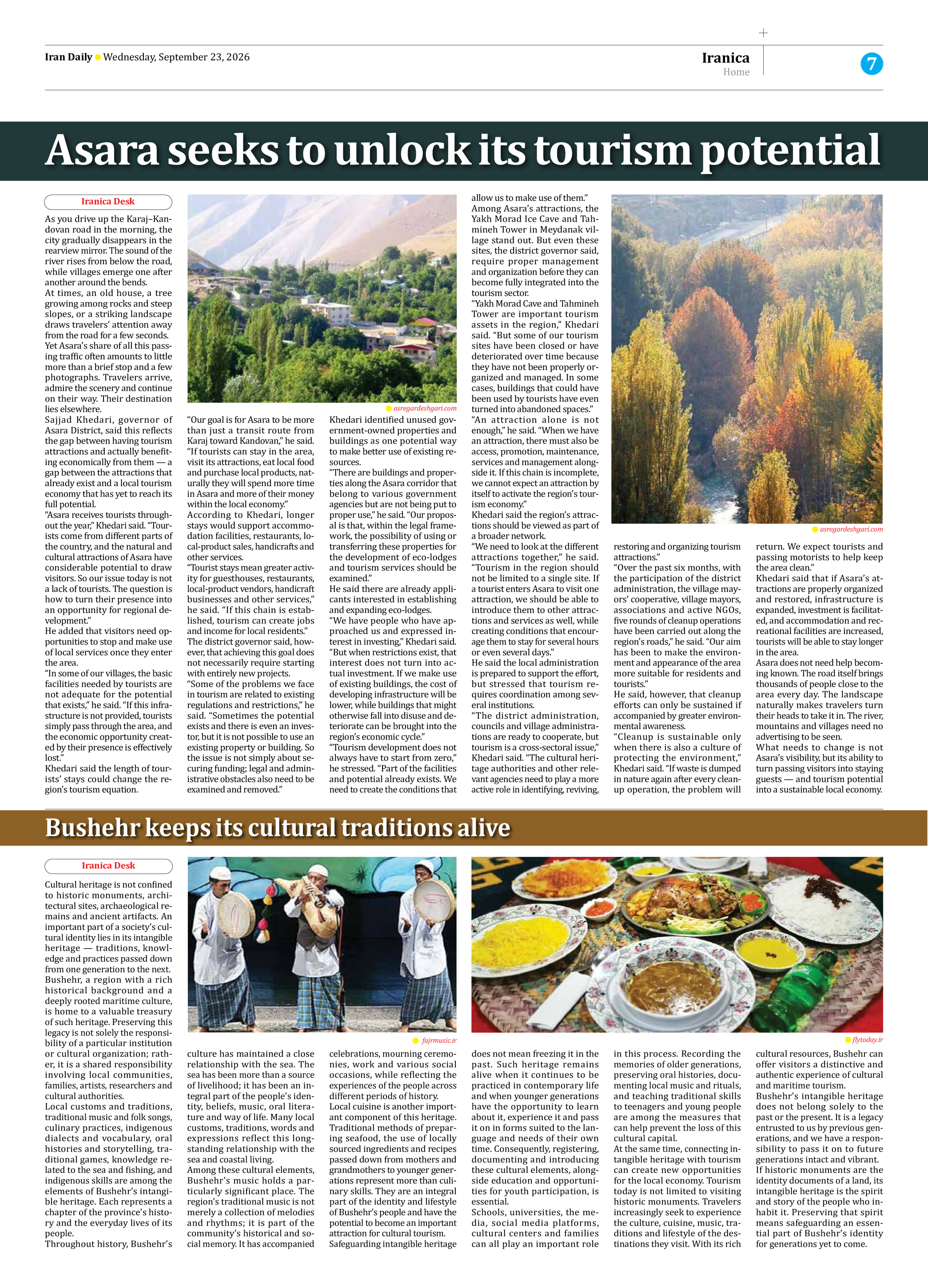
As you drive up the Karaj–Kandovan road in the morning, the city gradually disappears in the rearview mirror. The sound of the river rises from below the road, while villages emerge one after another around the bends.
At times, an old house, a tree growing among rocks and steep slopes, or a striking landscape draws travelers’ attention away from the road for a few seconds.
Yet Asara’s share of all this passing traffic often amounts to little more than a brief stop and a few photographs. Travelers arrive, admire the scenery and continue on their way. Their destination lies elsewhere.
Sajjad Khedari, governor of Asara District, said this reflects the gap between having tourism attractions and actually benefiting economically from them — a gap between the attractions that already exist and a local tourism economy that has yet to reach its full potential.
“Asara receives tourists throughout the year,” Khedari said. “Tourists come from different parts of the country, and the natural and cultural attractions of Asara have considerable potential to draw visitors. So our issue today is not a lack of tourists. The question is how to turn their presence into an opportunity for regional development.”
He added that visitors need opportunities to stop and make use of local services once they enter the area.
“In some of our villages, the basic facilities needed by tourists are not adequate for the potential that exists,” he said. “If this infrastructure is not provided, tourists simply pass through the area, and the economic opportunity created by their presence is effectively lost.”
Khedari said the length of tourists’ stays could change the region’s tourism equation.
“Our goal is for Asara to be more than just a transit route from Karaj toward Kandovan,” he said. “If tourists can stay in the area, visit its attractions, eat local food and purchase local products, naturally they will spend more time in Asara and more of their money within the local economy.”
According to Khedari, longer stays would support accommodation facilities, restaurants, local-product sales, handicrafts and other services.
“Tourist stays mean greater activity for guesthouses, restaurants, local-product vendors, handicraft businesses and other services,” he said. “If this chain is established, tourism can create jobs and income for local residents.”
The district governor said, however, that achieving this goal does not necessarily require starting with entirely new projects.
“Some of the problems we face in tourism are related to existing regulations and restrictions,” he said. “Sometimes the potential exists and there is even an investor, but it is not possible to use an existing property or building. So the issue is not simply about securing funding; legal and administrative obstacles also need to be examined and removed.”
Khedari identified unused government-owned properties and buildings as one potential way to make better use of existing resources.
“There are buildings and properties along the Asara corridor that belong to various government agencies but are not being put to proper use,” he said. “Our proposal is that, within the legal framework, the possibility of using or transferring these properties for the development of eco-lodges and tourism services should be examined.”
He said there are already applicants interested in establishing and expanding eco-lodges.
“We have people who have approached us and expressed interest in investing,” Khedari said. “But when restrictions exist, that interest does not turn into actual investment. If we make use of existing buildings, the cost of developing infrastructure will be lower, while buildings that might otherwise fall into disuse and deteriorate can be brought into the region’s economic cycle.”
“Tourism development does not always have to start from zero,” he stressed. “Part of the facilities and potential already exists. We need to create the conditions that allow us to make use of them.”
Among Asara’s attractions, the Yakh Morad Ice Cave and Tahmineh Tower in Meydanak village stand out. But even these sites, the district governor said, require proper management and organization before they can become fully integrated into the tourism sector.
“Yakh Morad Cave and Tahmineh Tower are important tourism assets in the region,” Khedari said. “But some of our tourism sites have been closed or have deteriorated over time because they have not been properly organized and managed. In some cases, buildings that could have been used by tourists have even turned into abandoned spaces.”
“An attraction alone is not enough,” he said. “When we have an attraction, there must also be access, promotion, maintenance, services and management alongside it. If this chain is incomplete, we cannot expect an attraction by itself to activate the region’s tourism economy.”
Khedari said the region’s attractions should be viewed as part of a broader network.
“We need to look at the different attractions together,” he said. “Tourism in the region should not be limited to a single site. If a tourist enters Asara to visit one attraction, we should be able to introduce them to other attractions and services as well, while creating conditions that encourage them to stay for several hours or even several days.”
He said the local administration is prepared to support the effort, but stressed that tourism requires coordination among several institutions.
“The district administration, councils and village administrations are ready to cooperate, but tourism is a cross-sectoral issue,” Khedari said. “The cultural heritage authorities and other relevant agencies need to play a more active role in identifying, reviving, restoring and organizing tourism attractions.”
“Over the past six months, with the participation of the district administration, the village mayors’ cooperative, village mayors, associations and active NGOs, five rounds of cleanup operations have been carried out along the region’s roads,” he said. “Our aim has been to make the environment and appearance of the area more suitable for residents and tourists.”
He said, however, that cleanup efforts can only be sustained if accompanied by greater environmental awareness.
“Cleanup is sustainable only when there is also a culture of protecting the environment,” Khedari said. “If waste is dumped in nature again after every cleanup operation, the problem will return. We expect tourists and passing motorists to help keep the area clean.”
Khedari said that if Asara’s attractions are properly organized and restored, infrastructure is expanded, investment is facilitated, and accommodation and recreational facilities are increased, tourists will be able to stay longer in the area.
Asara does not need help becoming known. The road itself brings thousands of people close to the area every day. The landscape naturally makes travelers turn their heads to take it in. The river, mountains and villages need no advertising to be seen.
What needs to change is not Asara’s visibility, but its ability to turn passing visitors into staying guests — and tourism potential into a sustainable local economy.