





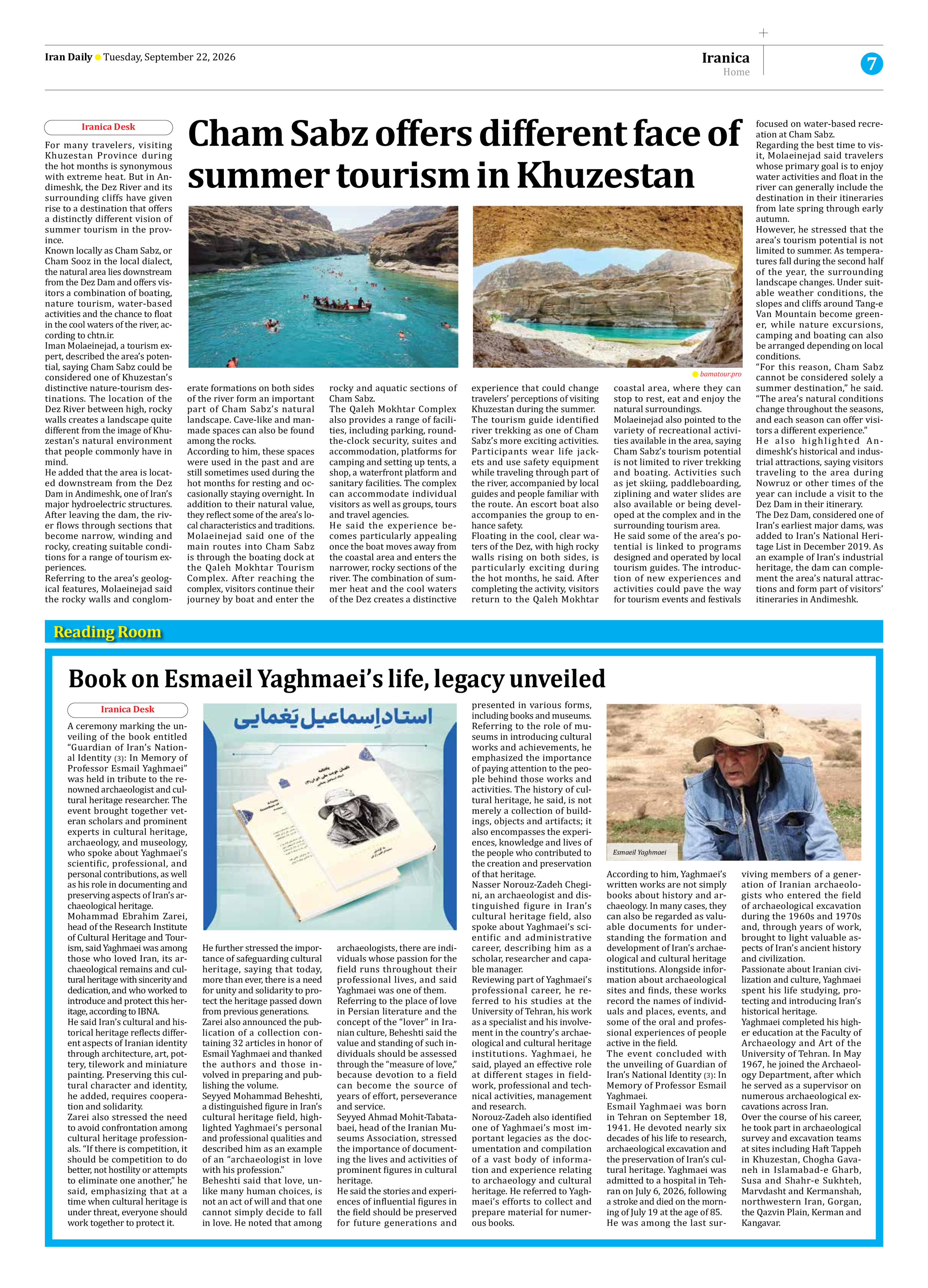


Book on Esmaeil Yaghmaei’s life, legacy unveiled
A ceremony marking the unveiling of the book entitled “Guardian of Iran’s National Identity (3): In Memory of Professor Esmail Yaghmaei” was held in tribute to the renowned archaeologist and cultural heritage researcher. The event brought together veteran scholars and prominent experts in cultural heritage, archaeology, and museology, who spoke about Yaghmaei’s scientific, professional, and personal contributions, as well as his role in documenting and preserving aspects of Iran’s archaeological heritage.
Mohammad Ebrahim Zarei, head of the Research Institute of Cultural Heritage and Tourism, said Yaghmaei was among those who loved Iran, its archaeological remains and cultural heritage with sincerity and dedication, and who worked to introduce and protect this heritage, according to IBNA.
He said Iran’s cultural and historical heritage reflects different aspects of Iranian identity through architecture, art, pottery, tilework and miniature painting. Preserving this cultural character and identity, he added, requires cooperation and solidarity.
Zarei also stressed the need to avoid confrontation among cultural heritage professionals. “If there is competition, it should be competition to do better, not hostility or attempts to eliminate one another,” he said, emphasizing that at a time when cultural heritage is under threat, everyone should work together to protect it.
He further stressed the importance of safeguarding cultural heritage, saying that today, more than ever, there is a need for unity and solidarity to protect the heritage passed down from previous generations.
Zarei also announced the publication of a collection containing 32 articles in honor of Esmail Yaghmaei and thanked the authors and those involved in preparing and publishing the volume.
Seyyed Mohammad Beheshti, a distinguished figure in Iran’s cultural heritage field, highlighted Yaghmaei’s personal and professional qualities and described him as an example of an “archaeologist in love with his profession.”
Beheshti said that love, unlike many human choices, is not an act of will and that one cannot simply decide to fall in love. He noted that among archaeologists, there are individuals whose passion for the field runs throughout their professional lives, and said Yaghmaei was one of them.
Referring to the place of love in Persian literature and the concept of the “lover” in Iranian culture, Beheshti said the value and standing of such individuals should be assessed through the “measure of love,” because devotion to a field can become the source of years of effort, perseverance and service.
Seyyed Ahmad Mohit-Tabatabaei, head of the Iranian Museums Association, stressed the importance of documenting the lives and activities of prominent figures in cultural heritage.
He said the stories and experiences of influential figures in the field should be preserved for future generations and presented in various forms, including books and museums.
Referring to the role of museums in introducing cultural works and achievements, he emphasized the importance of paying attention to the people behind those works and activities. The history of cultural heritage, he said, is not merely a collection of buildings, objects and artifacts; it also encompasses the experiences, knowledge and lives of the people who contributed to the creation and preservation of that heritage.
Nasser Norouz-Zadeh Chegini, an archaeologist and distinguished figure in Iran’s cultural heritage field, also spoke about Yaghmaei’s scientific and administrative career, describing him as a scholar, researcher and capable manager.
Reviewing part of Yaghmaei’s professional career, he referred to his studies at the University of Tehran, his work as a specialist and his involvement in the country’s archaeological and cultural heritage institutions. Yaghmaei, he said, played an effective role at different stages in fieldwork, professional and technical activities, management and research.
Norouz-Zadeh also identified one of Yaghmaei’s most important legacies as the documentation and compilation of a vast body of information and experience relating to archaeology and cultural heritage. He referred to Yaghmaei’s efforts to collect and prepare material for numerous books.
According to him, Yaghmaei’s written works are not simply books about history and archaeology. In many cases, they can also be regarded as valuable documents for understanding the formation and development of Iran’s archaeological and cultural heritage institutions. Alongside information about archaeological sites and finds, these works record the names of individuals and places, events, and some of the oral and professional experiences of people active in the field.
The event concluded with the unveiling of Guardian of Iran’s National Identity (3): In Memory of Professor Esmail Yaghmaei.
Esmail Yaghmaei was born in Tehran on September 18, 1941. He devoted nearly six decades of his life to research, archaeological excavation and the preservation of Iran’s cultural heritage. Yaghmaei was admitted to a hospital in Tehran on July 6, 2026, following a stroke and died on the morning of July 19 at the age of 85.
He was among the last surviving members of a generation of Iranian archaeologists who entered the field of archaeological excavation during the 1960s and 1970s and, through years of work, brought to light valuable aspects of Iran’s ancient history and civilization.
Passionate about Iranian civilization and culture, Yaghmaei spent his life studying, protecting and introducing Iran’s historical heritage.
Yaghmaei completed his higher education at the Faculty of Archaeology and Art of the University of Tehran. In May 1967, he joined the Archaeology Department, after which he served as a supervisor on numerous archaeological excavations across Iran.
Over the course of his career, he took part in archaeological survey and excavation teams at sites including Haft Tappeh in Khuzestan, Chogha Gavaneh in Islamabad-e Gharb, Susa and Shahr-e Sukhteh, Marvdasht and Kermanshah, northwestern Iran, Gorgan, the Qazvin Plain, Kerman and Kangavar.