







Shiraz’s engraving tradition keeps Persian heritage alive
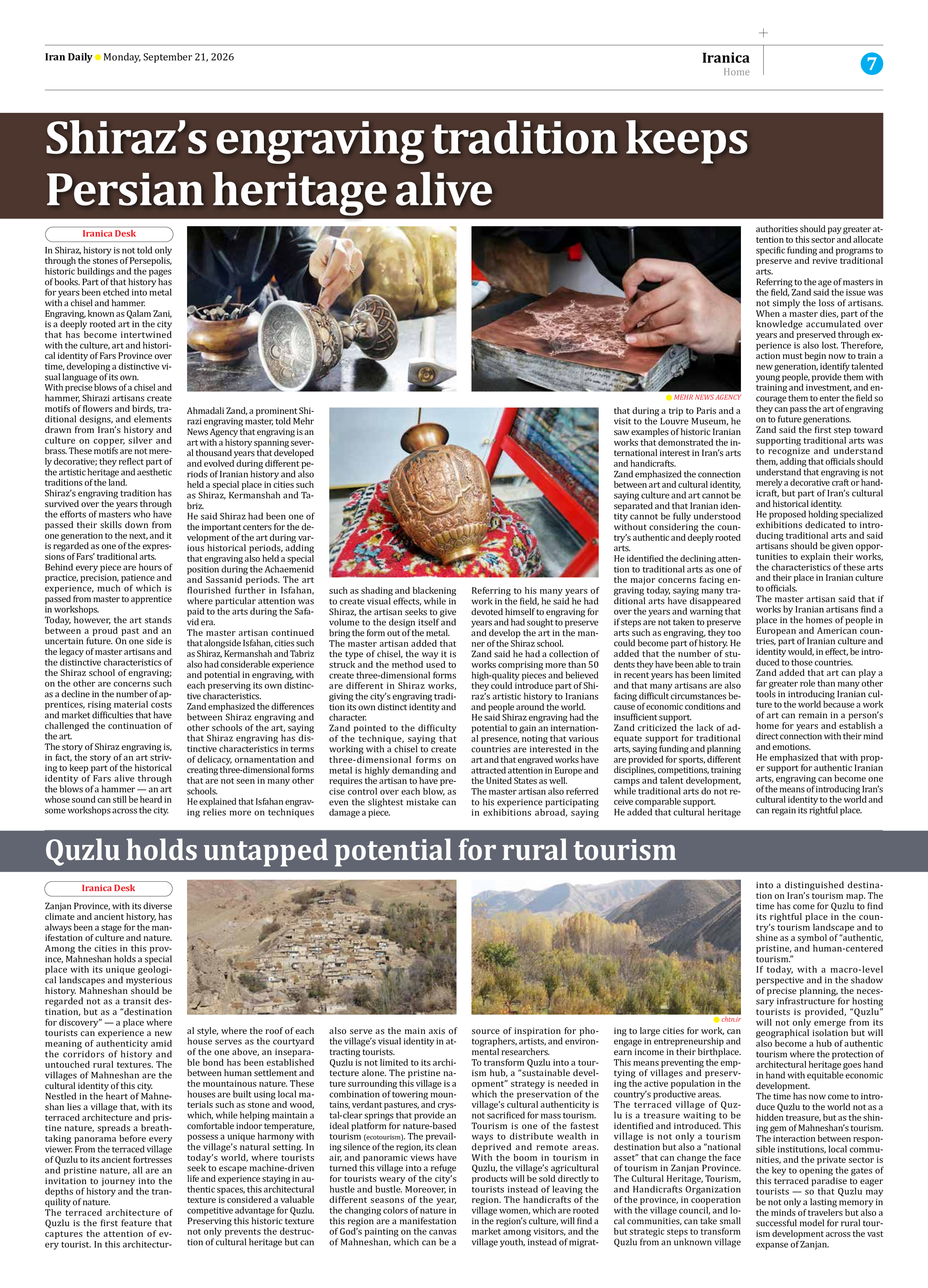
In Shiraz, history is not told only through the stones of Persepolis, historic buildings and the pages of books. Part of that history has for years been etched into metal with a chisel and hammer.
Engraving, known as Qalam Zani, is a deeply rooted art in the city that has become intertwined with the culture, art and historical identity of Fars Province over time, developing a distinctive visual language of its own.
With precise blows of a chisel and hammer, Shirazi artisans create motifs of flowers and birds, traditional designs, and elements drawn from Iran’s history and culture on copper, silver and brass. These motifs are not merely decorative; they reflect part of the artistic heritage and aesthetic traditions of the land.
Shiraz’s engraving tradition has survived over the years through the efforts of masters who have passed their skills down from one generation to the next, and it is regarded as one of the expressions of Fars’ traditional arts.
Behind every piece are hours of practice, precision, patience and experience, much of which is passed from master to apprentice in workshops.
Today, however, the art stands between a proud past and an uncertain future. On one side is the legacy of master artisans and the distinctive characteristics of the Shiraz school of engraving; on the other are concerns such as a decline in the number of apprentices, rising material costs and market difficulties that have challenged the continuation of the art.
The story of Shiraz engraving is, in fact, the story of an art striving to keep part of the historical identity of Fars alive through the blows of a hammer — an art whose sound can still be heard in some workshops across the city.
Ahmadali Zand, a prominent Shirazi engraving master, told Mehr News Agency that engraving is an art with a history spanning several thousand years that developed and evolved during different periods of Iranian history and also held a special place in cities such as Shiraz, Kermanshah and Tabriz.
He said Shiraz had been one of the important centers for the development of the art during various historical periods, adding that engraving also held a special position during the Achaemenid and Sassanid periods. The art flourished further in Isfahan, where particular attention was paid to the arts during the Safavid era.
The master artisan continued that alongside Isfahan, cities such as Shiraz, Kermanshah and Tabriz also had considerable experience and potential in engraving, with each preserving its own distinctive characteristics.
Zand emphasized the differences between Shiraz engraving and other schools of the art, saying that Shiraz engraving has distinctive characteristics in terms of delicacy, ornamentation and creating three-dimensional forms that are not seen in many other schools.
He explained that Isfahan engraving relies more on techniques such as shading and blackening to create visual effects, while in Shiraz, the artisan seeks to give volume to the design itself and bring the form out of the metal.
The master artisan added that the type of chisel, the way it is struck and the method used to create three-dimensional forms are different in Shiraz works, giving the city’s engraving tradition its own distinct identity and character.
Zand pointed to the difficulty of the technique, saying that working with a chisel to create three-dimensional forms on metal is highly demanding and requires the artisan to have precise control over each blow, as even the slightest mistake can damage a piece.
Referring to his many years of work in the field, he said he had devoted himself to engraving for years and had sought to preserve and develop the art in the manner of the Shiraz school.
Zand said he had a collection of works comprising more than 50 high-quality pieces and believed they could introduce part of Shiraz’s artistic history to Iranians and people around the world.
He said Shiraz engraving had the potential to gain an international presence, noting that various countries are interested in the art and that engraved works have attracted attention in Europe and the United States as well.
The master artisan also referred to his experience participating in exhibitions abroad, saying that during a trip to Paris and a visit to the Louvre Museum, he saw examples of historic Iranian works that demonstrated the international interest in Iran’s arts and handicrafts.
Zand emphasized the connection between art and cultural identity, saying culture and art cannot be separated and that Iranian identity cannot be fully understood without considering the country’s authentic and deeply rooted arts.
He identified the declining attention to traditional arts as one of the major concerns facing engraving today, saying many traditional arts have disappeared over the years and warning that if steps are not taken to preserve arts such as engraving, they too could become part of history. He added that the number of students they have been able to train in recent years has been limited and that many artisans are also facing difficult circumstances because of economic conditions and insufficient support.
Zand criticized the lack of adequate support for traditional arts, saying funding and planning are provided for sports, different disciplines, competitions, training camps and talent development, while traditional arts do not receive comparable support.
He added that cultural heritage authorities should pay greater attention to this sector and allocate specific funding and programs to preserve and revive traditional arts.
Referring to the age of masters in the field, Zand said the issue was not simply the loss of artisans. When a master dies, part of the knowledge accumulated over years and preserved through experience is also lost. Therefore, action must begin now to train a new generation, identify talented young people, provide them with training and investment, and encourage them to enter the field so they can pass the art of engraving on to future generations.
Zand said the first step toward supporting traditional arts was to recognize and understand them, adding that officials should understand that engraving is not merely a decorative craft or handicraft, but part of Iran’s cultural and historical identity.
He proposed holding specialized exhibitions dedicated to introducing traditional arts and said artisans should be given opportunities to explain their works, the characteristics of these arts and their place in Iranian culture to officials.
The master artisan said that if works by Iranian artisans find a place in the homes of people in European and American countries, part of Iranian culture and identity would, in effect, be introduced to those countries.
Zand added that art can play a far greater role than many other tools in introducing Iranian culture to the world because a work of art can remain in a person’s home for years and establish a direct connection with their mind and emotions.
He emphasized that with proper support for authentic Iranian arts, engraving can become one of the means of introducing Iran’s cultural identity to the world and can regain its rightful place.