







Khash Grand Mosque stands as a historic symbol of Shia-Sunni unity
The beautiful and unique historic Khash Grand (Jaame) Mosque in Sistan and Baluchestan Province is a prominent symbol of Shia-Sunni unity dating back generations and is among the city’s notable tourist attractions.
According to IRNA, the mosque has long served, both before and after the Islamic Revolution, as a venue for religious ceremonies, public gatherings and meetings attended by Persian and Baluch communities and followers of Shia and Sunni Islam. It has also been a place for prayer and worship.
Khash has long been regarded as a center of friendship, brotherhood, solidarity and ethnic and religious unity in the region, where residents have maintained close social ties and worked together to address one another’s concerns.
In the past, Khash lacked a suitable mosque for congregational prayer and worship. About a century ago, a benefactor named Emami, a Yazdi resident of Khash, took the initiative to build a mosque. Later, an army commander undertook the construction and completion of its minaret.
At the time, the groundwater table in Khash was very high. After the foundations were excavated and the first stones were laid, water began to rise. However, local residents and workers worked together, using stone and lime to prevent the water from advancing. The religious site subsequently became a symbol of unity and solidarity and a gathering place for worshippers.
In later years, as the mosque could no longer accommodate Friday prayers and related religious and civic ceremonies, the Friday prayer leader and residents of Khash decided to build a larger mosque next to it that would better accommodate the number of worshippers.
The head of the Khash Department of Cultural Heritage, Tourism and Handicrafts said the original structure of the mosque dates back to 1928.
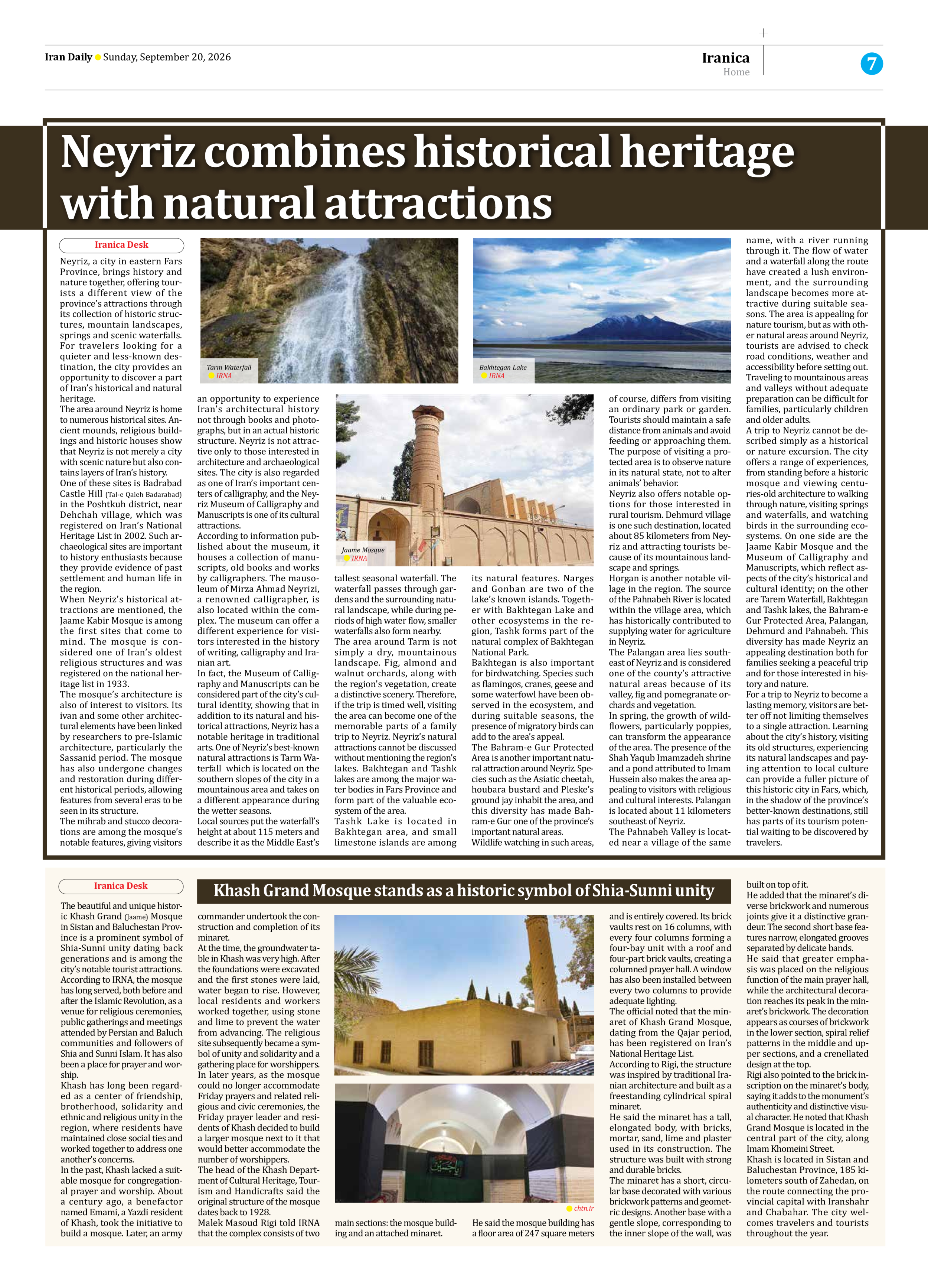
Malek Masoud Rigi told IRNA that the complex consists of two main sections: the mosque building and an attached minaret.
He said the mosque building has a floor area of 247 square meters and is entirely covered. Its brick vaults rest on 16 columns, with every four columns forming a four-bay unit with a roof and four-part brick vaults, creating a columned prayer hall. A window has also been installed between every two columns to provide adequate lighting.
The official noted that the minaret of Khash Grand Mosque, dating from the Qajar period, has been registered on Iran’s National Heritage List.
According to Rigi, the structure was inspired by traditional Iranian architecture and built as a freestanding cylindrical spiral minaret.
He said the minaret has a tall, elongated body, with bricks, mortar, sand, lime and plaster used in its construction. The structure was built with strong and durable bricks.
The minaret has a short, circular base decorated with various brickwork patterns and geometric designs. Another base with a gentle slope, corresponding to the inner slope of the wall, was built on top of it.
He added that the minaret’s diverse brickwork and numerous joints give it a distinctive grandeur. The second short base features narrow, elongated grooves separated by delicate bands.
He said that greater emphasis was placed on the religious function of the main prayer hall, while the architectural decoration reaches its peak in the minaret’s brickwork. The decoration appears as courses of brickwork in the lower section, spiral relief patterns in the middle and upper sections, and a crenellated design at the top.
Rigi also pointed to the brick inscription on the minaret’s body, saying it adds to the monument’s authenticity and distinctive visual character. He noted that Khash Grand Mosque is located in the central part of the city, along Imam Khomeini Street.
Khash is located in Sistan and Baluchestan Province, 185 kilometers south of Zahedan, on the route connecting the provincial capital with Iranshahr and Chabahar. The city welcomes travelers and tourists throughout the year.