







Neyriz combines historical heritage with natural attractions
Neyriz, a city in eastern Fars Province, brings history and nature together, offering tourists a different view of the province’s attractions through its collection of historic structures, mountain landscapes, springs and scenic waterfalls. For travelers looking for a quieter and less-known destination, the city provides an opportunity to discover a part of Iran’s historical and natural heritage.
The area around Neyriz is home to numerous historical sites. Ancient mounds, religious buildings and historic houses show that Neyriz is not merely a city with scenic nature but also contains layers of Iran’s history.
One of these sites is Badrabad Castle Hill (Tal-e Qaleh Badarabad) in the Poshtkuh district, near Dehchah village, which was registered on Iran’s National Heritage List in 2002. Such archaeological sites are important to history enthusiasts because they provide evidence of past settlement and human life in the region.
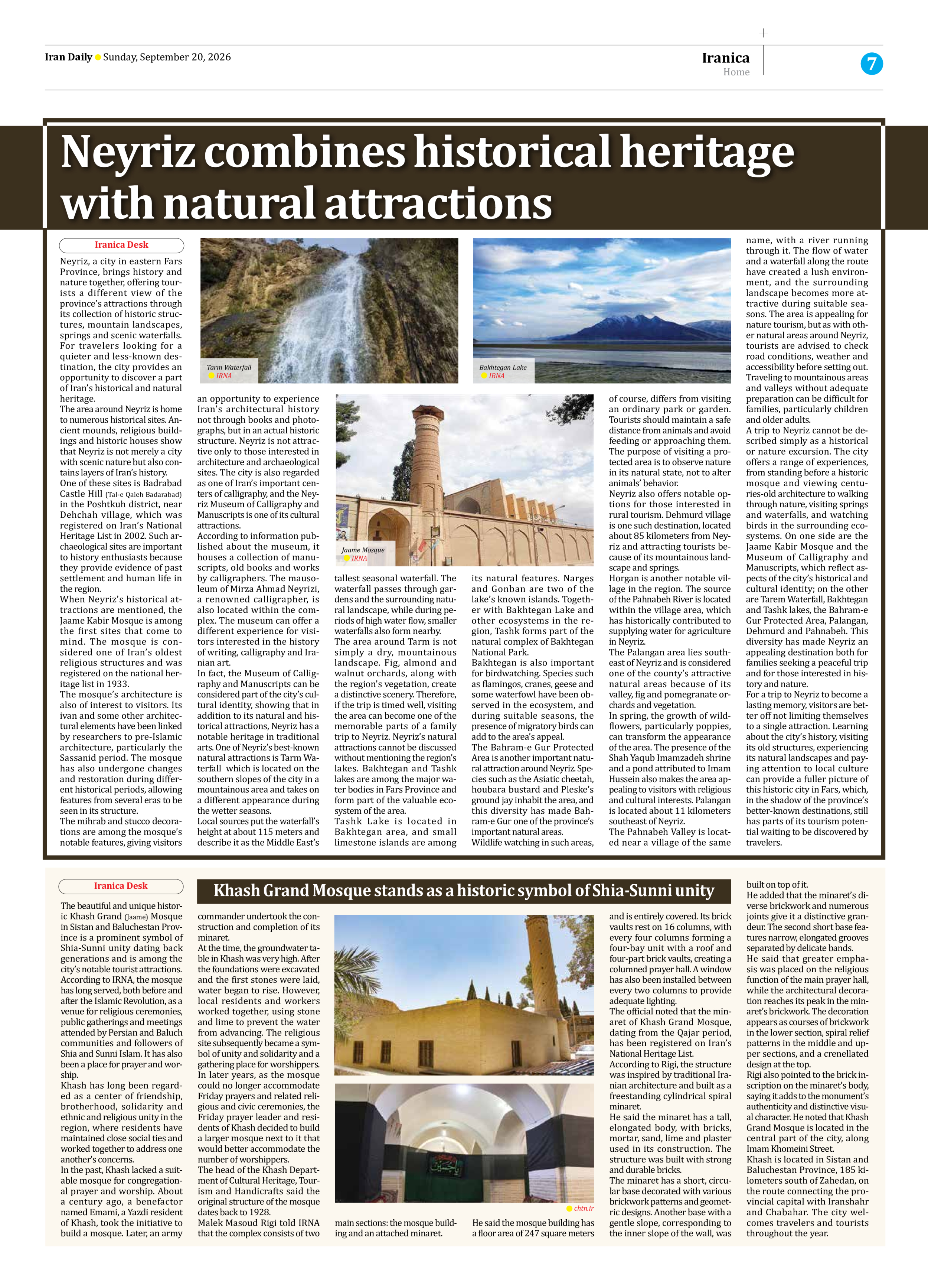
When Neyriz’s historical attractions are mentioned, the Jaame Kabir Mosque is among the first sites that come to mind. The mosque is considered one of Iran’s oldest religious structures and was registered on the national heritage list in 1933.
The mosque’s architecture is also of interest to visitors. Its ivan and some other architectural elements have been linked by researchers to pre-Islamic architecture, particularly the Sassanid period. The mosque has also undergone changes and restoration during different historical periods, allowing features from several eras to be seen in its structure.
The mihrab and stucco decorations are among the mosque’s notable features, giving visitors an opportunity to experience Iran’s architectural history not through books and photographs, but in an actual historic structure. Neyriz is not attractive only to those interested in architecture and archaeological sites. The city is also regarded as one of Iran’s important centers of calligraphy, and the Neyriz Museum of Calligraphy and Manuscripts is one of its cultural attractions.
According to information published about the museum, it houses a collection of manuscripts, old books and works by calligraphers. The mausoleum of Mirza Ahmad Neyrizi, a renowned calligrapher, is also located within the complex. The museum can offer a different experience for visitors interested in the history of writing, calligraphy and Iranian art.
In fact, the Museum of Calligraphy and Manuscripts can be considered part of the city’s cultural identity, showing that in addition to its natural and historical attractions, Neyriz has a notable heritage in traditional arts. One of Neyriz’s best-known natural attractions is Tarm Waterfall which is located on the southern slopes of the city in a mountainous area and takes on a different appearance during the wetter seasons.
Local sources put the waterfall’s height at about 115 meters and describe it as the Middle East’s tallest seasonal waterfall. The waterfall passes through gardens and the surrounding natural landscape, while during periods of high water flow, smaller waterfalls also form nearby.
The area around Tarm is not simply a dry, mountainous landscape. Fig, almond and walnut orchards, along with the region’s vegetation, create a distinctive scenery. Therefore, if the trip is timed well, visiting the area can become one of the memorable parts of a family trip to Neyriz. Neyriz’s natural attractions cannot be discussed without mentioning the region’s lakes. Bakhtegan and Tashk lakes are among the major water bodies in Fars Province and form part of the valuable ecosystem of the area.
Tashk Lake is located in Bakhtegan area, and small limestone islands are among its natural features. Narges and Gonban are two of the lake’s known islands. Together with Bakhtegan Lake and other ecosystems in the region, Tashk forms part of the natural complex of Bakhtegan National Park.
Bakhtegan is also important for birdwatching. Species such as flamingos, cranes, geese and some waterfowl have been observed in the ecosystem, and during suitable seasons, the presence of migratory birds can add to the area’s appeal.
The Bahram-e Gur Protected Area is another important natural attraction around Neyriz. Species such as the Asiatic cheetah, houbara bustard and Pleske’s ground jay inhabit the area, and this diversity has made Bahram-e Gur one of the province’s important natural areas.
Wildlife watching in such areas, of course, differs from visiting an ordinary park or garden. Tourists should maintain a safe distance from animals and avoid feeding or approaching them. The purpose of visiting a protected area is to observe nature in its natural state, not to alter animals’ behavior.
Neyriz also offers notable options for those interested in rural tourism. Dehmurd village is one such destination, located about 85 kilometers from Neyriz and attracting tourists because of its mountainous landscape and springs.
Horgan is another notable village in the region. The source of the Pahnabeh River is located within the village area, which has historically contributed to supplying water for agriculture in Neyriz.
The Palangan area lies southeast of Neyriz and is considered one of the county’s attractive natural areas because of its valley, fig and pomegranate orchards and vegetation.
In spring, the growth of wildflowers, particularly poppies, can transform the appearance of the area. The presence of the Shah Yaqub Imamzadeh shrine and a pond attributed to Imam Hussein also makes the area appealing to visitors with religious and cultural interests. Palangan is located about 11 kilometers southeast of Neyriz.
The Pahnabeh Valley is located near a village of the same name, with a river running through it. The flow of water and a waterfall along the route have created a lush environment, and the surrounding landscape becomes more attractive during suitable seasons. The area is appealing for nature tourism, but as with other natural areas around Neyriz, tourists are advised to check road conditions, weather and accessibility before setting out. Traveling to mountainous areas and valleys without adequate preparation can be difficult for families, particularly children and older adults.
A trip to Neyriz cannot be described simply as a historical or nature excursion. The city offers a range of experiences, from standing before a historic mosque and viewing centuries-old architecture to walking through nature, visiting springs and waterfalls, and watching birds in the surrounding ecosystems. On one side are the Jaame Kabir Mosque and the Museum of Calligraphy and Manuscripts, which reflect aspects of the city’s historical and cultural identity; on the other are Tarem Waterfall, Bakhtegan and Tashk lakes, the Bahram-e Gur Protected Area, Palangan, Dehmurd and Pahnabeh. This diversity has made Neyriz an appealing destination both for families seeking a peaceful trip and for those interested in history and nature.
For a trip to Neyriz to become a lasting memory, visitors are better off not limiting themselves to a single attraction. Learning about the city’s history, visiting its old structures, experiencing its natural landscapes and paying attention to local culture can provide a fuller picture of this historic city in Fars, which, in the shadow of the province’s better-known destinations, still has parts of its tourism potential waiting to be discovered by travelers.