







Banking, trade, and transit
Hemmati’s 2026 regional tour, Iran’s economic pivot
By Golzar Aghaei
Economic policy specialist
Abdolnaser Hemmati, governor of the Central Bank of Iran (CBI), has logged five foreign trips in six months, targeting payment corridors, blocked assets, and border trade. When Hemmati traveled to Istanbul on September 13, 2026, to attend the meeting of central bank governors from Islamic countries, it marked the latest stop in a year of intensive financial diplomacy. The trip — part of a broader 1405 regional tour that has already taken him to Pakistan, Qatar, Russia, India, and Iraq — reflects a shift from reactive crisis management to an attempt to build alternative economic architecture.
Istanbul; money, mechanisms, and Muslim markets
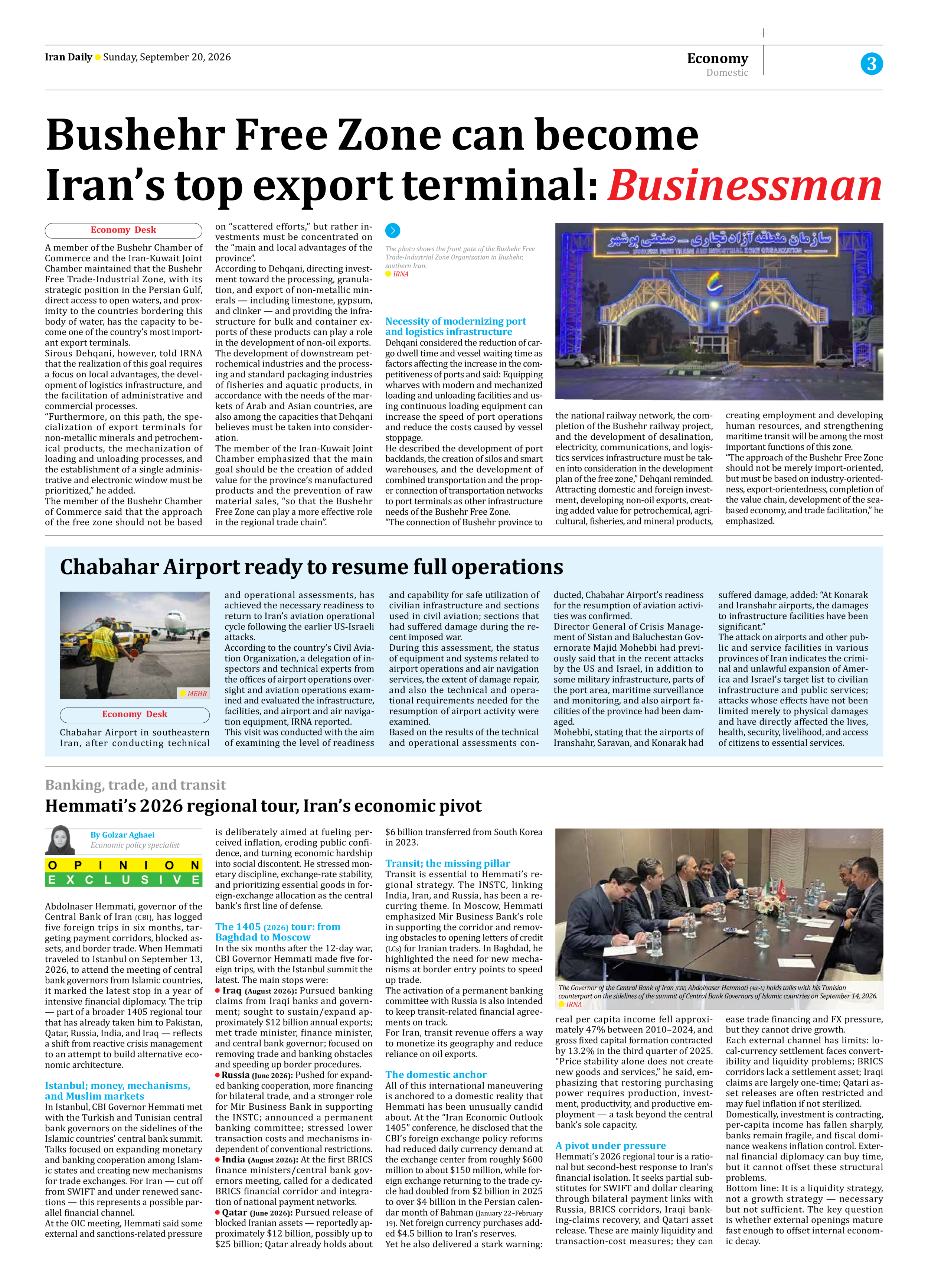
In Istanbul, CBI Governor Hemmati met with the Turkish and Tunisian central bank governors on the sidelines of the Islamic countries’ central bank summit. Talks focused on expanding monetary and banking cooperation among Islamic states and creating new mechanisms for trade exchanges. For Iran — cut off from SWIFT and under renewed sanctions — this represents a possible parallel financial channel.
At the OIC meeting, Hemmati said some external and sanctions-related pressure is deliberately aimed at fueling perceived inflation, eroding public confidence, and turning economic hardship into social discontent. He stressed monetary discipline, exchange-rate stability, and prioritizing essential goods in foreign-exchange allocation as the central bank’s first line of defense.
The 1405 (2026) tour: from Baghdad to Moscow
In the six months after the 12-day war, CBI Governor Hemmati made five foreign trips, with the Istanbul summit the latest. The main stops were:
Iraq (August 2026): Pursued banking claims from Iraqi banks and government; sought to sustain/expand approximately $12 billion annual exports; met trade minister, finance minister, and central bank governor; focused on removing trade and banking obstacles and speeding up border procedures.
Russia (June 2026): Pushed for expanded banking cooperation, more financing for bilateral trade, and a stronger role for Mir Business Bank in supporting the INSTC; announced a permanent banking committee; stressed lower transaction costs and mechanisms independent of conventional restrictions.
India (August 2026): At the first BRICS finance ministers/central bank governors meeting, called for a dedicated BRICS financial corridor and integration of national payment networks.
Qatar (June 2026): Pursued release of blocked Iranian assets — reportedly approximately $12 billion, possibly up to $25 billion; Qatar already holds about $6 billion transferred from South Korea in 2023.
Transit; the missing pillar
Transit is essential to Hemmati’s regional strategy. The INSTC, linking India, Iran, and Russia, has been a recurring theme. In Moscow, Hemmati emphasized Mir Business Bank’s role in supporting the corridor and removing obstacles to opening letters of credit (LCs) for Iranian traders. In Baghdad, he highlighted the need for new mechanisms at border entry points to speed up trade.
The activation of a permanent banking committee with Russia is also intended to keep transit-related financial agreements on track.
For Iran, transit revenue offers a way to monetize its geography and reduce reliance on oil exports.
The domestic anchor
All of this international maneuvering is anchored to a domestic reality that Hemmati has been unusually candid about. At the “Iran Economic Outlook 1405” conference, he disclosed that the CBI’s foreign exchange policy reforms had reduced daily currency demand at the exchange center from roughly $600 million to about $150 million, while foreign exchange returning to the trade cycle had doubled from $2 billion in 2025 to over $4 billion in the Persian calendar month of Bahman (January 22–February 19). Net foreign currency purchases added $4.5 billion to Iran’s reserves.
Yet he also delivered a stark warning: real per capita income fell approximately 47% between 2010–2024, and gross fixed capital formation contracted by 13.2% in the third quarter of 2025. “Price stability alone does not create new goods and services,” he said, emphasizing that restoring purchasing power requires production, investment, productivity, and productive employment — a task beyond the central bank’s sole capacity.
A pivot under pressure
Hemmati’s 2026 regional tour is a rational but second-best response to Iran’s financial isolation. It seeks partial substitutes for SWIFT and dollar clearing through bilateral payment links with Russia, BRICS corridors, Iraqi banking-claims recovery, and Qatari asset release. These are mainly liquidity and transaction-cost measures; they can ease trade financing and FX pressure, but they cannot drive growth.
Each external channel has limits: local-currency settlement faces convertibility and liquidity problems; BRICS corridors lack a settlement asset; Iraqi claims are largely one-time; Qatari asset releases are often restricted and may fuel inflation if not sterilized.
Domestically, investment is contracting, per-capita income has fallen sharply, banks remain fragile, and fiscal dominance weakens inflation control. External financial diplomacy can buy time, but it cannot offset these structural problems.
Bottom line: It is a liquidity strategy, not a growth strategy — necessary but not sufficient. The key question is whether external openings mature fast enough to offset internal economic decay.