





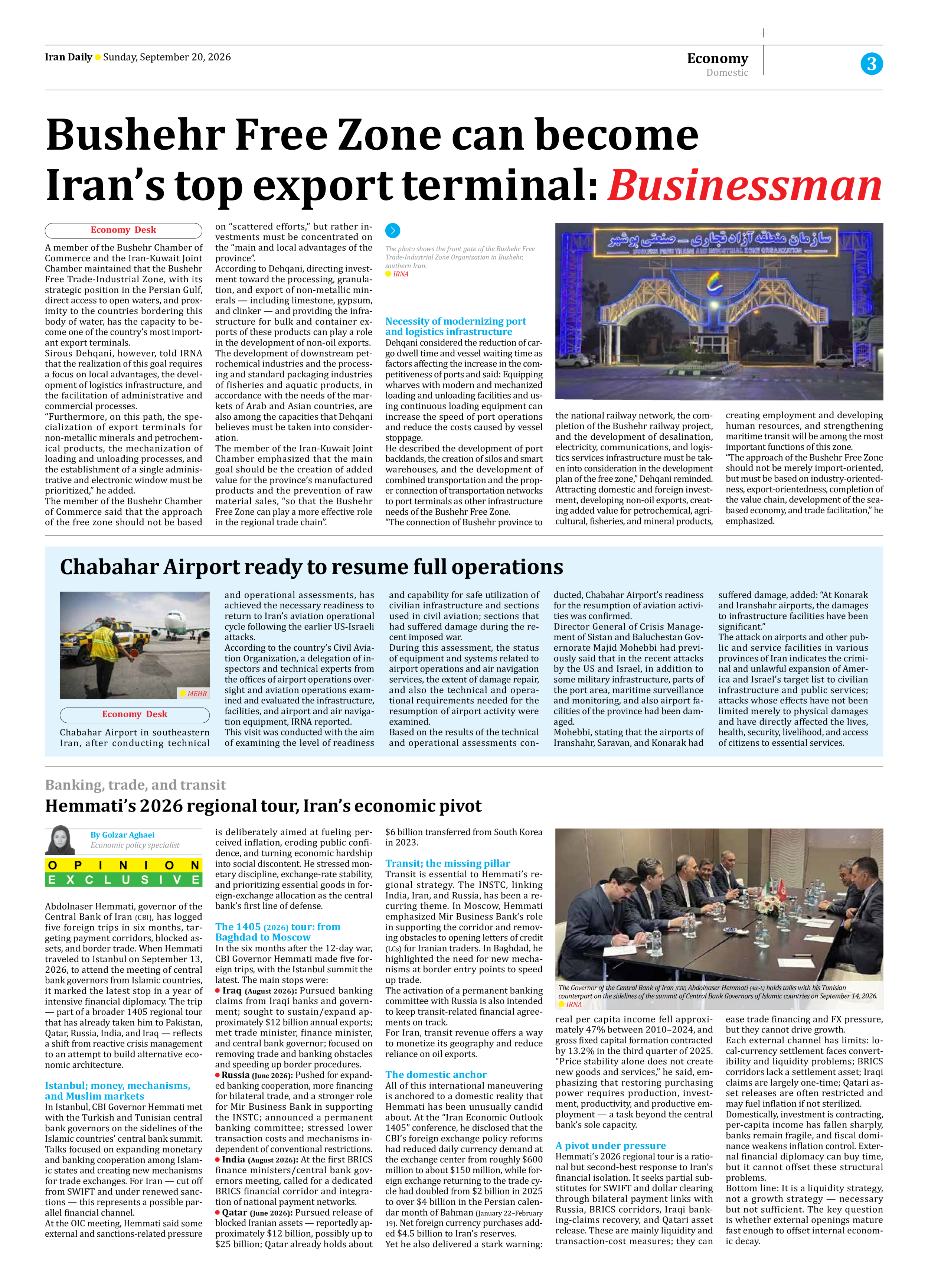


Bushehr Free Zone can become Iran’s top export terminal: Businessman
A member of the Bushehr Chamber of Commerce and the Iran-Kuwait Joint Chamber maintained that the Bushehr Free Trade-Industrial Zone, with its strategic position in the Persian Gulf, direct access to open waters, and proximity to the countries bordering this body of water, has the capacity to become one of the country’s most important export terminals.
Sirous Dehqani, however, told IRNA that the realization of this goal requires a focus on local advantages, the development of logistics infrastructure, and the facilitation of administrative and commercial processes.
“Furthermore, on this path, the specialization of export terminals for non-metallic minerals and petrochemical products, the mechanization of loading and unloading processes, and the establishment of a single administrative and electronic window must be prioritized,” he added.
The member of the Bushehr Chamber of Commerce said that the approach of the free zone should not be based on “scattered efforts,” but rather investments must be concentrated on the “main and local advantages of the province”.
According to Dehqani, directing investment toward the processing, granulation, and export of non-metallic minerals — including limestone, gypsum, and clinker — and providing the infrastructure for bulk and container exports of these products can play a role in the development of non-oil exports.
The development of downstream petrochemical industries and the processing and standard packaging industries of fisheries and aquatic products, in accordance with the needs of the markets of Arab and Asian countries, are also among the capacities that Dehqani believes must be taken into consideration.
The member of the Iran-Kuwait Joint Chamber emphasized that the main goal should be the creation of added value for the province’s manufactured products and the prevention of raw material sales, “so that the Bushehr Free Zone can play a more effective role in the regional trade chain”.
Necessity of modernizing port and logistics infrastructure
Dehqani considered the reduction of cargo dwell time and vessel waiting time as factors affecting the increase in the competitiveness of ports and said: Equipping wharves with modern and mechanized loading and unloading facilities and using continuous loading equipment can increase the speed of port operations and reduce the costs caused by vessel stoppage.
He described the development of port backlands, the creation of silos and smart warehouses, and the development of combined transportation and the proper connection of transportation networks to port terminals as other infrastructure needs of the Bushehr Free Zone.
“The connection of Bushehr province to the national railway network, the completion of the Bushehr railway project, and the development of desalination, electricity, communications, and logistics services infrastructure must be taken into consideration in the development plan of the free zone,” Dehqani reminded.
Attracting domestic and foreign investment, developing non-oil exports, creating added value for petrochemical, agricultural, fisheries, and mineral products, creating employment and developing human resources, and strengthening maritime transit will be among the most important functions of this zone.
“The approach of the Bushehr Free Zone should not be merely import-oriented, but must be based on industry-orientedness, export-orientedness, completion of the value chain, development of the sea-based economy, and trade facilitation,” he emphasized.