





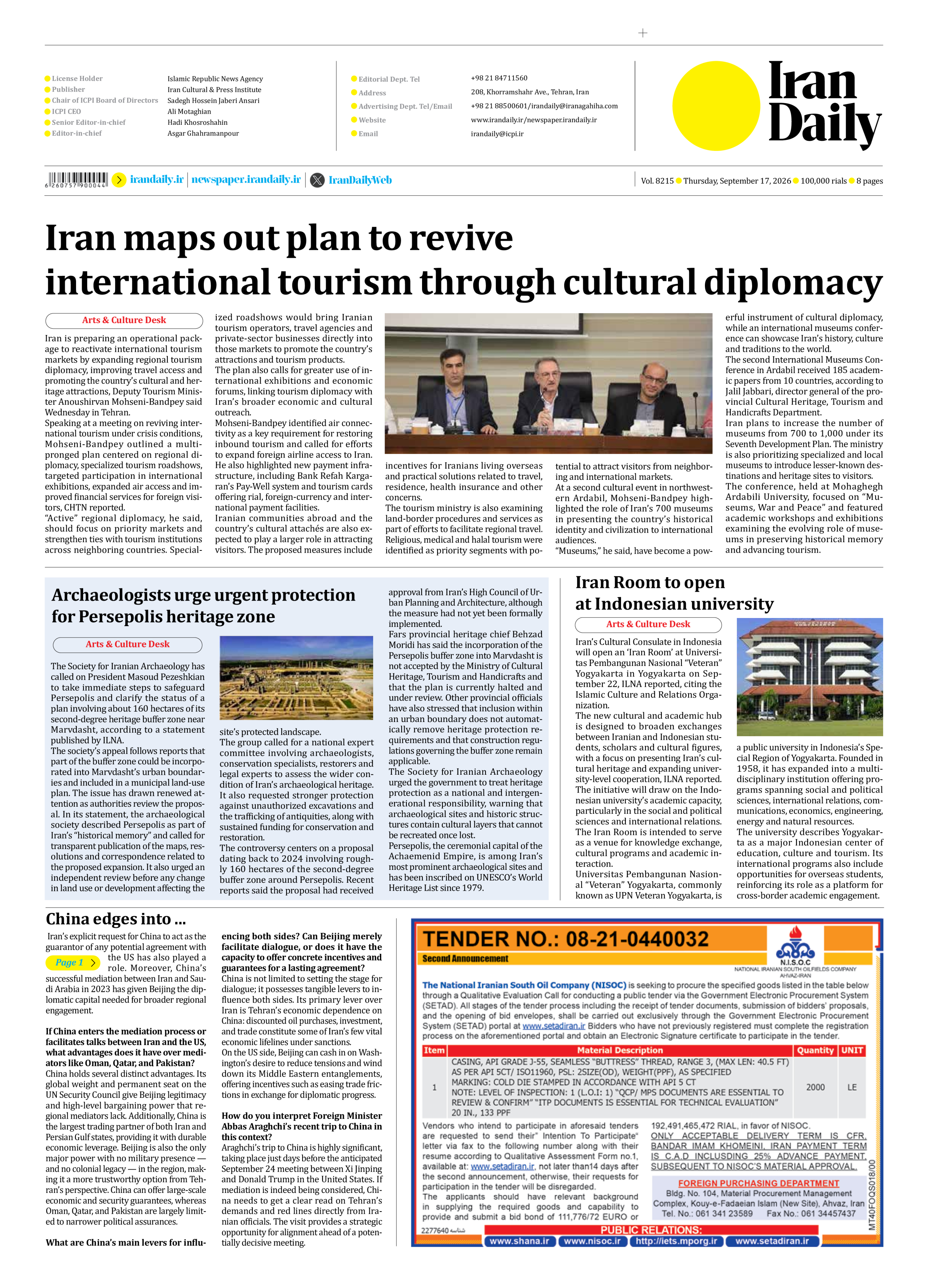


Archaeologists urge urgent protection for Persepolis heritage zone
The Society for Iranian Archaeology has called on President Masoud Pezeshkian to take immediate steps to safeguard Persepolis and clarify the status of a plan involving about 160 hectares of its second-degree heritage buffer zone near Marvdasht, according to a statement published by ILNA.
The society’s appeal follows reports that part of the buffer zone could be incorporated into Marvdasht’s urban boundaries and included in a municipal land-use plan. The issue has drawn renewed attention as authorities review the proposal. In its statement, the archaeological society described Persepolis as part of Iran’s “historical memory” and called for transparent publication of the maps, resolutions and correspondence related to the proposed expansion. It also urged an independent review before any change in land use or development affecting the site’s protected landscape.
The group called for a national expert committee involving archaeologists, conservation specialists, restorers and legal experts to assess the wider condition of Iran’s archaeological heritage. It also requested stronger protection against unauthorized excavations and the trafficking of antiquities, along with sustained funding for conservation and restoration.
The controversy centers on a proposal dating back to 2024 involving roughly 160 hectares of the second-degree buffer zone around Persepolis. Recent reports said the proposal had received approval from Iran’s High Council of Urban Planning and Architecture, although the measure had not yet been formally implemented.
Fars provincial heritage chief Behzad Moridi has said the incorporation of the Persepolis buffer zone into Marvdasht is not accepted by the Ministry of Cultural Heritage, Tourism and Handicrafts and that the plan is currently halted and under review. Other provincial officials have also stressed that inclusion within an urban boundary does not automatically remove heritage protection requirements and that construction regulations governing the buffer zone remain applicable.
The Society for Iranian Archaeology urged the government to treat heritage protection as a national and intergenerational responsibility, warning that archaeological sites and historic structures contain cultural layers that cannot be recreated once lost.
Persepolis, the ceremonial capital of the Achaemenid Empire, is among Iran’s most prominent archaeological sites and has been inscribed on UNESCO’s World Heritage List since 1979.