







Foreign investment doubles as government seeks to tap idle savings
Iran’s foreign investment has doubled in the Iranian year that began on March 21 compared with a year earlier, Economy Minister Ali Madanizadeh said on Wednesday, as the government seeks to channel idle foreign-currency savings into productive investment through new financial instruments.
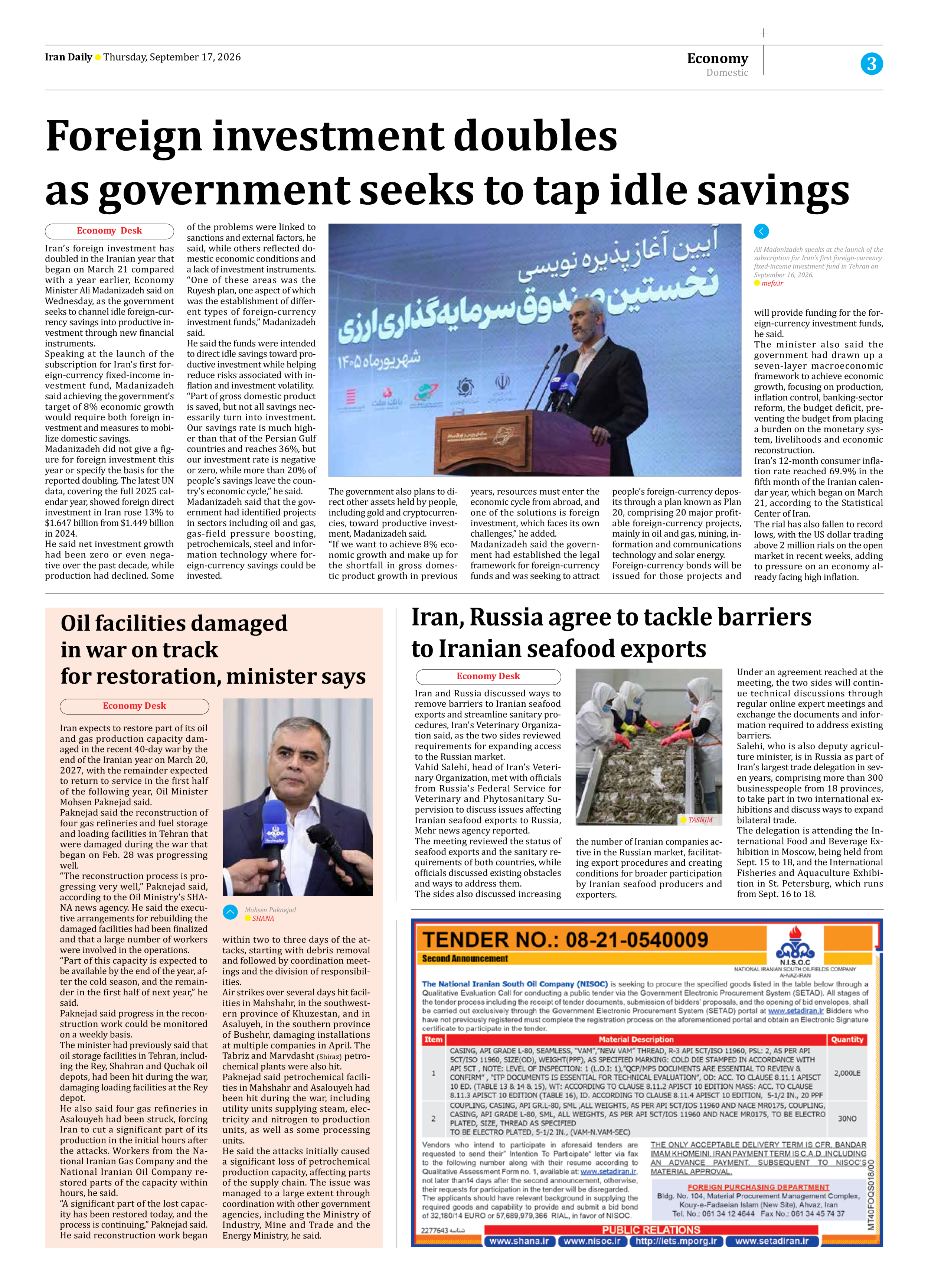
Speaking at the launch of the subscription for Iran’s first foreign-currency fixed-income investment fund, Madanizadeh said achieving the government’s target of 8% economic growth would require both foreign investment and measures to mobilize domestic savings.
Madanizadeh did not give a figure for foreign investment this year or specify the basis for the reported doubling. The latest UN data, covering the full 2025 calendar year, showed foreign direct investment in Iran rose 13% to $1.647 billion from $1.449 billion in 2024.
He said net investment growth had been zero or even negative over the past decade, while production had declined. Some of the problems were linked to sanctions and external factors, he said, while others reflected domestic economic conditions and a lack of investment instruments.
“One of these areas was the Ruyesh plan, one aspect of which was the establishment of different types of foreign-currency investment funds,” Madanizadeh said.
He said the funds were intended to direct idle savings toward productive investment while helping reduce risks associated with inflation and investment volatility.
“Part of gross domestic product is saved, but not all savings necessarily turn into investment. Our savings rate is much higher than that of the Persian Gulf countries and reaches 36%, but our investment rate is negative or zero, while more than 20% of people’s savings leave the country’s economic cycle,” he said.
Madanizadeh said that the government had identified projects in sectors including oil and gas, gas-field pressure boosting, petrochemicals, steel and information technology where foreign-currency savings could be invested.
The government also plans to direct other assets held by people, including gold and cryptocurrencies, toward productive investment, Madanizadeh said.
“If we want to achieve 8% economic growth and make up for the shortfall in gross domestic product growth in previous years, resources must enter the economic cycle from abroad, and one of the solutions is foreign investment, which faces its own challenges,” he added.
Madanizadeh said the government had established the legal framework for foreign-currency funds and was seeking to attract people’s foreign-currency deposits through a plan known as Plan 20, comprising 20 major profitable foreign-currency projects, mainly in oil and gas, mining, information and communications technology and solar energy.
Foreign-currency bonds will be issued for those projects and will provide funding for the foreign-currency investment funds, he said.
The minister also said the government had drawn up a seven-layer macroeconomic framework to achieve economic growth, focusing on production, inflation control, banking-sector reform, the budget deficit, preventing the budget from placing a burden on the monetary system, livelihoods and economic reconstruction.
Iran’s 12-month consumer inflation rate reached 69.9% in the fifth month of the Iranian calendar year, which began on March 21, according to the Statistical Center of Iran.
The rial has also fallen to record lows, with the US dollar trading above 2 million rials on the open market in recent weeks, adding to pressure on an economy already facing high inflation.